Author: [email protected]

  • 10 Steps to Creating a More Confident You

    10 Steps to Creating a More Confident You

    Building a more confident you is no easy task. Even when we succeed, many of us are confident in one thing but may lack confidence in another.

    One of the most important things to remember about confidence is that it goes hand in hand with consistency – consistency creates confidence!

    We often beat ourselves up for not being consistent or failing to follow through on things we previously committed to. This typically leads to negative self-talk, which makes us feel bad and erodes our confidence.

    Many get stuck in this cycle of overcommitment and negative self-talk. So how do we break this cycle? Start with these 10 steps…

    READ MORE | Decouple Body Image From Self-Worth To Find Your Confidence

    #1. Start by being nicer to yourself

    Tell yourself that you are on the right path and it is okay that you are not where you want to be yet. It is okay that you didn’t achieve your goal because what you are going to do about it next matters most.

    Maybe you had other things in your life that had to take priority at that moment. Perhaps your mind or body was not ready, which is completely understandable. Giving yourself grace and forgiving yourself helps create space for what’s ahead. This should make you feel a sense of relief and help you make a fresh start.

    #2. Learn how not to overcommit

    Maybe we feel ashamed of committing to less than what we think we should based on what we have seen around us. For example, we see someone on social media working out every day and you say “I should also hit the gym every day”.

    But if overcommitting is too overwhelming for you right now, then it is advisable to take a step back and commit to what works for your life.

    You can commit to one day versus five days, or one goal instead of 10. Maybe you should change the goal altogether and rather move your body in some way every day.

    By making the goal more achievable will make it easier to attain, which will make you feel better because you met your expectation.

    #3. Take pictures of yourself

    This may make you cringe, but I would not be where I am today, if I didn’t take photos of myself. It captures the good and the bad!

    Not only is this a great tool to track how your body is changing but will help you build you confidence as you see visible changes over time.

    Scheduling a photo shoot is a great way to hold yourself accountable and achieve your physique goals. I recommend finding inspiration from models you admire and practicing poses they do. You can do this at home by setting up a tripod anywhere and have fun with it. It may feel uncomfortable at first but you will get better with practice.

    #4. Check how you speak about yourself

    Buy a journal and whenever you have 10 minutes, write down 10 positive things about yourself. Many people who struggle with confidence often do not see their value and qualities.

    When I first did this, I could only name one positive thing about myself, which was that I was a good person. It took a lot of practice to get to 10. Through my journey, I realised you don’t have to believe it at first. But when you tell yourself enough times, you will start to see it.

    Like Henry Ford famously said: “Whether you think you can or you think you can’t, you are right.” You have the ability to change your thoughts, so tell yourself you are a badass, because you are!

    #5. Reflect on your past accomplishments

    After each month, I note down all of the good things and little wins I achieved during that period. I then review them all at the end of the year to reflect on the past 12 months.

    This process gives me the confidence and motivation to do even bigger and better things the next year!

    #6. Start a gratitude journal

    Make it a practice to write down 10 things for which you are thankful or grateful. Make it a daily or weekly practise. Gratitude helps you place more focus on the things you have versus the things you don’t.

    I lost my older brother Angelo when I was only 5 and then my little sister Serena recently in 2018. Both were from very unexpected tragedies. Angelo was only 18 and Serena only 21. These were some of my lowest points in life. The resultant depression destroyed my confidence.

    During this period, I hated the world and felt like I had lost everything, but many people in my life reminded me of all the blessings I have.

    No matter why you are struggling with confidence, write down your blessings. This exercise will help shift your mindset from negative thoughts by reminding you that you are blessed in many ways and, despite all the pain, there is so much to be grateful for.

    #7. Connect with like-minded people

    As human, we need social connections with other people to feel fulfilled and content. It’s very easy to isolate yourself and think you’re alone in your thoughts and ambitions when you don’t put yourself out there.

    It’s not until you start to open up about everything you love and everything you have been through that you can truly connect on a personal level.

    There are people out there just like you with similar goals who have either done what you’re trying to do, or are willing to support you in what you want to achieve.

    So, how do you connect with these people? You must open up and place yourself in an environment with people smarter than you or people who are learning in your same interests. The smarter than you is important because you are choosing to step out of your comfort zone, set your pride aside and open yourself up to personal growth, which builds confidence builds.

    #8. Analyse your environment

    Your environment makes a difference and says a lot about your state of mind. Have you ever felt like a mess and realised your room or house is also a mess, but by cleaning it you suddenly feel better about yourself or your life? I definitely have.

    A book I recommend in this regard is The Less Effect by Samantha Joy. This book talks about how having less can actually make you feel more fulfilled. I have experienced this firsthand by having way too much in my closet and realising I didn’t look or feel good in any of it. It wasn’t until I cleaned out my closet and got rid of all the things I didn’t feel confident in. I then started to feel more confident.

    If you attach any negative emotions to things in your environment or if your environment is not serving you anymore, remember that you are in control and you can change that. As I always say, “when in doubt leave it out”.

    dance-your-heart-out

    #9. Dance your heart out

    Find music that lifts you up. Play your favourite songs that makes you feel alive, then free yourself and dance. Taking dance classes is a great way to build confidence because you were courageous enough to start something new while learning a new skill with other people. More importantly, you deserve to have some fun.

    #10. Go to the gym

    Lifting weights builds confidence because you are challenging your perceived boundaries and you are in control of your progress. A healthy body also keeps us looking and feeling young, mobile and builds our mental and physical strength.

    Start by making an easy commitment, like two days a week of a full-body workout or 20 minutes a day of movement. This is crucial to confidence as

    Take control

    While following these steps won’t make you feel 100% confident all the time, knowing how to implement these things when your confidence levels take a dip will keep you in control of your progress and overall happiness.

    You are that ambitious, positive, loving person. You are a dreamer and hard worker. Remember that you live in a beautiful world full of abundance and love and you don’t need to prove anything to anyone but yourself.

    By Aviana Garcia

    About the author: Aviana Garcia is a certified personal trainer, yoga instructor and mindset coach. She created the Life Outside Mindset, which helps people who suffer from loss, anxiety and depression implement mindset shifts and healthy practices into their life. A Life Outside Mindset is a movement to push people outside of their comfort zone, mentally and physically, to ultimately overcome anxiety and depression. She enjoys snowboarding, dancing, going to the gym, shuffling and pretty much anything outdoors. Connect on Instagram @avianainspo

    Author: Pedro van Gaalen

    When he’s not writing about sport or health and fitness, Pedro is probably out training for his next marathon or ultra-marathon. He’s worked as a fitness professional and as a marketing and comms expert. He now combines his passions in his role as managing editor at Fitness magazine.


    Credit: Source link

  • Lift weights for the body you have, not the body you want

    Lift weights for the body you have, not the body you want

    Lifting weights can’t change your DNA, but it will create the best body you can build.

    Society today is driven by imagery, advertising and creative marketing that portrays physiques that typically fit a “one-size-fits-all” ideal. And chasing this ideal often ends in failure and dejection.

    When it comes to your intention in the weights room, aspire to create the physique you are able to and become the best version of you, rather than a second-rate version of someone else’s physique you saw on social media.

    READ MORE | My Strength Is My Resilience

    Own your reality

    We can all feel happier and more fulfilled if we focus on making the most of what we have, rather than attempting to transform ourselves into something we’re not.

    We are built genetically by our DNA. While this set of encoded instructions determines our physical traits, strength training influence the expression of certain genes and can help us reach our potential for physical development and performance.

    However, no matter how much we put into our exercise and nutrition, we cannot alter our genetic make-up or DNA.

    READ MORE | 3 Strength Training Myths That Must Fall

    Define your own standards

    When we start to shift our focus from chasing an idealised vision for ourselves to maximising our potential, we not only become more self-aware but discover our own standards of beauty and ability.

    And training for physical strength is what ultimately changes your physique in a manner that manifests your true potential.

    And the benefits are more than just physical. This training positively influences our hormonal profile, which is paramount to optimal health, wellbeing and performance. Additional by-products associated with improving your hormonal profile include increased confidence and less stress, anxiety and depression.

    READ MORE | Lift Like A Lady: Lessons From A Female S&C Coach

    The ageing antidote

    Training your body to lunge, hinge, pull, push and carry builds a body that not only looks good but also feels good and moves well. And this functional strength is the antidote to ageing.

    When you’re in the gym, focus on movements over muscles – this will always deliver the best results. Do not marry your mind or body to a single modality, especially when training to build the best version of you.

    You want to transform your body using the movements and exercises that have been advancing athletic performance for decades.

    A combination of strength, endurance, power, speed, agility, mobility, stability and functional training will empower you to develop your true capabilities across the board and will help you develop that structural balance that is key to a well-rounded physique.

    Living life lazy, unfit, out of shape and weak is ultimately a choice, much like fear. Fear is a choice. Don’t choose it. Why would you want to remain weak if you can become strong?

    When training for strength, the more you practice, the more you create beneficial habits through movement. And when you start to treat “getting strong” as a skill, you start to make major progress.

    Improvement and growth is not about the depth of the pool of sweat you create. Rather, being strong is about how your body moves as a unit. This is what allows you to improve your movement both inside the gym, avoid injuries and prepares your body for the hard hits in life.

    Moreover, developing physical strength requires indomitable mental strength. If you don’t have it when you start, you will have it when you finish as mental and physical strength go hand in hand.

    The pursuit of strength lies in the will of your mind. As such, developing power and tenacity through strength training will not only change the way the world sees you, but it will change the way you view the world. When you learn to build your unique body, it will build your character.

    By Lil Kimble, powerlifting coach, founder of OTG Athletic, and multiple Powerlifting World Champion

    Author: Pedro van Gaalen

    When he’s not writing about sport or health and fitness, Pedro is probably out training for his next marathon or ultra-marathon. He’s worked as a fitness professional and as a marketing and comms expert. He now combines his passions in his role as managing editor at Fitness magazine.


    Credit: Source link

  • An Herb for Strong Knees

    An Herb for Strong Knees

    I recently wrote an article about an incident with my dog and how comfrey worked so well for her healing. Well, that was only one comfrey success story among many. This prolific plant really does wonders for the body.


    Comfrey was once called knitbone because it works so well to repair tissue. This is thanks to the abundant allantoin compound it contains, which is a cell proliferant. The amazing thing about comfrey is that it knows which cells to grow and which cells not to, meaning that it only stimulates cell growth for healthy cells and will not do so for malignant cells. (1)


    My husband tore his ACL in high school, which was replaced through
    surgery. However, the thing about ACL tears is that once you tear it, replacements are likely to tear and likely to get arthritis. A second tear and replacement happened, and when the third tear occurred, he didn’t really want to get it replaced again. So I gave him comfrey fomentations for his knee by making a concentrated comfrey root decoction, soaking a towel in the warm mixture, and applying it to his knee. It definitely helped him feel better, but he unfortunately didn’t stick with it long
    enough. He still uses them off and on whenever his knee bothers him. He’ll do fomentations for about a week, and then inevitably his knee will feel better, and he’ll stop using the herb so the problem returns a while later.


    Now my sister also had a knee problem, though it was a different one. As an
    avid runner, she was willing to stick with any program that would allow her to get her running shoes back out. She didn’t fully know what the issue was with her knee, but I trusted that comfrey would solve it. So I gave her comfrey too, and showed her how to make a fomentation. I told her to apply the fomentations 6 nights per week. After a few weeks, she called me up to tell me that the comfrey was working great, but she had to alter the program somewhat because of an unexpected side effect.
    After about a week of using the fomentations on her knee, the area around her calf muscle would get inflamed and become painful. Continuing the fomentations made it worse, because the comfrey was draining the inflammation from her knee down to her calf. Instead of using the fomentations 6 days per week, she would do them for one week and then take one week off to allow the inflammation that had drained into her calf to dissipate. Then she would start the program again. She continued this for
    several weeks until there was nothing more to drain. Once the problem was resolved, she was finally able to go running again.


    The comfrey success with my dog showed just how important it is to act quickly, but these stories show how important it is to take care of an issue until it is resolved.
    Comfrey will work in either situation, but if you want lasting results, you need to work at it until the root cause is fully addressed and healed.


    1. Herb Syllabus, Dr. John R. Christopher, 2010. Page 156.


    Olivia Chasteen is Master Herbalist graduate of The School of Natural Healing. She is also certified lactation consultant and a homebirth natural mama who runs www.mamaearthwellness.net where she shares herbal information for parents, families, and anyone who believes they have the power to create health.

    Credit: Source link

  • Plantiful Kiki Nelson on Sustainable Weight Loss, Self-Acceptance

    Plantiful Kiki Nelson on Sustainable Weight Loss, Self-Acceptance

    In 2018, Kiki Nelson left her doctor’s office in low spirits, with high cholesterol, high blood sugar, high blood pressure, and a seemingly impossible task: “My doctor told me I needed to lose 40 pounds,” recalls Nelson. “I said, ‘Forty pounds is a lot!’ I’d had such a hard time losing five or 10 pounds, and anytime I’d get any amount of weight off, I couldn’t keep it off. It was super frustrating.” But not long afterward, Nelson ran into an old friend, who recommended looking into John McDougall, MD, “a doctor who helped people heal by eating potatoes.” It sounded far-fetched to Nelson, who had spent years operating on the assumption that low-carb, high-protein diets were healthiest. “I thought there was no way that I could eat potatoes, especially with my blood sugar being high,” Nelson says. “I ran to Barnes & Noble and got The Starch Solution and read it in a day. My mind was blown.”

    She soon transitioned to a whole-food, plant-based diet and brought down her blood sugar, blood pressure, triglycerides, and cholesterol to healthy levels while losing 70 pounds. “To get to this point without counting calories—it’s been absolutely life-changing for me,” Nelson says. She’s made it her mission to encourage others who are on similar journeys, sharing creative, crave-worthy recipes that showcase the abundance and ease of a plant-based diet on her website, Plantiful Kiki. Now, she’s compiled her favorite recipes and best advice into a book. Plantifully Lean, out April 11 from Simon & Schuster, is meant as an all-in-one resource for anyone curious about trying a plant-based diet for weight loss or better health. In addition to 125 recipes, it features a guide to getting started on a plant-based diet and practical tips for building self-esteem. “I wrote the manual that I wish I’d had,” Nelson says. “Everything that I’ve learned, all my trial and error, it’s all been fine-tuned and summed up in this book.” We spoke with Nelson about the book, the importance of positive self-talk, and the power of a daily affirmations practice.

    Struggling to cook healthy meals at home?

    Forks Meal Planner is here to help.

    In the book you emphasize the importance of knowing your “why.” Can you speak to that?

    Kiki Nelson: If your goal is to change a body that you hate…that is very difficult, because you’re already in an adversarial position with yourself. If you hate your body, it’s hard to do things for your body. But that’s how most of us enter into diets: We hate the way we look and we want to change. The fact is that it’s absolutely OK and possible to love yourself while you work on the things that you want to change. Starting to shift your language around that is really important, and knowing your “why” is about finding the healthiest reason for changing—not focusing on the negative things that you want to change but the positive things that you want to bring into your life. For me, I’d always [equated] getting healthy with being skinny and felt uncomfortable in my own skin. But after having two babies and realizing what’s really important in life, I decided that I needed to change my relationship with myself, and to stop making my journey about being a certain size. So instead of focusing on weight loss, I focused on health.

    How did you start a practice of daily affirmations?

    KN: I looked back and realized that I’d been every size, and I’d hated my body at all of them. I knew that I needed to change how I talked to myself. So I wrote down the things that I could appreciate about my body, like the fact that I was able to carry two healthy babies full term. I also wrote a list of the things that I aspired to feel about myself, like, “I am beautiful,” “I am confident,” or “I am healthy.” These are all things that I didn’t feel at the time.

    I would sit with my hand on my heart and read those two lists every single day, morning and night, before I started my day and before I ended my day. When you do this, it’s just a matter of time before you start respecting yourself a little bit more and you start catching those negative thoughts. You start saying, “No, I’m not going to talk down about myself.” And that self-respect will grow into a deep self-love. And I am a firm believer that true self-love really is what empowers long and lasting change in any area of your life.

    You didn’t believe your affirmations in the beginning?

    KN: No. I didn’t feel beautiful. I didn’t feel healthy. It’s interesting: When you start trying to change your belief systems, often that’s when you first become aware of what your current belief systems even are. One major belief that stuck out to me was that I was not a disciplined person, because I would always start things and not finish them. So I put the opposite on my list—“I am disciplined”—because I wanted to believe that. And now, if you ask me who I am, I’ll tell you that I’m one of the most disciplined people I know, not even a question. But yes, know that you’re not going to believe the affirmations at first. You’re going to feel like an imposter. It’s going to feel unnatural and uncomfortable, but you’ve just got to ride through that.

    In the book, you talk about eating more to weigh less. Can you explain how that works?

    KN: Before I came to a plant-based diet, I was always trying to eat less in order to weigh less. And I think we all know how that goes: Eating less food isn’t sustainable, because eventually your hunger drive takes over and you go back to where you started. Then I learned the principles of calorie density—that whole plant foods are naturally low in calories but huge in terms of volume, nutrients, fiber, and water. Fiber, water, and bulk are the major contributors to satiety (a sense of being full) in your brain. And so after filling my plate with those foods, I found that I was naturally satisfied while reducing my caloric intake, literally eating more [volume] than ever and losing weight.

    Why was it important to you to minimize oil in these recipes?

    KN: After reading Dr. McDougall’s book [The Starch Solution] and learning what a highly processed, devoid-of-nutrition product it is, I wanted to get oil out of my diet. When I was eating oil regularly, I didn’t realize how much fat I was taking in. I think that cutting oil was one of the biggest contributors to not only the weight loss but also to reducing inflammation in my body. Am I 100% oil-free? No. If I go on vacation or I go out to eat and there’s a little bit of oil in something, no big deal. But I don’t eat fried food. I don’t cook in oil. I use a light spray of oil if something’s going to stick. But I don’t use oil as an ingredient in my recipes, and that was foundational for me.

    What are some of your go-to oil-free cooking hacks?

    KN: I think a lot of people don’t realize—I know I didn’t—that if you have a good nonstick pan, you can cook without any oil and still get all of the flavor and caramelization. So number one, get a good nonstick pan that you feel comfortable using. Also, cooking things with balsamic vinegar is amazing, and adding some tamari or coconut aminos or low-sodium soy sauce, whatever you’re into, to help flavor things and to help them not stick to your pan is great. When it comes to baking, mashed bananas or applesauce can easily take the place of fat and eggs, and your baked goods still come out just as moist. It’s mind-blowing!

    Try Kiki Nelson’s Onion Rings recipe, excerpted from the Plantifully Lean cookbook!

    A photo of baked or air-fryer onion rings on a wooden tray, with a hand holding one ring and dipping it in ketchup

    Credit: Source link

  • Is Laetrile (Amygdalin or Vitamin B17) an Effective Alternative Cure for Cancer?

    Is Laetrile (Amygdalin or Vitamin B17) an Effective Alternative Cure for Cancer?

    The Mayo Clinic puts laetrile to the test to see if it is an effective cancer treatment.

    My video Does Laetrile (Amygdalin or Vitamin B17) Work as an Alternative Cancer Cure? looks at amygdalin and whether it is “quackery or cure.”

    A cyanide-containing compound found in apple seeds, amygdalin is ten times more concentrated in the seeds of peaches, apricots, and bitter almonds. It can be sold as a derivative called laetrile, which has been advertised with the misnomer “vitamin B17.” “Amygdalin gained high popularity among cancer patients in the 1970s” as an alternative treatment, but the reason researchers published a review of amygdalin in 2016 and why I’m doing videos about it is that it has “experienced a renaissance,” thanks to the internet.

    Back in the 1970s, the FDA could only send out its Bulletin to a million doctors and other health professionals, warning them that laetrile is not only worthless, but dangerous. About ten thousand copies of the alert were posted in U.S. post offices, and The New York Times editorialized that we should be able to choose our own placebo. But laetrile was killing people. Finally, as the New England Journal of Medicine reported it, the “Supreme Court stops the nonsense” with Justice Thurgood Marshall writing the unanimous court opinion that terminally ill patients deserve the same FDA protections against unsafe drugs. At last, laetrile was banned on a federal level.

    Rational argument failed to dissuade people, though, so the State stepped in, but that had the opposite effect. “Cancer victims and their families almost universally respond[ed] by accusing organized government and organized medicine of conspiracy.” At an FDA meeting, for example, a physician from M.D. Anderson Cancer Hospital rhetorically asked: “‘You surely cannot believe that the quarter of a million of American physicians are sitting on a cancer cure just so they can get rich?’ He was answered with a chorus of yeses from the audience, many of whom had been borne to the hearings on chartered buses.” Some laetrile advocates were getting rich, though, like the head of the “Committee for Freedom of Choice in Cancer Therapy.” More like committed to the freedom of pocketing millions a year in laetrile sales.

    “Laetrile’s proponents consider it to be a ‘natural cancer cure’; whereas opponents consider it ‘the slickest, most sophisticated, and certainly the most remunerative [lucrative and profitable] cancer quack promotion in medical history.’” Which is it? You don’t know until you put it to the test.

    “The National Cancer Institute, in response to widespread public interest, undertook a retrospective analysis of Laetrile treatment.” In other words, it sent out a letter to every physician in the country and tens of thousands of other health professionals, and contacted all of the pro-laetrile groups, basically saying, send us the best you got. Although at least 70,000 Americans are estimated to have used laetrile, only 93 cases were submitted for evaluation, and, of those, only six appeared to be legitimate, where taking laetrile was associated with at least some partial improvement.

    Now, of course, the people sending in those reports may have gotten things wrong or falsified data, but, maybe those six actually did respond to the treatment. If that’s out of 70,000 treated, though, you’d think maybe that’d just be by chance. Regardless, the fact that so many people tried it should count for something. They may have all just been boondoggled, but maybe there’s something to it. Certainly, the fact that it didn’t seem to help with any of the laboratory animal cancers doesn’t mean it couldn’t work in people. The only way to know for sure is to put it to the test: “a tightly controlled clinical trial performed in competent and experienced hands.” The Mayo Clinic accepted the challenge.

    One hundred seventy-eight cancer patients were treated with it and all of the patients died rapidly. “No substantive benefit was observed in terms of cure, improvement, or stabilization of cancer, improvement of symptoms related to cancer, or extension of life span.” There were only adverse effects of cyanide toxicity.

    The conclusion? “Amygdalin (Laetrile) is a toxic drug that is not effective as a cancer treatment.”

    The books have been closed on this for more than 30 years. “Laetrile doesn’t work.” It is unsafe and ineffective. Researchers “found no sound evidence that laetrile is effective as an anticancer agent.” So, the label “unproven” cancer remedy may be too generous at this point; “it is time to vehemently assert that laetrile cancer therapy has been ‘disproven.’”

    What about eating apricot seeds directly? In case you missed my previous video, check out Do Apricot Seeds Work as an Alternative Cancer Cure?.


    Credit: Source link

  • Vegan Brookie (Gluten-free Pan Cookie)

    Vegan Brookie (Gluten-free Pan Cookie)

    This vegan brookie recipe combines rich brownie and decadent chocolate chip cookie in a single baking pan to make one epic Pan cookie! Gluten-free grain free almond flour pan cookie.

    close-up of sliced pieces of brookie on parchment paper
    Table of Contents

    Instead of making individual cookies, this vegan brookie mixes together two kinds of cookie dough in an 8×8- or 9×9-inch baking pan. Making a pan cookie also reduces active. No need to scoop individual cookie, just bake all the dough into 1 pan. It’s quick and easy to make and is perfect for satisfying those chocolate cravings!

    brookie in the baking pan after baking

    The brownie batter and cookie dough are both based on my almond flour cookie dough recipe. You can use my other almond flour-based cookies like blueberry muffin cookies , snickers cookies, or almond joy cookies. Mix and match to make your own, custom vegan brookie!

    This vegan brookie comes out really great if you bake them at the right temperature. They are chewy when slightly under-baked and crispy when just slightly over baked. Since you use almond flour, you want to bake them at a slightly lower temperature.

    To make them oil-free omit the oil and use a little bit more maple syrup for each of the doughs.

    sliced pieces of vegan pan cookie on parchment paper

    Why You’ll Love Vegan Brookies

    • gluten-free , grain-free
    • packed with chocolatey goodness
    • oil-free option
    • versatile and customizable
    close-up of a stack of vegan brookie slices, so you can see the pretty, swirled inside

    Recipe Card

    close-up of sliced pieces of brookie on parchment paper
    Print Recipe

    This vegan brookie recipe combines rich almond flour brownie and decadent chocolate chip cookie in a single baking pan to make one epic pan cookie. Gluten-free grain free . 

    Prep Time20 mins

    Cook Time16 mins

    Total Time36 mins

    Course: Brownie, Cookie, Dessert

    Keyword: almond flour brookie, brookie vegan, vegan brookie, vegan pan cookie

    Servings: 9

    Calories: 204kcal

    Author: Vegan Richa

    Ingredients

    For the chocolate chip cookie:

    • 3/4 cup blanched almond flour
    • 2 tablespoons tapioca starch
    • 1/8 teaspoon baking soda
    • 1/8 teaspoon salt
    • 1/2 teaspoon or more vanilla extract
    • 2 teaspoons solid coconut oil , refined for no coconut flavor, melt before using
    • 2 to 3 tablespoons maple syrup
    • 5 tablespoons chocolate chips

    For the brownie:

    • 3/4 cup almond flour
    • 2 tablespoons tapioca starch
    • 1/8 teaspoon baking soda
    • 1/8 teaspoon salt
    • 3 tablespoons cocoa powder
    • 1/2 teaspoon vanilla extract
    • 2 teaspoons solid coconut oil , melt before using
    • 1 tablespoon applesauce or non dairy yogurt
    • 2 to 3 tablespoons maple syrup

    Instructions

    Make the chocolate chip cookie dough.

    • In a bowl, add all the dry ingredients (that’s almond flour, tapioca starch, baking soda, and salt) and mix really well. Press and mix to break up all of the flour lumps, then add in the wet ingredients (melted coconut oil, vanilla extract, maple syrup) and mix into a dough. It will take a few seconds for the almond flour to incorporate with the wet ingredients, and then it will become a dough, mix in 2 tablespoons of the chocolate chips and set aside.

    Make the brownie.

    • In another bowl, add the almond flour, tapioca starch, baking soda, salt and cocoa powder and mix really well. Press and mix to break the almond flour lumps, then add in the wet ingredients(melted coconut oil, maple syrup, applesauce) and mix again to make a smooth dough. You can add 1-2 tablespoons chocolate chips to this dough as well, if you like, for an extra chocolatey brownie. Then line a brownie pan or an 8×8- or 9×9-inch baking dish with parchment paper.

    Make the brookie.

    • Take scoops of each of the doughs and press into the pan. Then even it out with a spatula, top it with as many chocolate chips as you like and press them in. Bake for 16 to 19 minutes. Check at the 17-minute mark. If it is starting to get golden on top, then take the baking dish out. Otherwise, let it bake for another 1 to 2 minutes.

    • Remove the baking dish from the oven and let it cool for 10 minutes and then transfer the brookie to a cooling rack delicately. Let it cool for another 5 minutes before slicing into bars or squares or whatever shapes you like.

    • Store in a covered container on the counter for upto a week.

    Notes

      The baking time will vary depending on your pan. If you’re using a metal pan, then the cookies will be ready at the 16 to 17 minute mark. If you’re using ceramic, stoneware, or a glass baking dish, then they will probably need about 19 minutes. Check around the 17-minute mark to be on the safe side. 

    Nutrition

    Nutrition Facts

    Vegan Brookie (Gluten-free Almond flour Pan Cookie)

    Amount Per Serving

    Calories 204 Calories from Fat 117

    % Daily Value*

    Fat 13g20%

    Saturated Fat 3g19%

    Sodium 102mg4%

    Potassium 48mg1%

    Carbohydrates 20g7%

    Fiber 3g13%

    Sugar 11g12%

    Protein 5g10%

    Vitamin A 19IU0%

    Vitamin C 0.1mg0%

    Calcium 61mg6%

    Iron 1mg6%

    * Percent Daily Values are based on a 2000 calorie diet.

    almond flour and other brookie ingredients in bowls on a kitchen table

    Ingredients and Substitutions

    • blanched almond flour – This is the base for both cookies. Blanched almond flour will yield a better color for the chocolate chip cookies. For the brownie, you can use blanched or regular almond flour.
    • tapioca starch – The starch works as a binder to help the cookies stay together since there is no gluten in almond flour
    • baking soda – These help the cookies rise.
    • vanilla extract and salt – Vanilla adds a great flavor to both cookie doughs, salt balances the sweet!
    • coconut oil – A little bit of fat helps the cookies have an amazing texture. You can use vegan butter instead of coconut oil. Use extra maple syrup to make this oil-free
    • maple syrup – This is your sweetener. You can use agave nectar or other liquid sweetener(date syrup, jaggery syrup) , if you prefer.
    • chocolate chips – These boost the chocolate quotient, a key for this recipe! Feel free to use more and add some to the brownie, as well, if you like.
    • applesauce – Only the brownie uses applesauce, which gives it that fudgy, brownie texture.

    Tips

    • You can adjust the texture depending on how long you bake. Slightly underbake for a chewier brookie or bake a bit longer, if you want them crisp.
    • Baking time varies depending on the pan you use. A metal pan will cook more quickly, around 16-17 minutes. If you’re using other types of pans, your pan cookie may need to bake for up to 19 minutes. Check often, starting around 16 to 17 minutes, to make sure you don’t overcook.
    • Feel free to mix and match using any of my other almond flour cookie doughs!
    • Almond flour loves to clump with mixed with liquid, so make sure you press out the clumps when you mix the dough!
    • Almond flour dough is baked at lower heat as it browns quickly

    How to Make a Vegan Brookie

    Preheat the oven to 335° F (170° C) while you make the doughs. Start with the chocolate chip cookie dough.

    In a bowl, add all the dry ingredients, and mix really well. Press and mix to break up all of the flour lumps.

    dry chocolate chip cookie ingredients in the bowl, before mixing

    Now, add in the wet ingredients and mix into a dough. It will take a few seconds for the almond flour to incorporate with the wet ingredients, and then it will become a dough.

    chocolate chip cookie ingredients in the bowl, after adding wet ingredients and mixing

    Mix in half of the chocolate chips and set aside.

    finished chocolate chip cookie dough

    In another bowl make the brownie.

    Add the almond flour, tapioca starch, baking soda, salt and cocoa powder, and mix really well. Press and mix to break the almond flour lumps, then add in the wet ingredients and mix again to make a smooth dough.

    dry brownie ingredients, before adding cocoa powder
    dry brownie ingredients, after adding cocoa powder
    dry brownie ingredients, after mixing
    brownie batter, all mixed together

    You can add 1-2 tablespoons chocolate chips to this dough as well, if you like, for an extra chocolatey brownie.

    Then, line a brownie pan or an 8×8- or 9×9-inch baking dish with parchment paper.

    To assemble the vegan brookie, take scoops of each of the doughs and press them into the pan until you have one, giant cookie in two colors.

    pieces of brownie batter in the lined baking pan
    pieces of brownie batter and chocolate chip cookie dough in the lined baking pan

    Then even it out with a spatula, top it with chocolate chips as you like, and press them in.

    flattening the brookie doughs with a spatula
    brookie after flattening with a spatula

    Bake for 16 to 19 minutes, checking at the 16- or 17-minute mark. If it is starting to get golden on top, then take the baking dish out. Otherwise, let it bake for another 1 to 2 minutes.

    Remove the baking dish from the oven and let it cool for 10 minutes and then transfer the brookie to a cooling rack delicately.

    brookie in the baking pan after baking

    Slice into bars or squares or whatever shapes you like. 

    baked brookie cooling on parchment paper

    Frequently Asked Questions

    What is a brookie?

    A brookie is part cookie, part brownie, and all delicious! Cookie dough and brownie batter get mixed together in a single baking pan for an epic dessert.

    Is this recipe gluten-free?

    Yes! This is gluten-free as-is.

    Can this be made oil-free?

    It can! Use maple syrup instead of the oil.

    Credit: Source link

  • Spicy Peanut Butter Ramen

    Spicy Peanut Butter Ramen

    Spicy peanut butter ramen is an absolute comfort food recipe with a delicious, creamy broth, gochujang flavors, lots of ginger and garlic, topped with Gochujang tofu. It’s a 30-minute, One-pan meal! Options for gluten-free Soyfree Nutfree included.

    Table of Contents

    For this spicy peanut butter ramen, you cook the noodles directly in the broth, so you only need one pot. I topped it with some crispy tofu, and you can use the same pot to crisp up the tofu that you use to cook the ramen. You can bake the tofu, though, if you prefer.

    The peanut butter gives this ramen a creamy, rich broth, and gochujang brings sweet heat and gives this vegan ramen recipe such a special flavor!

    noodles in the peanut broth, after cooking, garnished with green onion

    Why You’ll Love Spicy Peanut Butter Ramen

    • spicy-sweet-creamy broth
    • One Pot dinner
    • nut-free option
    • crispy gochujang garlic tofu is toothsome and flavorful
    • Good balance of protein.
    • Versatile, add more of less veggies to balance in the broth
    spicy peanut butter ramen in the bowl, after adding tofu, green onions, and sesame seeds

    More Vegan Ramen Recipes

    Recipe Card

    spicy peanut butter ramen in the bowl, after adding tofu, green onions , and sesame seeds
    Print Recipe

    Spicy Peanut Butter Ramen

    Spicy peanut butter ramen is an absolute comfort food recipe with a delicious, creamy broth, gochujang flavors, lots of ginger and garlic, topped with Gochujang tofu. It’s a 30-minute, One-pan meal. The noodles are cooked directly in the broth, so you only need one pot.

    Prep Time10 mins

    Cook Time20 mins

    Total Time30 mins

    Course: dinner, Main, Main Course, Soup

    Cuisine: Asian fusion

    Keyword: peanut gochujang ramen, spicy peanut butter ramen

    Servings: 4

    Calories: 342kcal

    Author: Vegan Richa

    Ingredients

    For the crispy gochujang garlic tofu:

    • 10 oz (283.5 g) firm or extra firm tofu pressed for at least 15 minutes and sliced into rectangles or cubes or whatever shape you like
    • 2 teaspoons soy sauce or tamari
    • 2 teaspoons gochujang
    • 1/2 teaspoon garlic powder
    • 1 teaspoon sesame oil
    • 1 tablespoon cornstarch or tapioca starch

    For the peanut butter ramen:

    • 1 teaspoon oil optional
    • 6 oz (170.1 g) sliced mushrooms such as white or cremini or portabella
    • 2 tablespoon ginger-garlic paste or you can mince or blend 1 inch of ginger and 3 cloves of garlic with a few teaspoons water, to make a paste and use
    • 3 tablespoons smooth peanut butter
    • 1 tablespoon gochujang or other Asian chile sauce
    • 1 tablespoon maple syrup
    • 2 tablespoons soy sauce or tamari
    • 5-6 cups (1182.94 ml) water or stock
    • 6 oz (170.1 g) ramen or thin udon noodles

    For garnish:

    • lime wedges, green onions, sesame seeds

    Instructions

    Make the gochujang garlic tofu.

    • Press and cube the tofu if you haven’t already and add it to a bowl.

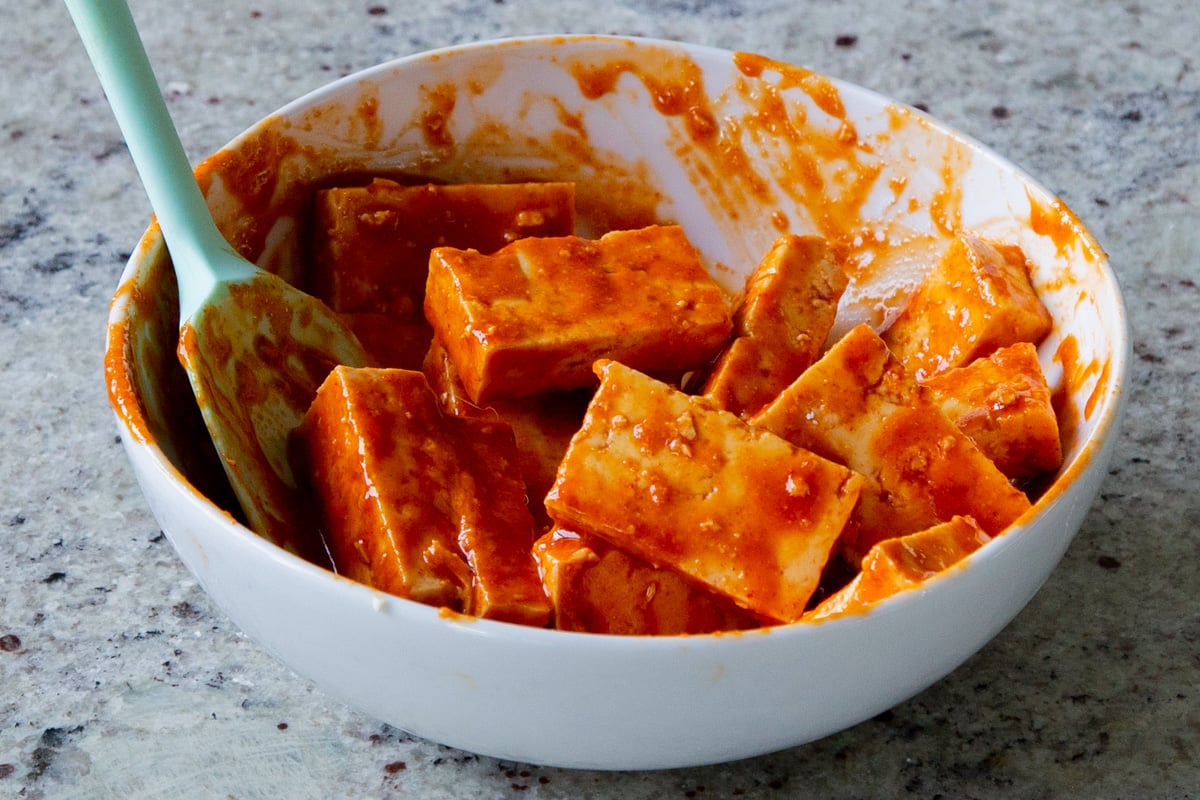
    • In a small bowl mix the soy sauce, gochujang, garlic powder, and sesame oil and pour it over the tofu. Toss well to coat. Add 2 teaspoons of the cornstarch and toss well. If the mixture is still somewhat wet then add the rest of the cornstarch and toss well.

    • Then either bake the tofu: transfer the tofu cubes to a parchment-lined baking sheet and bake it at 400ºF (205c) for 20-25 minutes , or transfer them to a hot wok with a teaspoon of oil and cook them until they are crisp on most of the edges, about 5-6 minutes.

    Make the ramen:

    • I use the same wok for making the tofu as well as the ramen. Remove the tofu once crisp from the pot and then make the ramen. Add oil, mushrooms, and a good pinch of salt and cook for 2-3 minutes to brown the mushrooms on some of the edges. Then add the ginger-garlic paste, peanut butter, gochujang, and soy sauce and mix really well. Add 1/4 cup of the water or broth and mix in. Mix well to incorporate the peanut butter.

    • Bring the mixture to a boil then gradually add the rest of the broth. Mix and Bring to a good rolling boil, then add your noodles. Press to submerge in the boiling broth, then cook them according to the time on the packaging. Ramen noodles will cook pretty quickly, within 3-4 minutes, while udon noodles will take around 7-8 minutes.

    • Once the noodles are cooked to your preference, switch off the heat. Taste and adjust salt and flavor. If you want it sweeter then you can add more maple syrup. You can more salt if needed or some black pepper for extra heat.

    • To serve, ladle the broth into your serving bowls. Then transfer some of the noodles with mushrooms to your serving bowls. Top it with the crispy tofu, lime wedge, green onions, and sesame seeds, and serve.

    • To make ahead: cook the noodles separately and store. Crisp up the tofu and store. Add only 3 cups broth and boil and refrigerate after cooling. To serve, bring the broth to a boil, add noodles and serve. Refrigerate for up 3 days.

    Notes

    • Nutfree: use sunflower butter or almond butter instead of peanut butter for Peanut-free
    • Glutenfree: Use Glutenfree noodles, use tamari instead of soy sauce. ensure that Gochujang is gluten-free 
    • Soy-free: Use chickpea tofu instead of tofu, coconut aminos for the soy sauce.  Gochujang often has soy, so use 2 teaspoons each of gochugaru pepper flakes, chickpea miso, coconut aminos and. 1 teaspoon maple syrup to make your own Gochujang. 
       

    Nutrition

    Nutrition Facts

    Spicy Peanut Butter Ramen

    Amount Per Serving

    Calories 342 Calories from Fat 99

    % Daily Value*

    Fat 11g17%

    Saturated Fat 1g6%

    Sodium 625mg27%

    Potassium 306mg9%

    Carbohydrates 45g15%

    Fiber 4g17%

    Sugar 10g11%

    Protein 18g36%

    Vitamin A 13IU0%

    Vitamin C 2mg2%

    Calcium 114mg11%

    Iron 2mg11%

    * Percent Daily Values are based on a 2000 calorie diet.

    ramen and spicy peanut sauce ingredients in bowls on the kitchen counter

    Ingredients and Substitutions

    • tofu – This is your protein. You can use chickpea tofu, if you prefer. Do know that gochujang contains soy. You can make your Soyfree Gochujang and use that instead..
    • soy sauce – Adds salt and umami to the tofu flavoring and to the broth. Use tamari for gluten-free
    • gochujang – This adds a sweet heat that’s just amazing in the peanut butter broth! You’re using gochujang in both the tofu and in the broth.
    • garlic powder – Deepens the flavor of the tofu.
    • cornstarch – Helps the tofu get really nice and crisp. You can use tapioca starch, if you prefer.
    • sesame oil – Oil helps the tofu get crispy, and using sesame oil specifically also adds even more flavor!
    • mushrooms – These add a nice texture and flavor to the peanut butter ramen broth.
    • ginger-garlic paste – Ginger and garlic pair so well with peanut butter! You can use minced or pureed ginger and garlic if you can’t find ginger-garlic paste.
    • smooth peanut butter – Makes the broth creamy and gives it an amazing flavor!
    • water /stock – This bulks out the broth and cooks the noodles at the same time, in the same pan.
    • noodles – Use ramen or thin udon noodles to make this soup.
    • garnishes – Lime wedges, green onion, and sesame seeds finish this ramen.

    Tips

    • Make sure that you press your tofu for 15 minutes before cooking! You can prep the rest of the ingredients while the tofu presses.
    • You may not need all of the cornstarch listed. Start with two teaspoons, and see if that’s enough to soak up the moisture, so it adheres to the tofu. If needed, add the remaining cornstarch.
    • When you add that first quarter cup of broth, whisk well to get the peanut butter to dissolve, so you won’t have any lumps.

    How to Make Peanut Butter Ramen

    First, make the gochujang garlic tofu. 

    Press and cube the tofu, and add it to a bowl.

    sliced tofu in a bowl

    In a small bowl mix the soy sauce, gochujang, garlic powder, and sesame oil and pour it over the tofu. Toss well to coat.

    sliced tofu in a bowl with gochujang added
    adding cornstarch to the gochujang tofu

    Add two teaspoons of the cornstarch and toss well. If the mixture is still somewhat wet, then add the rest of the cornstarch and toss well. 

    gochujang tofu after mixing in the cornstarch

    Then you can either transfer the tofu cubes to a parchment-lined baking sheet and bake it at 400ºF for 20-25 minutes or you can transfer them to a hot wok or saucepan with a teaspoon of oil and cook them until they are crisp on most of the edges, about 5-6 minutes. 

    gochujang tofu in the frying pan, before cooking
    gochujang tofu in the frying pan, after cooking

    I use the same wok for making the tofu as well as the ramen. Remove the tofu once crisp from the pot and then make the ramen.

    Add oil, mushrooms, and a good pinch of salt and cook for 2-3 minutes to brown the mushrooms on some of the edges.

    adding mushrooms to the pan after removing the tofu

    Then add the ginger-garlic paste, peanut butter, gochujang, and soy sauce and mix really well.

    adding ginger-garlic paste to the pan of mushrooms
    adding peanut butter and spicy gochujang to the pan of mushrooms

    Add a 1/4 cup of the water or broth and mix in to mix the peanut butter, else it will clump up . Bring the mixture to a boil then gradually add the rest of the broth and mix in. 

    peanut butter mixture dissolved in hot water in the pan
    spicy peanut butter broth after adding the additional water

    Bring the broth to a good rolling boil, then add your noodles and cook them according to the time on the packaging. Ramen noodles will cook pretty quickly, within 3-4 minutes, while udon noodles will take around 7-8 minutes. 

    adding ramen noodles to the spicy peanut broth

    Once the noodles are cooked to your preference, switch off the heat. Taste and adjust salt and flavor. If you want it sweeter then you can add more maple syrup. You can add more salt if needed or some black pepper for extra heat. 

    noodles in the peanut broth, after cooking

    Serve the broth using a ladle into your serving bowls. Then transfer some of the noodles with mushrooms to your serving bowls. Top it with the crispy tofu, lime wedge, green onions, and sesame seeds, and serve.

    spicy peanut butter brot, ladled into the bowl
    adding ramen noodles to the bowl of spicy peanut butter broth
    spicy peanut butter ramen in the bowl, after adding tofu and green onions

    Frequently Asked Questions

    Can I make this peanut-free?

    To make this recipe without peanuts, you can use sunflower butter or almond butter instead of peanut butter. 

    What is gochujang?

    Gochujang is a spicy-sweet Korean chili paste made from fermented glutenous rice and soybeans with red chilis and salt.

    Can I make this gluten-free?

    Use Glutenfree noodles, use tamari instead of soy sauce. ensure that Gochujang is gluten-free 

    Can I make this soy-free?

    Use chickpea tofu instead of tofu, coconut aminos for the soy sauce.  Gochujang often has soy, so use 2 teaspoons each of gochugaru pepper flakes, chickpea miso, coconut aminos and. 1 teaspoon maple syrup to make your own Gochujang. 

    Credit: Source link

  • Vegan Easter recipes – Lazy Cat Kitchen

    Vegan Easter recipes – Lazy Cat Kitchen

    Spring is in the air and Easter is just round the corner so I figured that a little round up of Easter worthy recipes may come in handy if you celebrate it. And if you don’t then all these recipes are quite light and seasonal anyway so perhaps they will inspire a Sunday dinner or some other occasion meal that is part of your family tradition.

    Whenever it comes to big family gatherings involving food (and pretty much all of them do, don’t they?), it’s not always easy being (often the only) vegan at the table. Whether you are celebrating on your own turf, and therefore make the rules, or turning up to someone else’s house, it is essential to be prepared.

    Hopefully everyone around the table will be welcoming and respectful of your choice not to eat animal products, but even if you are not that lucky, having banging vegan food will make you feel more included and will maybe convince those who remain unaccepting or even hostile towards veganism that vegan food is just food. It provides just as much sustenance and enjoyment as any food and can certainly be just as delicious as anything non vegan. Here are some dishes that will make your Easter experience delicious.

    Centerpieces

    A table centerpiece is always the biggest challenge when it comes to a festive table that is free from animal products. There is a range of possibilities here, but my personal go to is puff pastry wrapped vegan mushroom pie featuring a delectable filling of herby mushrooms and melty vegan cheese sauce. It doesn’t require many or any niche ingredients and is quite straightforward to make too.

    Alternatively a savoury free hand pie with a seasonal topping is always a good idea. As it doesn’t require a baking tin, you can make it as big or small as you like. This vegan zucchini galette with dukkah and a creamy cheesy topping encased in crispy spelt pastry is always a winner with my guests.

    You could also make a more traditional looking centerpiece except that instead of a meat filling, it will feature a delicious plant-based filling instead. My personal favourites, which I make for all big occasions throughout the year, are my Beet Wellington or a less-labour intensive Giant Vegan Sausage Roll, which features umami-rich centre wrapped in shop-bought puff pastry and baked to perfection.

    You could also make this gluten-free vegan roast based on this one I published ahead of Christmas but you may want to update the filling to feature vegetables that are currently in season. I would stuff it with grilled asparagus, for example. Another idea is this roasted tomato galette that features creamy filling and juicy, oven-roasted tomatoes on a spelt base. It can easily be made without gluten too.

    You could take a leaf out of Greeks’ book and make a herby and creamy spinach pie – spanakopita – topped with crispy phyllo pastry or make an eggless quiche – I made mine with asparagus and petite pois, but any topping of seasonal veg will be just as delicious.

    Mains

    If you are after something a big casserole style dish that can be shared amongst your guests or enjoyed for days afterwards (if you are not celebrating with many people), how about a few Greek or Italian inspired dishes? I have a range of lasagne recipes that will certainly be suitable for the occasion including a simpler to make, yet just as delicious, Greek-style lasagne known as pastitsio.

    First up a vegan take on classic lasagne bolognese, it features a deliciously meaty (without any meat of course) bolognese sauce between layers of perfectly baked pasta and crowned with a creamy bechamel sauce. The other one, vegan lasagne primavera, is the same concept but inspired by the seasonal Spring produce: leeks, zucchini and green peas.

    Vegan spinach lasagne is another lighter take on the classic. It features a creamy spinach sauce that is fragrant with lemon and herbs. Alternatively, how about a naturally gluten-free vegan moussaka. This recipe was inspired by our time on a Greek island where we moved for a few years. It features a layer of potatoes, eggplants, beautifully spiced vegan mince layer and a creamy cashew bechamel to boot and it never fails to impress.

    If you like the sound of a pasta bake but would like to try something a little different, give Pastitsio a go – it’s a Greek answer to lasagne and it’s less fussy to make too. or how about vegan cannelloni stuffed with spinach and baked in an aromatic tomato sauce.

    If you are celebrating in a very small company, are brave and want to impress, you could make some fresh vegan pasta instead. On the left dainty vegan wild garlic ravioli served with a bit of wild garlic pesto and on the right gluten-free ravioli with homemade gluten-free pasta (that’s right!) and a herby green pea filling.

    Sides

    You can never go wrong with preparing a bunch of delicious sides and combining them with each other for a true flavour and texture explosion. There are so many options…

    My two latest favourites are these roasted carrots with a sprinkling of crunchy (and totally addictive) dukkah brittle, fragrant with fennel, cumin and coriander. And the other is a plate of green beans topped with fried breadcrumbs to add texture and excitement. It’s a dish inspired by two classics – French bean almondine and Italian pangrattato and it’s anything but boring.

    This simple vegan pate with delicate balsamic jelly is another idea, which would go along beautifully with some quality bread or crackers. Or how about some smashed potatoes with a simple sage pesto.

    If you love carrots as well as heat (spicy heat), this simple dish of roasted baby carrots in gochujang glaze maybe just what you are after. Or how about roasted green beans topped with almond bacon bits? Just be sure to keep an eye on whoever is making the topping as it has a strange propensity to disappear into people’s mouths as soon as it cool enough not to burn their tongues and then there is nothing left for the dish itself 😉 .

    A skillet of simple potato gratin is another dinner party must have, easy to make, creamy and full of flavour. Or a plate of roasted beets on a creamy cauliflower mash drizzled with balsamic glaze may be more enticing.

    If you are feeding a crowd this larger potato gratin will probably be more suitable and how about this little crowd-pleaser? Harissa roasted carrots with cranberries – it always gets so many compliments. As I created this dish for Christmas I used fresh cranberries, which I roasted in the oven – simply use dried cranberries rehydrated in orange juice and add them in at the end for little pops of tart sweetness.

    My last two suggestions are roasted beets on a garlicky skordalia – a beautiful side dish inspired by Greek cuisine and vegan stuffed mushrooms, which are always in season and always get rave reviews.

    Salads

    You do want something green and crunchy in amongst all that rich food that you’ll be indulging in, but it does not need to be boring. Here are some of my favourites…

    This colourful beetroot salad with maple walnuts bridges the gap between winter and spring produce, it’s exciting, fresh and a food processor makes a quick job of it too. The other dish is a simple potato salad with seasonal wild garlic (or other) pesto that’s satiating yet fresh.

    Chargrilled gem lettuce with a creamy Caesar-style dressing is another easy option or if your table is missing some green tones, this green vegan salad with quinoa and basil dressing will certainly deliver those in spades.

    Or how about roasted aubergine and farro salad with simple balsamic dressing and optional smattering of soft vegan cheese or a crispy shaved fennel salad with sweet roasted grapes.

    Herby chickpea and grilled vegetable salad with crispy rustic croutons delivers plenty of flavour and texture or this cannellini bean and grilled zucchini salad with lemon dressing is another great option – as both of them contain legumes they are a great option if you are worried that your guests will go hungry – this is a perpetual worry of mine 😉 .

    Vegan Brussels sprouts slaw with caesar style dressing, smoky almonds and croutons would also be a nice side and if Brussels sprouts are no longer in season where you are or you are simply done with them until Christmas, use finely shredded white cabbage or sweetheart cabbage instead. Next up is easy vegan BBQ salad featuring chargrilled asparagus and zucchini and despite its name, it does not require a BBQ – a hot griddle pan does the trick.

    If, like me, you cannot resist new potatoes as soon as they start appearing in stores, I have two potato themed salads for you. One is inspired by the ingredients of Spring, which are brought together with a beautifully creamy sunflower seed dressing and the other is like classic BLT sandwich, but in a salad form – you are welcome to try them both.

    Savoury bites

    If your table is missing some savoury finger food, I have a few ideas for you.

    If you are a keen forager, you may want to give these savoury scones a go. They are made with wild garlic, which grows prolifically at this time of the year, but if you don’t live near a foraging spot simply swap it out for chives. These are delicious with a sliver of vegan butter. These mini sausage rolls featuring umami-rich filling encased in golden puff pastry will make anyone, vegan or non-vegan, swoon, I promise.

    Another option is make your wild garlic bounty into these beautiful quiche tarts and serve them on their own or alongside a simple salad. Finally these vegan spanakopita triangles filled with a creamy and herby spinach filling would also be quite popular I am sure.

    Desserts

    If you want to make a big dessert to be able to share amongst your guests, there is a range of options – a beautiful festive tart, cheesecake or pie to name just a few. My favourites for this time of the year are this creamy vegan custard tart, which is pretty straightforward to make actually or, if you feel like something a little extra, this vegan lemon meringue pie is guaranteed to be popular too.

    A creamy no-bake vegan cheesecake on a biscuit base and adorned with fruit would be another idea or this nutty vegan chocolate tart if you are hosting a bunch of chocolate lovers.

    If a baked cheesecake is what you are after, how about this creamy, lemon-flavoured beauty. It is made out of common ingredients and does not require much pastry skills – the crust comes together in a food processor and the filling needs a good blend. This two layered vegan chocolate tart with peanut butter caramel is also a dessert that is bound to make a good impression on your guests.

    Cakes

    If you are more of a cake person, a tray of luxurious brownies or good sponge may be more up your street – here some of my personal favourites…

    These vegan cheesecake brownies are a dream in a dessert form – a fudgy deeply chocolate-y base contrasting with a tangy cheesecake layer studded with frozen raspberries, which create little pockets of tangy and juicy relief. Or if lemon, rather than chocolate, is on your mind right now this simple vegan lemon poppy seed cake is a classic that will bring a smile on everyone’s face.

    No frills vegan brownies, with crispy exterior and fudgy interior, are another option. Or if you feel like a white chocolate brownie – these vegan blondies studded with raspberries may sound even better.

    If you are looking for a recipe for a simple yet delicious loaf cake – this moist vegan raspberry cake studded with raspberries and vegan white chocolate chunks was a massive winner with everyone who tried it. Or classic flavour of vegan lemon drizzle may be more appropriate. Easy to make, moist, fluffy and delicious and if you are feeling brave infuse your lemon syrup with a spring of rosemary for a delicious twist.

    Walnut and coffee cake is another classic – in fact I am making a three tiered version of it this weekend – or a vegan carrot cake , fragrant with spices and crowned with an indulgent cashew frosting.

    Sweet buns, breads and scones

    Sweet buns, breads and scones (a category of its own, I guess) are all part of Easter baking tradition. Here is a range of sweet dough delicacies that may inspire you to create. I think that some of these are not traditional Easter food per say, but I feel like they would go well with the general Easter vibe…

    Swedish cinnamon buns are my latest obsession and while I think they are an all year staple in Sweden, I would welcome them on my Easter table with open arms…if only someone made them for me….Hot cross buns are an Easter staple here in the UK and they really are delightful, studded with dried fruit and heady with spice and glazed with thinned jam for that signature shine.

    In my native Poland, babka is a traditional Easter sweet and although it’s shaped more like a panettone it uses enriched dough like this vegan chocolate babka. It has a generous streak of dark chocolate running through the dough and it’s hands down one of my favourite sweet breads ever. It’s absolutely addictive. Scones are a British institution, which I have fully embraced and this version is studded with sweet ginger chunks and served with roasted rhubarb, which makes these beauties very Easter appropriate in my view.

    Another two options are a fruit studded challah and sweet cheese rolls, both of which remind me of home. The former is a twist on something my gran served every Easter and the latter is a delightful sweet pastry that I and people from many other countries grew up on. It’s not part of Polish Easter tradition but with its lemon flavoured cheesecake filling I feel like it could be.

    Here is a plainer version of my childhood sweet cheese rolls and some delightful chocolate and orange twists.

    If you would like to make scones but this is your first attempt or you are a scone purist who does not believe in adding things to the dough like I did here and here, try this basic vegan scone recipe first. Or perhaps these beautifully pink rhubarb and ginger buns are more your thing – you could use the same dough and swap rhubarb out for other fruit, like blueberries for example and add blueberry juice to the icing for another striking tray of buns.

    Individual desserts

    If pastry based desserts scare you (I understand, pastry can be tricky if you’ve never made it before) or you are celebrating in a small group, an individual dessert may be more appropriate.

    These creamy and indulgent no bake vegan cheesecakes have a simple biscuit base and a hint of white chocolate, they go really well with a tangy fruit topping like roasted rhubarb, for example. Another idea is a vegan lemon mousse that’s airy and light thanks to the magic of aquafaba.

    These indulgent cheesecake jars come together really easily (in a blender) and are heavily spiced with ginger and adorned with an impressive looking but dead easy to make almond brittle. Another option is a vegan take on Portuguese custard tarts. As they are made with shop-bought pastry, there is no pastry know how required at all and the custard comes together in a blender in minutes.

    If mousse is what you are after, I have many vegan mousse recipes on my blog but the two below are probably my firm favourites (at least for now, I am fickle you see…). This vegan hazelnut mousse is like a glass of airy Nutella or if you are a peanut fiend, this vegan peanut butter mousse with a layer of dark chocolate ganache will definitely make you very happy indeed.

    Finally, two takes on classic desserts – vegan tiramisu jars, which are not only quite easy to make but beautiful to look at too and a fluffy vegan chocolate mousse, which marries the wonder of whipped aquafaba and melted dark chocolate together to create a rich yet airy texture that makes it hard to put down.

    I hope you will enjoy this simple round-up and that it will spark some Easter meal ideas for you and if you have any questions about any of these recipes, contact me on Instagram or Facebook or leave a comment under the recipe and I will get back to you as soon as I can.

    Happy Easter

    Lazy Cat & co.

    Credit: Source link

  • Meet the Plant-Based Doctor Transforming Chattanooga into a Blue Zone

    Meet the Plant-Based Doctor Transforming Chattanooga into a Blue Zone

    Lifestyle medicine doctor Suzannah Bozzone, MD, is making waves in Chattanooga, Tennessee, working to reshape her city into a hub for healthy living that preserves the rich culture of Southern cuisine. Between her private health-consulting business and collaboration with the internationally acclaimed Blue Zones Project, Bozzone keeps her plate full of community-strengthening ventures. Forks Over Knives spoke with Bozzone about how her experience working with marginalized populations shaped her perspective on health care, how to combine traditional cooking techniques with a whole-food, plant-based diet, and her favorite tricks for creating healthy soul food at home.

    How did you start practicing lifestyle-based medicine?

    Dr. Suzzanah Bozzone: After medical school I worked in a Spanish-speaking clinic. I began to recognize the necessity of understanding where your patients are coming from before you treat them. Then I went to residency in Denver at a clinic where I worked with a lot of refugees from Myanmar, Ethiopia, Eritrea. … Those experiences showed me that our [medical] system, even with the best intentions, often takes away patients’ power. We give them a diagnosis and a new identity as a sick person. But when we address the root drivers of their disease and teach them how to heal themselves, we give them back their power.

    Master plant-based cooking with Forks

    Spring Sale! Up To 40% Off Our Courses
    For A Limited Time

    What inspired you to branch out and launch a health-consulting business?

    SB: I took a job with a major medical system in Chattanooga and was trying to redirect this Titanic crisis of chronic disease. I started running group visits [with patients] who all had diabetes or heart disease, and we would give them cooking demonstrations or talk about their lifestyle habits. I met my business partner, Christine Smith, there, and we could see the difference that program made, so we started True Health Journey together. We help people identify the barriers preventing them from living a healthier life, and then we partner with them to reach their goals. That could involve taking them to the grocery store, helping clean out their pantry, cooking demos, or even private yoga lessons.

    How do you make whole-food, plant-based eating accessible to your community?

    SB: We’re currently running a program to teach teens how to grow food and then cook whole-food, plant-based soul food. It focuses on Latino and African American flavors to appeal to the populations we’re working with. The meals they cook then go to heart-failure discharge patients to hopefully reduce their hospital readmission. It’s important to adapt the flavors [of the recipes] to the cultural traditions the kids know. In order to make healthy eating mainstream, we need to make it applicable and reachable for everyone.

    Tell us about your work with the Blue Zones Project to transform health outcomes in Chattanooga.

    SB: Blue zones are the five regions where longest-living populations in the world reside. The [Blue Zones] organization uses what they call the Power 9—nine trends throughout all of these blue zones that point to why people live so long. Those include purpose-driven living, strong community, wind-down time built into their schedules, and moving throughout the day. But with regard to food, these areas eat 95% plant-based. So the organization uses these evidence-based principles to work with cities to make impactful shifts toward longer lives, less

    chronic disease, and more productivity. The heart of the South is the most unhealthy place in the Western world. If we can do this in Chattanooga, I really believe we can do it anywhere.

    How do you make a WFPB diet sustainable for patients who are brand-new to it?

    SB: It’s important to find joy in the journey and to celebrate the pieces along the way that you’re doing right. I see a lot of patients who are overwhelmed, whether it’s from a certain diagnosis or life in general, and it’s easy to lose your identity in that worry. I try to help people reconnect to their “why” for prioritizing their health. That’s why we named it True Health Journey—because it’s not about the destination. If we lose the joy of our day-to-day lives, then why are we here?

    3 Tips For Cooking Healthy Southern Comfort Food

    True Health Journey co-founders Suzannah Bozzone, MD, and Christine Smith, RN, help clients “keep the South in their mouth” while going whole-food, plant-based with these tasty tips. Try them at home whenever you’re craving something packed full of nourishing ingredients that still tastes extra indulgent.

    1. Creamy Without the Cream

    For green bean and broccoli casseroles, try a decadent cream sauce made entirely from plants.

    In a blender combine 1 cup peeled and cooked potatoes, ¼ cup cooked carrots, ¼ cup cooked onions, ½ cup cashews or white beans, ¼ cup nutritional yeast, 1 tablespoon lemon juice, ½ teaspoon garlic powder, and a pinch each of paprika, sea salt, and cayenne pepper. Blend until smooth. Add vegetable broth to thin as needed.

    2. Barbecue Sans Meat

    Use canned jackfruit to mimic pulled pork by shredding it into strips with two forks. The shredded texture helps it thoroughly absorb the flavors of the barbecue sauce and retain moisture. It’s perfect for sandwiches and tacos.

    3. Spice It Up

    If you’re cooking collard greens or beans and want to infuse them with lots of savory flavor, use garlic, onion, lemon, low-sodium soy sauce, or liquid smoke—no meat necessary.

    To learn more about a whole-food, plant-based diet, visit our Plant-Based Primer. For meal-planning support, check out Forks Meal Planner, FOK’s easy weekly meal-planning tool to keep you on a healthy plant-based path.

    Credit: Source link

  • Are Apricot Seeds an Alternative Cancer Cure?

    Are Apricot Seeds an Alternative Cancer Cure?

    If you choose alternative cancer treatments, do you live longer?

    In addition to conventional therapies, “does the use of alternative medicine predict survival from cancer?” Even if the alternative therapies themselves were useless, one might predict users would live longer because they tend to have more hope and a greater “will to live,” and are nearly three times as likely to believe their cancer is curable even if it isn’t. But, researchers found that death rates were actually higher in alternative medicine users. When they followed up with them years later, they found that 79 percent of the alternative medicine users had died, compared to 65 percent of non-users. If the alternative medicine users started out sicker, though, that could certainly explain why. And, in fact, they did tend to be sicker, but the difference didn’t reach statistical significance. The bottom line is that the association between the use of alternative medicine and shortened survival is not necessarily cause and effect, but it’s possible some of the alternative modalities may have indeed been harmful, as I discuss in my video Do Apricot Seeds Work as an Alternative Cancer Cure?.
    Thanks to the internet, there has been a resurgence of older complementary and alternative cancer treatments, such as laetrile, which is a compound derived from amygdalin, a natural cyanide-containing substance concentrated in apricot kernels, the seeds inside the pits. To skirt regulations, it was branded as “vitamin” B17, but it’s not a vitamin at all. What’s more, the “lack of laetrile’s effectiveness [against cancer] and the risk of side effects from cyanide poisoning led the Food and Drug Agency (FDA) in the US and the European Commission to ban its use” decades ago. However, you can still buy it on the internet, just as you can still purchase the apricot kernels themselves. Is there any harm in just giving them a try? Yes, because of cyanide intoxication.

    In a typical case report, a woman ate some apricot seeds. She had gotten them from a health food store, so they had to be healthy, right? Twenty minutes later, she had trouble breathing and slipped into a coma. Some calculations were made, and it appears an eight-ounce bag of apricot kernels is enough to kill six people if consumed in one sitting. Therefore, “the continuing sale of apricot kernels as health food is troubling.”

    In another case, a person had been consuming a quarter-teaspoon of ground apricot kernels daily and had just switched brands the day before she ended up in the ICU. Thankfully, she survived, but others are not so lucky. For instance, a 17-year-old was dead within a day from severe cyanide poisoning, which can result in coma, convulsions, and cardiovascular collapse. That’s why calling laetrile a vitamin is so insidious. In yet another example, a 32-year-old woman arrived at the emergency room in a coma. Was she on anything? No, she had just taken some “vitamin supplements.” Thankfully, a relative showed up to the ER with them: so-called vitamin B17. The patient was given a cyanide antidote and survived. But, had that relative not brought the B17 or not shown up at all, the case “could have proved fatal.”

    So, “cancer patients should be informed about the high risk of developing serious adverse effects due to cyanide poisoning after laetrile or amygdalin,” the natural compound in apricot seeds. Especially at risk may be those taking mega-doses of vitamin C or those not getting enough vitamin B12. The body has two major ways to detoxify cyanide. It can attach it to vitamin B12 to form the supplement form cyanocobalamin, which can be harmlessly eliminated when we pee, or it can use the amino acid cysteine, which is also used to metabolize vitamin C. So, if you take too much vitamin C, your levels can drop and you can end up more vulnerable to cyanide toxicity.

    Conventional cancer treatments, such as chemotherapy, can be toxic, too. It’s all about benefits versus risks. Yes, amygdalin can block the growth of certain cancer cells in a petri dish, although it doesn’t appear to have any anti-cancer effects against tumors in laboratory animal. But you don’t know what happens in people until you put it to the test and do a clinical trial of amygdalin in the treatment of human cancer. For those results, see my video Does Amygdalin or Vitamin B17 Work as an Alternative Cancer Cure?.


    Credit: Source link