Author: [email protected]

  • Optimize Your Destiny 2 Build for Guardian Games

    Optimize Your Destiny 2 Build for Guardian Games

    Balancing raw firepower with strategic finesse is key to excelling in the Guardian Games. You can’t just rely on brute strength; a well-thought-out build will give you the edge. Start by choosing weapons that synergize well, like a high-damage shotgun paired with a rapid-fire auto rifle. Then, focus on armor mods that enhance essential stats such as Mobility, Resilience, and Recovery. But don’t stop there—customizing your abilities to align with your subclass and team dynamics is essential. How can you guarantee your loadout maximizes both individual performance and team success?

    Key Takeaways

    • Synergize Weapons: Pair high-damage shotguns with fast-firing auto rifles to cover various combat scenarios effectively.
    • Elemental Affinity: Match weapon elements to enemy shields for optimal damage output and quicker shield breaks.
    • Mod Selection: Focus on armor mods that boost Mobility, Resilience, and Recovery to enhance survivability and performance.
    • Ability Customization: Choose abilities with shorter cooldowns to maintain frequent usage and maximize subclass synergy.
    • Role Specialization: Assign clear team roles and communicate constantly to ensure cohesive strategies and efficient gameplay.

    Choosing the Right Weapons

    Selecting the right weapons is vital for maximizing your performance in the Guardian Games. To start, you need to think about weapon synergy. This means choosing weapons that work well together, complementing each other’s strengths. For example, pairing a high-damage shotgun with a fast-firing auto rifle can be a powerful combination. The shotgun can take down tougher enemies quickly, while the auto rifle handles groups of weaker foes.

    Next, consider elemental affinity. In Destiny 2, weapons come with different elemental types, such as Arc, Solar, and Void. Matching your weapon’s element to your enemy’s shield can make a significant difference. An Arc weapon will quickly break an Arc shield, dealing extra damage. This elemental match-up is important in high-level activities where enemies have stronger defenses.

    Another factor to keep in mind is your play style. If you prefer close combat, shotguns and submachine guns might suit you best. For long-range engagements, sniper rifles or scout rifles are ideal. Remember, the goal is to create a well-rounded loadout that can handle various situations.

    Essential Armor Mods

    When optimizing your build for the Guardian Games, you can’t overlook the importance of essential armor mods. These mods greatly impact your stat distribution and energy management, making them essential for maximizing your performance.

    Start by focusing on mods that boost your key stats like Mobility, Resilience, and Recovery. Each of these stats influences your overall effectiveness in combat, so tailor your choices based on your playstyle.

    Energy management is another critical aspect. Each piece of armor has an energy capacity, which limits the number and type of mods you can equip. Efficiently managing this energy ensures you get the most out of your armor.

    Prioritize mods that complement your abilities and weapons, such as those that reduce cooldown times or improve ammo acquisition.

    Mods like ‘Powerful Friends’ and ‘Radiant Light’ are excellent for increasing your stats while providing additional benefits. For instance, ‘Powerful Friends’ grants a Mobility bonus when you have another Arc mod equipped. Understanding these synergies allows you to fine-tune your build.

    Ability Customization

    https://www.youtube.com/watch?v=ZOH9KVoFDnQ

    After optimizing your armor mods, focus on customizing your abilities to further enhance your performance in the Guardian Games. The right ability customization can make a significant difference when it comes to maximizing your subclass synergy and managing your ability cooldowns.

    First, choose a subclass that complements your playstyle and your team’s needs. For instance, a Titan’s Sunbreaker subclass provides powerful solar abilities that can clear waves of enemies quickly. Next, prioritize abilities with shorter cooldowns. Abilities like grenades, melee attacks, and class abilities can turn the tide of battle when used frequently.

    Consider the following table for a quick reference on ability customization:

    Subclass Key Ability Cooldown Time
    Hunter Dodge 9-22 seconds
    Titan Barricade 14-20 seconds
    Warlock Rift 18-25 seconds

    Effective Team Strategies

    Effective team strategies hinge on communication, coordination, and leveraging each player’s strengths. In Destiny 2’s Guardian Games, success is built on coordinated teamwork and role specialization. Each player should understand their role and how it fits into the team’s overall strategy.

    To maximize your team’s efficiency, follow these guidelines:

    • Assign Roles: Designate players as either DPS (damage per second), support, or tank. This guarantees each player knows their responsibility and can focus on their specific tasks.
    • Communicate Constantly: Use in-game chat or external voice channels to keep everyone informed about enemy movements, objectives, and status updates. Clear, concise communication can make the difference between victory and defeat.
    • Sync Abilities: Coordinate your supers and abilities to maximize their impact. For example, use a Titan’s Ward of Dawn to provide a damage buff before launching a synchronized attack.

    Effective teamwork isn’t just about individual skill; it’s about how well you work together. By focusing on role specialization and maintaining constant communication, you can create a cohesive unit capable of overcoming any challenge. Remember, the Guardian Games are about showcasing your class’s superiority, and that starts with a well-coordinated team.

    Maximizing Score Gains

    To maximize your score gains in the Guardian Games, focus on completing high-value activities and bounties efficiently. Start by prioritizing bounties that offer the most points. Check in with the Tower vendors frequently to grab new bounties and complete them as part of your daily routine. Efficient bounty completion can greatly boost your score.

    Activity rotation is also important. Engage in a mix of PvE and PvP activities to keep things fresh and prevent burnout. Strikes, Crucible matches, and Gambit rounds all contribute to your overall score. Adjust your loadout to suit each activity, ensuring maximum effectiveness.

    Here’s a quick reference table to help guide your activity choices:

    Activity Type High Points Low Points
    Nightfall Strikes High Value Time-Consuming
    Crucible Matches Moderate Value Skill-Dependent
    Gambit Rounds Balanced Value Requires Coordination
    Public Events Low Value Easy Completion

    Frequently Asked Questions

    How Do I Earn Laurels Quickly During Guardian Games?

    To earn laurels quickly, focus on activities that maximize laurel generation. Efficient farming involves equipping mods that boost laurel drops and participating in high-enemy-density events like Strikes and Public Events. Don’t forget to use subclass abilities.

    What Are the Rewards for Participating in Guardian Games?

    Imagine a gold medal hanging around your neck. Participation rewards include exclusive emblems, shaders, and exotic gear. Reward tiers depend on your performance throughout the event duration, so aim high and stay engaged for the best loot!

    Can I Switch Classes During the Event?

    Yes, you can switch classes during the event. However, to achieve the best class synergy, it’s best to stick with one class. Event switching might disrupt your team dynamics and reduce your overall effectiveness.

    Are There Any Exclusive Cosmetics Available Only During Guardian Games?

    If you want to strike while the iron’s hot, yes, there are exclusive cosmetics like emotes and Guardian shaders available only during Guardian Games. Grab them now, because once the event’s over, they’re gone for good.

    How Do Daily Challenges Affect My Overall Progress?

    Daily challenges boost your overall progress by granting Laurel bonuses and advancing Challenge tiers. Completing them daily guarantees you maximize rewards, making it easier to compete and excel in the event. Don’t skip them!

    Conclusion

    By carefully selecting your weapons, optimizing your armor mods, customizing your abilities, and coordinating with your team, you’ll become an unstoppable force in the Guardian Games.

    Remember to prioritize synergy and energy management for the best results.

    Strategize your supers and abilities to outplay the competition, and focus on teamwork to maximize your score gains.

    With these tips, you’re not just participating—you’re dominating the Guardian Games like a legend!

    Explore more D2 secrets in our blog. Join the adventure now!

    Credit: Source link
  • Escape From Tarkov Story Mode: What to Expect in 2025

    Escape From Tarkov Story Mode: What to Expect in 2025

    For years, Escape From Tarkov has thrived on its hardcore survival sandbox, but fans have long awaited something deeper—a story-driven experience that ties all the chaos together. In 2025, that long-requested Story Mode is closer than ever. While details remain under wraps, developer insights, leaks, and early concept discussions have painted a promising picture of how narrative and gameplay will merge into a cohesive experience.

    This article compiles everything currently known about Tarkov’s upcoming Story Mode, what to expect from its structure, and how it could change the game forever.

    Confirmed Story Mode Development

    Battlestate Games has confirmed multiple times that Story Mode is an active development focus. The team plans to create an interconnected single-player and cooperative campaign that explores the factions, events, and political tensions within Tarkov. Unlike the raid-based gameplay of traditional Tarkov, Story Mode aims to offer persistent missions that evolve with player choices and character progression.

    While no release date has been officially announced, developers have hinted that initial chapters could launch in late 2025 or early 2026 as part of a phased rollout.

    What the Story Mode Will Include

    Early information suggests the mode will feature branching storylines, cinematic cutscenes, and voice-acted dialogue. Players will take on missions from different factions, such as BEAR, USEC, and TerraGroup, with choices impacting alliances and available quests. Progression may carry over into multiplayer, allowing certain perks or cosmetic rewards to bridge the gap between modes.

    This blend of narrative and realism could transform Tarkov from a purely mechanical shooter into a living, evolving war chronicle.

    Gameplay and Exploration Changes

    Story Mode will reportedly make use of Tarkov’s existing maps but with scripted encounters, AI dialogue, and new exploration opportunities. Expect previously inaccessible buildings, story-only loot, and interactive environments that flesh out Tarkov’s mysterious setting. Quests will go beyond simple fetch tasks, involving tactical infiltration, rescue missions, and moral choices.

    For players craving immersion, this mode promises the same intensity of standard Tarkov but with structured narrative purpose.

    Cooperative and Solo Play Possibilities

    Developers have confirmed that Story Mode will include both solo and co-op options. Co-op missions may feature synchronized objectives requiring stealth coordination and resource sharing. Difficulty will reportedly scale based on player count, maintaining Tarkov’s punishing tone even when playing with friends.

    This hybrid system allows for both introspective solo exploration and cooperative strategy reminiscent of traditional tactical shooters.

    Developer Insights and Player Hopes

    In interviews, Battlestate Games emphasized their desire to make Story Mode feel organic—less like a scripted campaign and more like a lived experience. They want players to feel that every action, from dialogue choices to tactical decisions, has long-term consequences. Players hope this system will also serve as a tutorial bridge for newcomers, easing them into the brutal sandbox of Tarkov’s multiplayer.

    The community’s anticipation is massive, and expectations for depth and immersion are higher than ever.

    Potential Impact on Tarkov’s Future

    If implemented successfully, Story Mode could reshape Tarkov’s identity. It would attract new audiences interested in narrative-driven content while giving veterans new goals beyond loot and PvP. Many players also expect it to expand the lore universe, potentially setting the stage for future expansions and spin-off titles.

    More than just a new mode, it could become the defining chapter in Tarkov’s evolution as a living, breathing world.

    Conclusion

    Escape From Tarkov’s Story Mode represents one of the most ambitious undertakings in its history. While much remains uncertain, the confirmed details hint at a rich blend of narrative, choice, and survival. If Battlestate Games delivers on its vision, players won’t just fight for loot—they’ll fight for meaning in a city torn apart by greed and war.

    In 2025, the story of Tarkov may finally begin—and it’s shaping up to be unforgettable.

    Home

    Credit: Source link
  • Destiny 2 Storylines and Their Future Evolution

    Destiny 2 Storylines and Their Future Evolution

    Destiny 2 has always been known for its rich lore, intriguing characters, and expansive world. Over the years, the game’s storylines have evolved with each new expansion, offering players new perspectives on the ongoing war between Light and Darkness. In this article, we’ll explore why Destiny 2’s storylines continue to captivate players, what makes them relevant even as the game evolves, and how Bungie could expand and deepen the narrative in future expansions.

    The Power of Destiny 2’s Ongoing Story

    One of the main reasons Destiny 2’s storylines remain relevant is the game’s ability to weave personal and large-scale conflicts into a single narrative. Players experience not just the grand war between Light and Darkness, but also personal stories of betrayal, redemption, and sacrifice. Characters like Ikora Rey, Zavala, and the Exo Stranger have all gone through deep character arcs, creating a strong emotional connection for players who have followed their journeys over the years.

    Moreover, the game’s lore is constantly expanding. Each new season or expansion builds on the previous storylines, adding layers of depth and complexity. By tying new content to ongoing story arcs, Destiny 2 ensures that the universe always feels alive, with consequences that ripple through time and space. The continuous development of this narrative keeps the game fresh, even after years of content updates, allowing players to feel like they are part of a larger, ever-evolving universe.

    Current Story Arcs: The Light vs. Darkness and Beyond

    The primary narrative focus of Destiny 2 has been the conflict between Light and Darkness, and this battle continues to drive much of the game’s content. The introduction of Savathûn, the Witch Queen, and her manipulation of the Light opened up new possibilities for how the story can evolve. With the arrival of the Darkness in the story, players have been forced to rethink their allegiances, adding moral complexity to the game’s narrative.

    In addition to this core conflict, Destiny 2 has introduced various smaller storylines that further enrich the universe. The story of the Fallen, the Cabal, and the Vex all continue to evolve, with new revelations and twists in each expansion. These factions, each with their own history and motivations, continue to be key players in the ongoing story, creating a complex web of interactions that make the Destiny universe feel dynamic and unpredictable.

    The Future of Destiny 2’s Storylines

    Looking ahead, Destiny 2’s storylines have many possibilities for growth and evolution. The ongoing battle between Light and Darkness is far from over, and future expansions will likely explore even more of the complexities surrounding these forces. With the introduction of the Witness and other enigmatic figures, the game could delve deeper into the mystery of the Darkness and what it truly represents for the universe and its inhabitants.

    In addition to this core conflict, future expansions could explore the untold histories of Destiny’s factions, such as the long‑lost Awoken or the deep mysteries of the Vex. New characters could rise to prominence, and familiar ones could face even greater challenges. By continuing to expand the scope of its story while also maintaining a deep emotional connection with its characters, Destiny 2 has the potential to offer players a truly epic narrative experience for years to come.

    The Role of Seasonal Content in Narrative Evolution

    One of the most innovative aspects of Destiny 2’s storytelling is its use of seasonal content to push forward the narrative. Each season introduces new characters, quests, and storylines that build upon the overarching narrative of the game. These seasonal story arcs keep the game fresh, providing players with ongoing updates to the game’s lore while also giving them the opportunity to influence the outcome of various events.

    Seasons also allow Bungie to introduce smaller, more intimate storylines that might not fit into the larger expansions but still have a significant impact on the world. These seasonal content updates make the game feel like an ongoing story, with each chapter contributing to the larger narrative tapestry of Destiny 2. This method of storytelling keeps players engaged, as they know that every new season brings something new and exciting to the story.

    Conclusion: The Enduring Legacy of Destiny 2’s Story

    Destiny 2’s ability to craft compelling storylines that evolve and change over time is one of the key reasons for its enduring success. By combining personal character arcs with large-scale conflicts and continuously building on existing lore, the game keeps its universe feeling fresh and alive. As the game moves forward, the possibilities for expanding its narrative are endless. The ongoing battle between Light and Darkness, the exploration of new factions, and the introduction of new characters and mysteries ensure that Destiny 2’s storylines will remain relevant and captivating for years to come.

    Home

    Credit: Source link
  • Advanced Movement Tactics in Tarkov

    Advanced Movement Tactics in Tarkov

    Introduction: Movement as Survival

    Escape from Tarkov isn’t only about who has the best weapon or armor—it’s about how you move. Skilled players know that advanced movement tactics can make them nearly impossible to hit, even when fighting multiple enemies. By combining speed, unpredictability, and map awareness, you transform yourself from an easy target into a phantom that enemies struggle to track. Survival in Tarkov depends on staying one step ahead, and movement is the foundation of that advantage.

    This guide covers the most effective advanced movement tactics to keep you alive longer and help you win more gunfights.

    Unpredictable Strafing

    Basic strafing is common, but advanced players randomize their movements with irregular side steps, crouch toggles, and sprint bursts. By mixing these actions together, you break enemy aim and force them to adjust constantly. Predictability is death in Tarkov—unpredictable strafing turns you into a nightmare to track.

    Consistency kills, but unpredictability saves your life.

    Slide Peeking and Quick Leaning

    Leaning left or right is useful, but when paired with sudden slides or crouches, it becomes a powerful evasive tactic. Enemies expect stationary peeks, not aggressive slide angles. By practicing lean and crouch timing, you expose only minimal parts of your body while forcing enemies into panicked sprays.

    Slides and leans make every corner your personal cover advantage.

    Movement Tactics Overview

    Tactic Execution Effect
    Unpredictable Strafing Mix side steps with crouches and sprints Breaks enemy aim tracking
    Slide Peeking Combine slides with lean mechanics Expose less, shoot faster
    Crouch Spam Rapid crouch toggling mid-firefight Throws off headshot accuracy

    These tactics make you a moving target that’s nearly impossible to hit consistently.

    Using Terrain to Stay Alive

    Movement isn’t only about strafes and slides—it’s also about terrain exploitation. Hills, stairs, and debris create uneven fighting environments. By moving erratically across vertical surfaces, you make enemies miss shots that would otherwise hit on flat ground. Terrain mastery is one of the biggest advantages in Tarkov, letting you outmaneuver squads without needing superior gear.

    Terrain is as much a weapon as your rifle—use it to dodge bullets and dictate fights.

    Conclusion: Be the Target They Can’t Hit

    Advanced movement tactics separate average players from survivors who thrive under pressure. Unpredictable strafing, slide peeking, and terrain mastery make you a target enemies struggle to hit. In Tarkov, you don’t need to win every fight with firepower—sometimes just being harder to hit is enough to guarantee victory.

    Master these tactics, and you’ll be the ghost that bullets never catch.

    Home

    Credit: Source link

  • Room Entry Guide for Arc Raiders: Master Slice Angles

    Room Entry Guide for Arc Raiders: Master Slice Angles

    Mastering room entry in Arc Raiders is a distinct mechanical progression path that focuses on the physics of perspective. In the high-stakes world of extraction shooters, the way you “swing” a door determines whether you win the fight or get deleted instantly. For players aiming to master close-quarters combat, following the “Rules of the Room” forms a reliable framework for victory. It is about understanding that room entry is a game of geometry, not just a game of aim.

    This guide examines how to approach doorways and corners efficiently, focusing on the “slicing the pie” technique, the importance of the “power swing,” and the strategic management of your silhouette to ensure you are always the one with the perspective advantage.

    The Logic of Perspective Advantage

    In any tactical engagement involving a corner, the player further from the wall has “Perspective Advantage.” This is a deterministic law of geometry: if you stand further back from a doorway, you will see the enemy’s shoulder before they see yours. Most players make the mistake of hugging the wall as they enter, which actually gives the defender a split-second head start. To win the entry, you must “slice the pie”—moving in an arc around the door from a distance, clearing it inch by inch.

    Slicing the pie turns one big “coin flip” encounter into a series of small, controlled checks. By clearing the “easy” angles first from the outside, you reduce the number of places an enemy could be hiding when you finally commit to the full entry. This methodical approach ensures that your crosshair is always pre-placed on the most likely threat, allowing you to react with precision rather than panic.

    Core Tactics: Slicing the Pie and the Snap-Peek

    To enter a room with maximum safety, you must master these fundamental movement patterns:

    • The Arc Sweep: Stand two to three meters back from the door. Move laterally in a wide arc, clearing the visible area of the room in small “slices.” Stop and aim at each new segment as it appears.
    • The Snap-Peek: Briefly “jiggle” your shoulder into the doorway and then immediately pull back. This baits the defender into firing or using utility, revealing their exact location without you committing to the fight.
    • The Power Swing: Once you have “sliced” as much of the room as possible from the outside, the final corner must be taken with a “Power Swing”—a full-speed, committed movement into the room to beat the defender’s tracking.

    Managing the Silhouette and “Camera” Height

    Your character’s height and posture significantly affect your entry success. When entering a room, many players instinctively crouch to be “stealthy,” but this actually makes you an easier target. A crouching player moves slower, making it easier for a defender to track their head. In a room entry, speed is your armor. Use a standing sprint or a slide to “break” the enemy’s pre-aim. Sliding, in particular, shifts your “camera” height downward mid-entry, often causing the defender to shoot over your head.

    You must also be aware of your “shadow” and gear. If there is a light source behind you, your shadow will enter the room before you do, giving the defender a perfect warning. Always check the lighting before a breach. A raider who manages their silhouette and utilizes erratic movement heights during the entry is significantly harder to “delete.” By controlling how the enemy perceives your body, you dictate the terms of the duel. Mastery of these physical variables is what separates the veterans from the casuals in the Exclusion Zone.

    Clearing the “Deep Corners” and Reseting

    The most dangerous part of any room entry is the “deep corner”—the two corners immediately to the left and right of the door that cannot be seen from the outside. When you perform your Power Swing, you must pick one deep corner to clear immediately and hope your teammate clears the other. This is why squad coordination is vital. If you are solo, you must use utility like a stun or a scanner to “clear” one of those deep corners before you swing. Never assume a corner is empty because it’s quiet.

    If you enter a room and don’t immediately see the enemy, do not stand still. Move to the nearest piece of internal cover and “reset” your aim. Many campers will wait for you to stop moving before they fire. By maintaining your momentum and immediately seeking a defensive posture inside the room, you neutralize their “ambush” advantage. A successful entry is only the beginning; you must be prepared to win the subsequent fight from within the room. Integrating these entry rules into your daily routine ensures that you are always the one with the geometric advantage, providing a consistent path to victory in every close-quarters encounter.

    Conclusion: Geometry of the Kill

    Room entry mastery rewards the disciplined and the methodical. By slicing the pie and using speed to break the enemy’s tracking, you transform a dangerous breach into a structured tactical operation. Integrating these entry habits into your daily routine ensures that you are always the one with the perspective advantage, providing a consistent path to dominance in the industrial and urban zones of Arc Raiders.

    Home

    Credit: Source link

  • Arc Raiders Warm-Up Routine for Faster Aim

    Arc Raiders Warm-Up Routine for Faster Aim

    Efficient warm-up routines for Arc Raiders represent a distinct preparation path, separate from in-match combat. They emphasize activating muscle memory, sharpening reflexes, and synchronizing aim with movement before dropping into the high-stakes Exclusion Zone. For players aiming to hit the ground running, consistently land shots, and immediately perform at their peak, a targeted ten-minute aim routine forms a reliable and repeatable framework for competitive readiness.

    This guide examines how to approach a quick warm-up efficiently, focusing on key aiming mechanics, integrating movement, simulating in-game scenarios, and building a routine that directly translates to improved performance and confidence from the very start of your Arc Raiders matches.

    Understanding the Importance of Pre-Match Warm-Up

    Jumping into Arc Raiders cold can lead to fumbled engagements, missed shots, and early eliminations. The goal of a warm-up isn’t just to “get your hands warm,” but to prime your entire motor system for the demands of precise aiming and movement. This reduces reaction time, improves tracking, and builds confidence. It’s a deterministic process that rewards consistent practice.

    The structure of an effective warm-up encourages efficiency through focused repetition. Mastery is achieved by targeting specific aiming fundamentals, minimizing wasted time, and executing precise drills, turning an often-overlooked preparation step into a direct advantage.

    Phase 1: Reflex and Click-Timing (2-3 Minutes)

    This phase focuses on quick target acquisition and precise single-shot accuracy. Use a shooting range or a custom game mode with stationary or slow-moving bots. The goal is speed and precision.

    • Static Targets: Place several static targets at varying distances (short, medium, long). Practice quickly snapping your crosshair from one target to another and firing a single, precise shot. Focus on the initial flick.
    • Headshots Only: Challenge yourself to only hit headshots. This forces a higher degree of precision and crosshair placement.
    • Vary Pace: Start slow and precise, then gradually increase your speed, maintaining accuracy. Don’t sacrifice accuracy for raw speed initially.
    • Purpose: Primes your hand-eye coordination for sudden enemy appearances and initial shot accuracy.

    Phase 2: Tracking and Movement Integration (4-5 Minutes)

    This phase introduces movement and continuous target tracking, mimicking more realistic combat scenarios where enemies are constantly moving. Utilize moving bots or AI in a training environment.

    • Strafing While Shooting: Select a moving bot and practice strafing left and right while keeping your crosshair locked onto the target. Focus on smooth, consistent tracking.
    • ADAD Spam: Practice short, erratic strafes (A-D-A-D movement) while tracking a moving target. This builds muscle memory for dodging while maintaining aim.
    • Circle Strafing: Move in a circle around a target while keeping your aim steady. This improves aim when engaged in close-quarters combat.
    • Weapon Variety: Switch between your primary AR/SMG and a secondary pistol or shotgun. Practice tracking with different weapon feel.
    • Purpose: Develops the ability to maintain accuracy while performing evasive maneuvers, crucial for winning duels.

    Phase 3: Recoil Control and Burst Firing (2-3 Minutes)

    This final phase refines your control over weapon recoil and burst firing, essential for efficient damage output in sustained engagements. Use a wall or a large target to visualize bullet spread.

    • Recoil Pattern Drill: Practice firing full auto into a wall. Observe the recoil pattern, then consciously try to pull your mouse down (or adjust thumbstick) to counteract it, creating a tighter grouping.
    • Controlled Bursts: Fire 3-5 round bursts at a target. Focus on minimizing vertical and horizontal spread within each burst. This conserves ammo and maintains accuracy.
    • Switch Targets with Bursts: Practice firing a burst at one target, then quickly flicking to another and firing a controlled burst.
    • Purpose: Ensures consistent damage on targets even during sustained fire, improving overall weapon efficiency.

    Integrating into Your Arc Raiders Routine

    This ten-minute routine is designed to be quick and effective, making it easy to integrate into your daily play session.

    • Consistency is Key: Performing this routine daily, or before every play session, is more beneficial than infrequent long sessions.
    • Game-Specific Settings: Always perform this warm-up using your exact in-game sensitivity, FOV, and keybinds to ensure maximum transferability.
    • Focus Over Speed: Initially, prioritize performing each drill correctly and with good form over raw speed. Speed will naturally improve with consistency.
    • Adapt as Needed: If you find yourself consistently struggling with a particular aspect of your aim (e.g., long-range tracking), dedicate a bit more time to that specific drill.

    Conclusion: A Sharper Start to Every Raid

    A fast, focused aim routine for Arc Raiders rewards consistency, intentional practice, and a commitment to peak performance. By dedicating ten minutes to activating your reflexes, refining your tracking, and mastering recoil, players can dramatically improve their in-match combat effectiveness.

    When integrated into your daily routine, this warm-up becomes less of a chore and more of a vital ritual, offering immediate improvements in accuracy, confidence, and overall combat readiness. Hit the ground running, land your shots, and dominate from the moment you drop into the Exclusion Zone with a sharper start to every raid.

    Home

    Credit: Source link

  • The Meat Papers Contradicted Their Own Data

    The Meat Papers Contradicted Their Own Data

    The meat industry’s own study concluded that meat consumption increased the risk of cancer, heart disease, diabetes, and premature death.

    A series of papers published in the Annals of Internal Medicine that “largely discounted all but the highest quality randomised studies…reached a conclusion directly contrary to the public health advice we’ve heard for years.” They suggested that we should continue our current consumption of red and processed meats. The authors based their exclusion of evidence on the so-called GRADE (Grading of Recommendations Assessment, Development, and Evaluation) criteria, which were mainly created for evaluating evidence from drug trials. We need randomized, double-blind, placebo-controlled trials for drugs, but the “strictness of these criteria will probably cause evidence for just about every dietary, lifestyle, and environmental factor related to chronic disease to be graded as ‘low’ or ‘very low.’ If the GRADE criteria were used to evaluate the evidence for other factors related to diet (such as low consumption of fruits and vegetables and high consumption of sugar-sweetened beverages), lifestyle (such as alcohol, physical inactivity, safe sex, and inadequate sleep), and environment (such as passive smoking and air pollution, none of the current recommendations on these issues would be supported by high- or even moderate-quality evidence.”

    But even after ignoring major parts of the available evidence, they still found an association between meat intake and an increased risk of cancer—and not only cancer. They found that following diets lower in red or processed meat consumption may decrease risks for premature death, cardiometabolic disease and mortality (meaning the risk of getting and dying of diseases like heart disease and type 2 diabetes), and getting cancer and dying from cancer. Yet, they still concluded in their dietary guideline recommendations to “continue current unprocessed red meat consumption” and “continue current processed meat consumption.” Forget the whole premature death thing and everything about cancer, heart disease, diabetes—just keep eating your burgers and bacon.

    So, these are “dietary guidelines developed by a self-appointed panel that are tantamount to promoting meat consumption, despite their own findings that high consumption is harmful to health.” How did they square that, contradicting the evidence from their own meta-analyses? There’s only one body of evidence, and they found the same risk that all the other reviews found. “So they’re not saying meat is less risky; they’re saying the risk… is acceptable for individuals.”

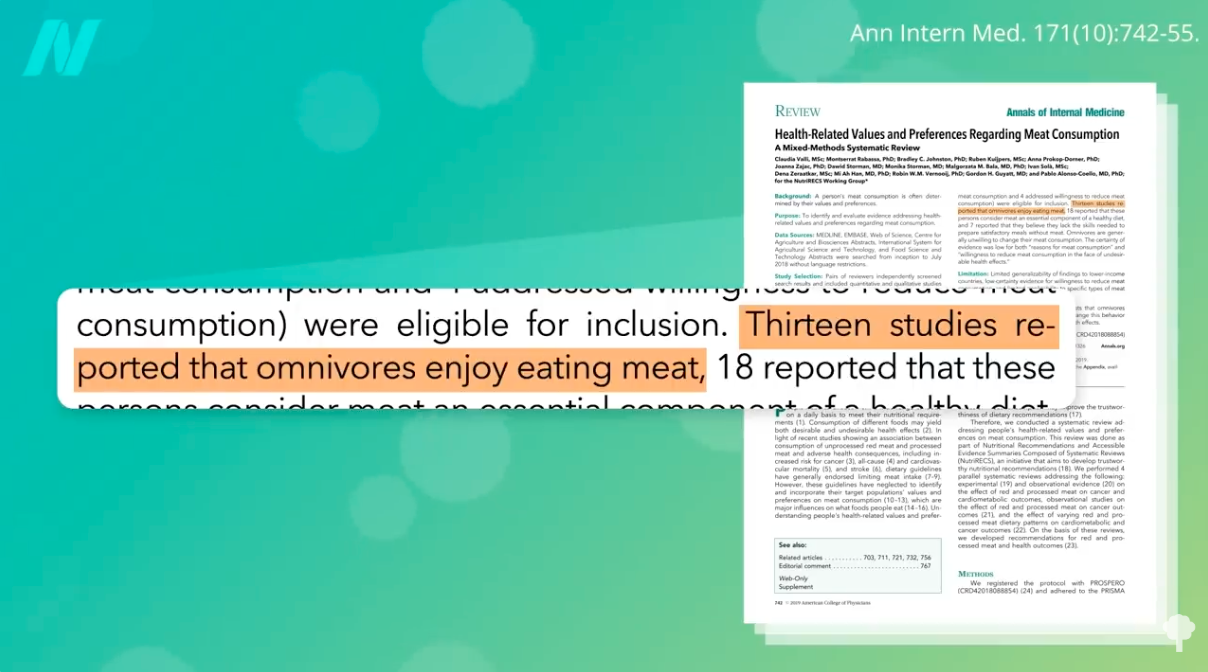
    As I discuss in my video The Health Risks vs. Benefits of Meat Consumption, you do have to consider the risk and benefits. We covered the harms. “[Their] own data show that a moderate reduction in red and processed meat consumption…can reduce total mortality by 13%, heart disease mortality by 14%, cancer mortality by 11% and type 2 diabetes risk by 24%.” What are the benefits? “In short, omnivores enjoy eating meat.” Uh, okay. “Given peoples’ attachment to their meat-based diet, the associated risk reduction”—in our leading killers like cancer, heart disease, and diabetes—“is not likely to provide sufficient motivation to reduce consumption of red meat or processed meat…” So, therefore, eat up! In fact, they even say that the other dietary guidelines that suggest we limit meat consumption because of the cancer association “have paid little or no attention to the reasons people eat meat,” whereas they did a systematic review of preferences regarding meat consumption and found that people who eat meat “enjoy eating meat,” as you can see here and at 3:40 in my video. Quite the revelation, wouldn’t you say?

    “Omnivores are generally unwilling to change their meat consumption,” even in response to health concerns, according to the panel. (The panel, you’ll remember, that had “generous support” of a group getting millions every year from the meat industry). The panel believed that for the majority of people, the desirable effects associated with reducing meat consumption—like lowering your risk of family-devastating cancer and heart attacks—“probably do not outweigh the undesirable effects,” like having to give up all that yummy meat. This is what led them to make their recommendation to “continue current consumption.”

    That sounds like something straight out of the journal Meat Science. “Why should we keep eating red meat?” Because of “the immediate enjoyment,” as you can see below and at 4:25 in my video.

    Well, some people like smoking, drinking sugary sodas, and maybe having unsafe sex, too. “It’s kind of like saying: We know [motorcycle] helmets can save lives, but some people still prefer the feeling of the wind in their hair.” So, does that mean we should just tell people not to wear helmets?

    Sounds foolish, but you’ll actually see this argument. “Complying with dietary recommendations therefore imposes a ‘taste cost’ on consumers,” so how about making “socially desirable recommendations that are most compatible with consumer preferences (i.e., that best balance health benefits against ‘taste cost’)”? Following that logic, “even if science told us that eating butter is unhealthy, its taste justifies the continuation of using it.”

    What do you expect from NutriRECS, the meat industry–partnered panel that also published the paper criticizing the sugar guidelines, funded by the soda and candy industries?

    NutriRECs aims to produce nutritional guideline recommendations based on the “preferences of patients.” What’s next, telling people to eat donuts and ice cream all day? Yet the Annals of Internal Medicine published the meat papers with a press release saying, “No need to reduce red or processed meat consumption for good health.” As Dr. David Katz, director of Yale’s Prevention Research Center, put it: Using the same methodology and rationale, they might as well have said, “No need to quit smoking for good health” or “No need to exercise for good health,” as shown below and at 5:49 in my video.

    Said Dr. Katz, “Guidelines opposing the very data on which they purport to be based are not science; they are anti-science.”

    Doctor’s Note

    What do relative risk numbers actually mean? See, for example, How Much Cancer Does Processed Meat Cause?.

    This is the sixth in an eight-part series on how industries impact dietary and health guidelines. The first five parts are in the related posts below.

    The final two are How Big Meat Distorted the Evidence and How Many Minutes of Life Does a Burger Cost?.


    Credit: Source link
  • ARC Raiders Explosives Handbook: Grenades, C4 & Everything Between

    ARC Raiders Explosives Handbook: Grenades, C4 & Everything Between

    Explosives provide area denial and burst damage in ARC Raiders. Proper usage turns difficult fights into manageable engagements. This comprehensive guide covers all explosive options and tactics.

    Explosive Types Comparison

    Each explosive serves distinct tactical purposes effectively. The table below compares available explosive options:

    Type Damage Radius Fuse Time Throw Range Best Use
    Fragmentation Grenade 5m 2.5 sec 30m Anti-personnel
    Smoke Grenade 0 Instant 25m Cover and concealment
    Flashbang 8m 1.5 sec 25m Room clearing
    C4 Charge 7m Remote 5m Traps and structures
    Proximity Mine 6m Trigger 15m Area denial

    Fragmentation Grenade Fundamentals

    Frag grenades remain most common explosive choice. Cook grenades reducing fuse time before throwing. Bounce grenades off walls reaching covered enemies. Direct throws work against grouped targets. Never grenade your own cover position. Use to finish wounded enemies behind cover. Practice throwing arcs in safe zones regularly.

    Smoke Grenade Tactics

    Smoke provides visual concealment without damage. Block enemy sight lines during approaches. Cover retreat movements from superior forces. Mark landing zones for team coordination. Multiple smokes create extended concealment corridors. Wind and weather affect smoke behavior. Remember smoke blocks your vision too.

    Flashbang Room Clearing

    Flashbangs enable safe building entry procedures. Pop flash before entering unknown rooms. Close eyes during detonation avoiding blindness. Enter immediately after flash effect begins. Clear corners systematically after stunning enemies. Coordinate flash timing with squad entries. Excessive flash use builds enemy immunity.

    C4 Trap Setting

    C4 enables creative explosive trap configurations. Place behind corners catching pursuing enemies. Booby-trap high-value loot containers. Remote detonation allows timing control. Multiple C4 charges create chain reactions. Visible C4 deters enemy advancement. Invisible C4 creates deadly surprises.

    Proximity Mine Defense

    Proximity mines automate area denial effectively. Cover flank approaches during holds. Protect extraction points from rushers. Layer mines creating defensive fields. Mark mine locations for teammates. Remove mines when positions abandoned. Enemy mines can be disarmed carefully.

    Explosive Safety Protocols

    Explosives endanger users without proper handling. Maintain safe distances from detonations. Never carry explosives with melee weapons. Store separately from ammunition when possible. Check corners before throwing grenades. Warn teammates before explosive usage. Friendly fire from explosives causes team friction.

    Home

    Credit: Source link

  • Console vs PC: Best Platform for Arc Raiders Experience

    Console vs PC: Best Platform for Arc Raiders Experience

    In the ever-evolving landscape of gaming, the debate between console and PC performance has reached new heights, particularly with the release of games like Arc Raiders. This cooperative shooter emphasizes teamwork, strategy, and skill, making the choice of platform critical for optimal gameplay. Players often find themselves at a crossroads, weighing the pros and cons of each system to determine which offers the best overall experience. With considerations such as graphics fidelity, frame rates, and input responsiveness, as well as community engagement, this article delves into the key aspects of console versus PC performance in the context of Arc Raiders.

    Graphics and Performance Metrics

    When it comes to graphics and performance, PCs often have the upper hand, particularly for players who invest in high-end hardware. For Arc Raiders, the ability to run the game at higher resolutions and frame rates can significantly enhance the visual experience, allowing players to see enemies and environmental details more clearly. Consoles, while offering optimized performance for the hardware, may experience limitations in terms of graphical fidelity and frame rates. Below is a comparison table showcasing typical performance metrics between consoles and high-end PCs for Arc Raiders:

    Platform Resolution Frame Rate Graphics Settings
    PC (High-end) 4K 60+ FPS Ultra
    Console (Next-gen) 1440p 30-60 FPS High

    While PCs can achieve superior performance metrics, it’s essential to consider the diminishing returns of higher settings and frame rates. Console players might not experience the same graphical fidelity, but the optimization for specific hardware allows for a smoother, more consistent experience, particularly in chaotic encounters typical to Arc Raiders.

    Input Responsiveness and Control

    Input responsiveness is crucial for games that require quick reflexes and precise actions, such as Arc Raiders. PC gamers tend to favor keyboard and mouse setups, which can offer finer control and faster reaction times compared to traditional game controllers. This advantage can be particularly noticeable when aiming at fast-moving targets or executing complex maneuvers. However, recent advancements in controller technology have narrowed this gap, with features like adaptive triggers and haptic feedback enhancing the console experience. Players should consider the following factors when evaluating input responsiveness:

    • Personal preference for keyboard and mouse versus gamepad
    • Reaction times and precision aiming capabilities
    • Ergonomics and comfort during extended play sessions

    Ultimately, the choice of control scheme can significantly impact the overall experience in Arc Raiders, and players must select the one that best suits their playstyle and comfort level.

    Community and Multiplayer Experience

    The multiplayer component of Arc Raiders is a significant draw, emphasizing cooperation among players to achieve objectives. Console platforms often have a more unified community due to their closed ecosystems, which can foster a stronger sense of camaraderie and engagement. Conversely, PC gamers benefit from a broader array of communication tools and modding capabilities, allowing for a more customizable experience. Community engagement can be assessed through:

    • Availability of clans and guilds
    • Access to third-party communication tools
    • Involvement in community events and tournaments

    Both platforms offer unique advantages in fostering community interaction, which can enhance the overall experience in Arc Raiders, making it crucial for players to consider where they feel most connected.

    Cost of Entry and Long-term Investment

    The cost of entry is a significant factor in choosing between console and PC for gaming. Consoles generally have a lower initial investment, with the latest machines often retailing at a fixed price. In contrast, PCs can vary widely in cost based on the components selected, with high-end setups requiring substantial investment. However, PCs may also offer long-term advantages through the ability to upgrade components over time, which can result in better performance for future titles like Arc Raiders. Players should weigh the following considerations:

    • Initial hardware cost versus upgrade potential
    • Ongoing expenses for peripherals and accessories
    • Subscription services for online play and additional content

    Understanding the financial implications of each platform is vital for gamers looking to make an informed decision that aligns with their budget and gaming aspirations.

    Conclusion: Choosing Your Platform

    In conclusion, the choice between console and PC for playing Arc Raiders ultimately boils down to personal preference and priorities. Each platform has its merits, with PCs generally excelling in performance and customization, while consoles offer ease of use and community engagement. Players should consider their gaming style, budget, and the importance of graphical fidelity, input responsiveness, and multiplayer experience when deciding. Regardless of the choice made, the aim should always be to enhance enjoyment and facilitate a seamless experience in the thrilling world of Arc Raiders.

    Home

    Credit: Source link

  • Arc Raiders Solo vs Squad: Best Playstyle for Beginners Farming Currency

    Arc Raiders Solo vs Squad: Best Playstyle for Beginners Farming Currency

    In the expansive universe of Arc Raiders, new players often find themselves grappling with the decision between solo play and squad play. Each approach has its own merits and challenges, particularly when it comes to efficiently farming early game currency. Understanding the nuances of both playstyles can significantly impact a player’s progression. This guide will delve into the advantages and disadvantages of solo and squad play, helping beginners make informed choices to maximize their currency gains in the early stages of the game.

    Understanding Solo Play

    Solo play in Arc Raiders allows players to experience the game at their own pace, providing a unique opportunity for exploration and mastery of mechanics. Beginners can hone their skills without the pressure of coordinating with a team, which is particularly beneficial when learning game mechanics such as aggro management and item utilization. However, the challenges of solo play can be significant; players may find themselves overwhelmed by enemy encounters and the need for efficient resource management. Moreover, while farming currency is possible alone, the rate of currency accumulation is generally slower compared to squad play, as players may not be able to tackle higher-level content that yields better rewards.

    The Advantages of Squad Play

    Squad play, on the other hand, introduces a collaborative element that can greatly enhance the farming of early game currency. Working with a team allows players to combine their strengths and cover each other’s weaknesses, making it easier to take on tougher enemies and complete missions efficiently. This synergy can lead to faster clear times and increased loot drops, significantly ramping up currency accumulation. Additionally, squads can tackle more challenging missions that solo players might find daunting, leading to higher rewards. However, the necessity for teamwork can pose a hurdle for beginners who may struggle with communication and coordination, potentially leading to frustrating experiences if the squad is not well-organized.

    Currency Farming Strategies

    Regardless of the chosen playstyle, there are specific strategies that can maximize early game currency farming. For solo players, focusing on completing daily missions, scavenging for resources, and efficiently managing cooldowns on abilities can yield significant rewards. Squad players, meanwhile, should prioritize team synergy and effective role distribution. Below is a table that outlines some key strategies and their benefits for both playstyles:

    Strategy Solo Play Benefit Squad Play Benefit
    Daily Missions Consistent currency boost Group completion for faster runs
    Resource Scavenging Control over resource management Shared resources increase efficiency
    Cooldown Management Personal timing for engagements Coordinated ability use for maximum damage

    Team Composition and Roles

    In squad play, understanding team composition and roles is crucial for success. A well-rounded team typically includes a tank to absorb damage, DPS (damage per second) players to output high damage, and support characters to heal or enhance team performance. Beginners should focus on developing a balanced composition to ensure they can handle various encounters effectively. Here are some recommended roles for new players to consider:

    • Tank: Absorbs damage and draws enemy aggro.
    • DPS: Focuses on maximizing damage output to eliminate threats quickly.
    • Support: Provides healing and buffs to enhance team performance.

    Final Thoughts: Choosing the Right Playstyle

    Ultimately, the choice between solo and squad play in Arc Raiders boils down to personal preference and playstyle. Beginners may find solo play offers a gentler learning curve, allowing them to familiarize themselves with the game mechanics without the pressure of a team. Conversely, squad play can provide a more dynamic experience with faster currency gains, but may require a greater investment in teamwork and communication skills. By weighing the pros and cons of each approach and considering individual comfort levels, new players can effectively decide which playstyle will best suit their early game currency farming needs.

    Home

    Credit: Source link