School lunch is the one meal of the day I have to plan around someone else’s schedule, someone else’s taste buds, and a nut-free rule. Our kids range from 4 to 14, so one lunch has to work for a preschooler and a teenager. And it all has to survive a backpack until noon.
The hardest part for me is standing in the kitchen at 9 pm on a school night, trying to decide what to make. I’ve written before about eating mostly the same things every week so we don’t waste brain cells figuring out what to eat. School lunches are where I needed that most.
So here’s the system: one plan, one grocery trip, one Sunday prep session, and a few minutes the night before.
The week
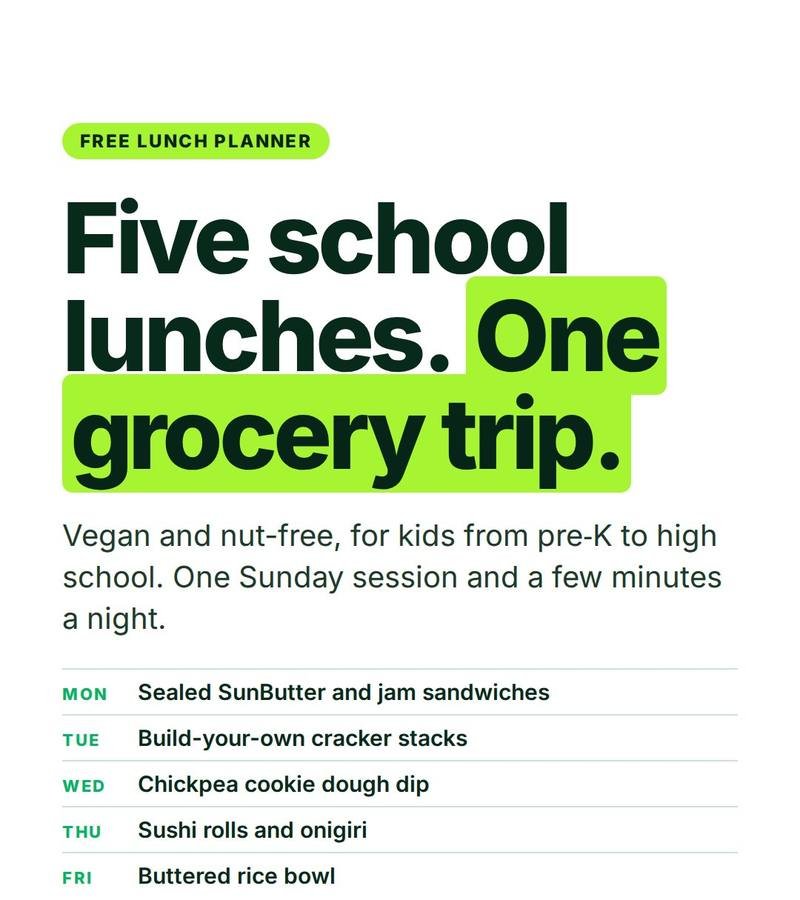
Monday: Sealed SunButter and jam sandwiches, sliced pears and baby carrots, oat energy bites
Tuesday: Build-your-own cracker stacks with baked tofu and vegan cheddar, cucumber coins and grapes, dried mango
Wednesday: Chickpea cookie dough dip with graham crackers for dipping, strawberries and snap peas, roasted chickpeas or popcorn
Thursday: Veggie sushi rolls or onigiri (Trader Joe’s, or an onigiri mold and cooked rice), edamame and mandarins, more energy bites
Friday: Warm buttered rice bowl with Daring plant chicken, peas and carrots, cherry tomatoes and melon, vegan cream cheese and pretzel crisps
Every day has a plant protein the kids actually recognize: SunButter, tofu, chickpeas, edamame, plant chicken.
The prep
Sunday: Roll the energy bites and make Monday’s sandwiches. Crimping the edges with a sandwich cutter keeps the jam in the sandwich and out of the lunchbox.
Monday to Wednesday nights: Slice, portion, pack. Move the edamame from the freezer to the fridge Wednesday night so it thaws.
Friday morning: Rice with frozen peas and carrots in the Instant Pot, then stir in vegan butter and the warmed chicken.
Pro Tip: Make a double batch of energy bites. They cover Monday and Thursday this week and a couple of days next week.
Pro Tip: Fill the thermos with hot water while the rice cooks, then dump it out right before you pack. Hot lunch stays hot until noon.
Little kids and big kids
Same lunch, small changes.
Little ones: Cut sandwiches into quarters. You may want to halve the grapes and cherry tomatoes. Start peeling the mandarin so small hands can finish it.
Big kids: Two sandwiches on practice days, extra tofu or plant chicken, and they build their own cracker stacks.
Nut-free swaps
This is the part that trips people up, because a lot of vegan staples are made from nuts.
Cream cheese: Violife, Tofutti or bettergoods (Walmart). Skip the almond and cashew brands.
Graham crackers: Nabisco Original or Kinnikinnick. Both are honey-free, and Kinnikinnick is gluten-free too.
Seed butter: SunButter, anywhere you would use peanut butter.
Chocolate chips: Enjoy Life mini chips.
Vegan butter: Read the label. Some plant butters use almond or cashew.
Brands change recipes and factories without telling anyone, so check every label against your school’s allergy rules.
Get the planner
I put the whole week into a free planner: each day’s prep step, tips for little ones and big kids, and a grocery list sorted by aisle that you can check off as you shop.
What’s the one lunch your kids reliably bring home empty? I’m always looking for the next one to add to the rotation.
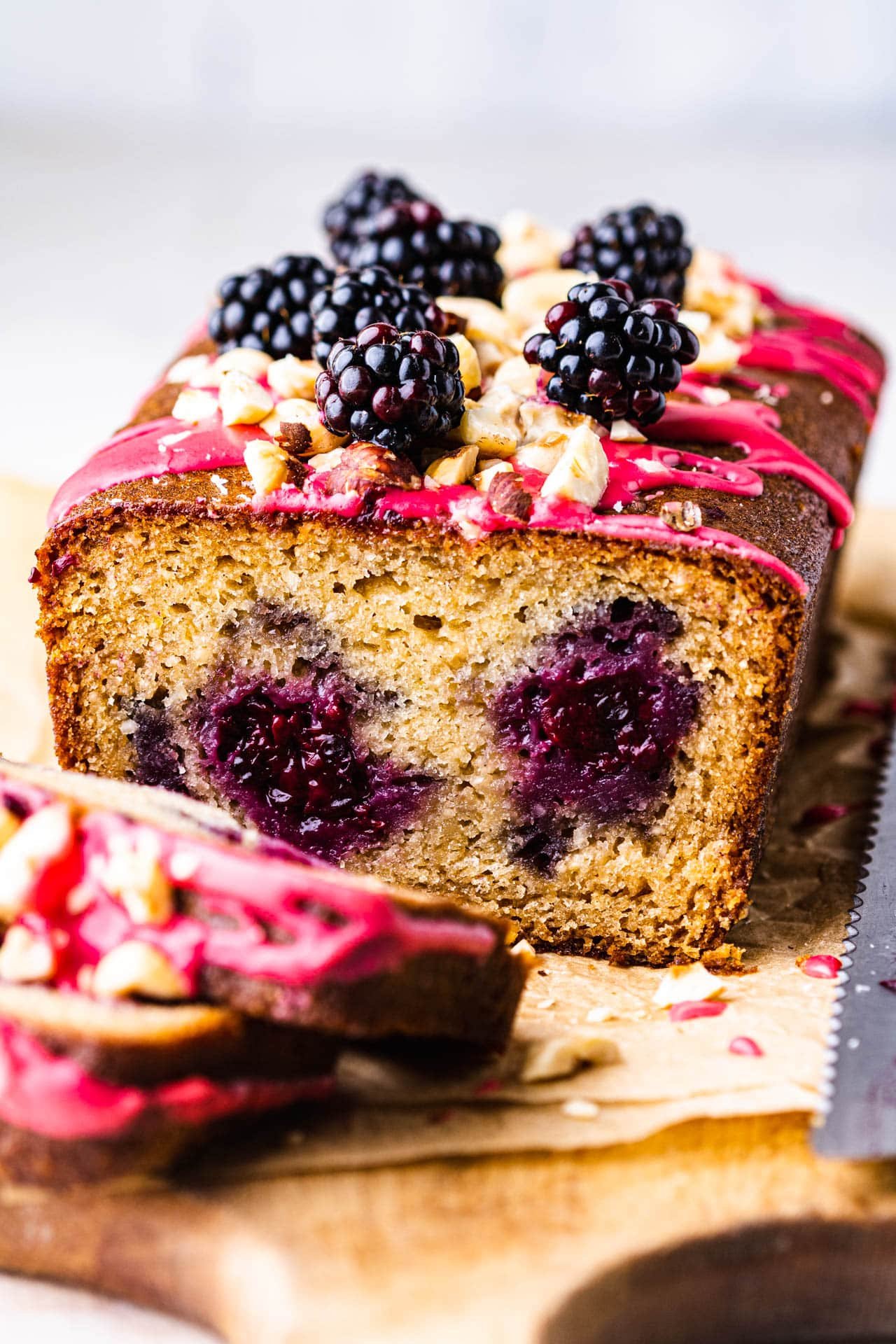
Is it me or autumn has crept up on us? It’s probably me as I have been on holidays for the last couple of weeks. The return to reality was painful but baking an autumn inspired vegan blackberry cake has eased the pain and I have no regrets.
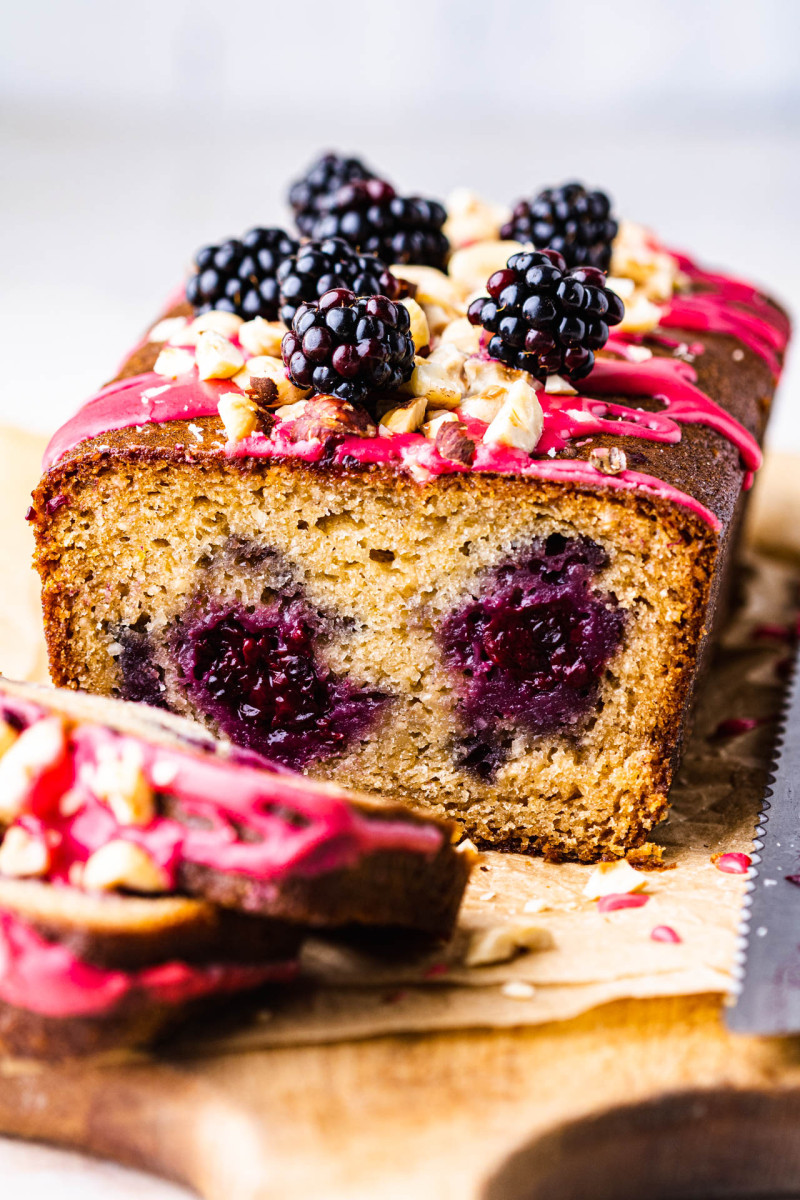
This vegan blackberry cake is moist, fruity and nutty and absolutely prefect with your favourite hot beverage, enjoyed, ideally, in the warmth of September sunrays that I have been so grateful for this past week.
This simple, one bowl vegan blackberry cake is inspired by season’s produce: juicy and tangy blackberries and hazelnuts, both of which are autumn babies and because Mother Nature is endlessly clever go really well with each other too. It’s easy to make and a lovely weekend treat so I hope you’ll give it a try!
MORE ABOUT THE INGREDIENTS
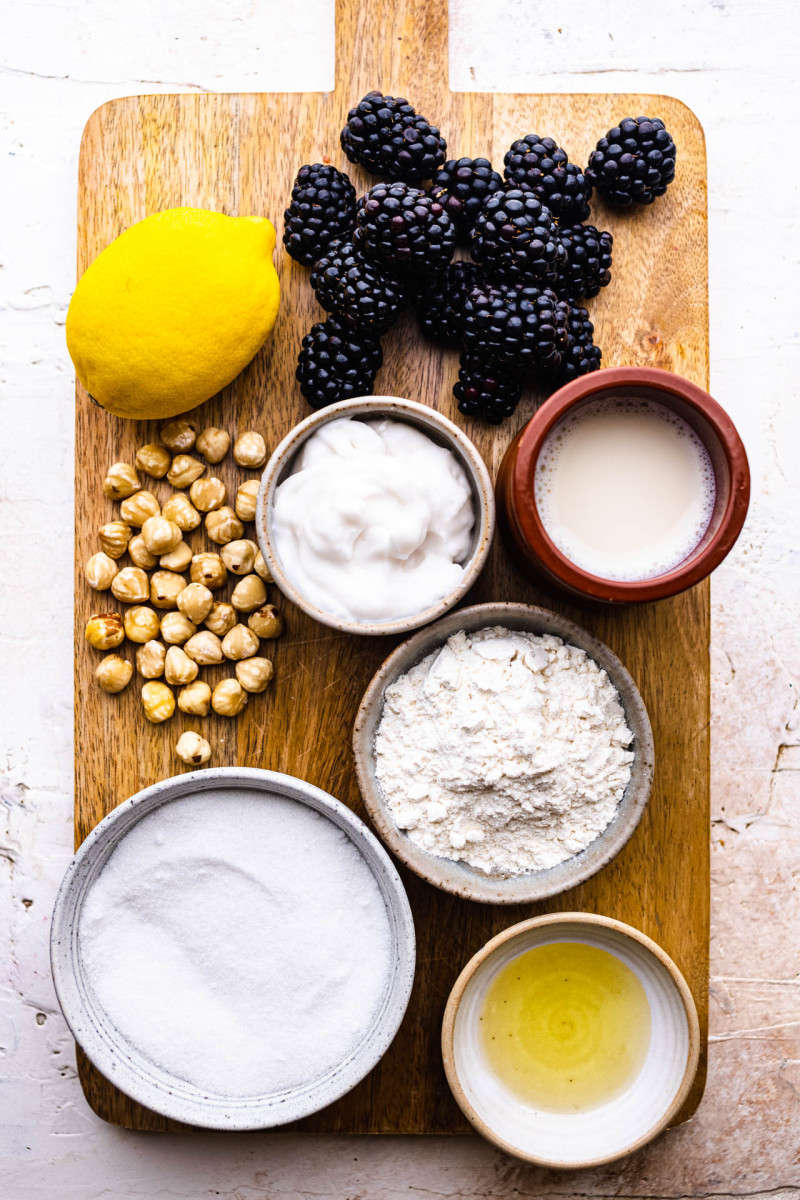
VEGAN YOGHURT – vegan yoghurt keeps this cake moist and minimises the need for added fat. In fact, you could make it completely oil-free by replacing oil with extra yoghurt. I recommend using thick (rather than pourable) yoghurt here for best results. I used vanilla yoghurt by The Coconut Collaborative.
OIL – a small amount of neutral oil (grapeseed, sunflower, mild olive oil) helps to keep this cake beautifully moist, but you can make this cake OIL-FREE by replacing the oil with extra yoghurt.
SUGAR – I used caster (superfine) sugar in combination with light muscovado sugar.
BLACKBERRIES – I used fresh blackberries, which once submerged into the cake batter and baked produce fruity pops of flavour throughout the cake.
PLANT MILK – any plant milk will work well here although I like using soy milk in baked goods.
LEMON – lemon juice helps this cake rise as it comes into a reaction with baking soda so don’t skip it although you could use lime juice instead. As for the zest, it’s optional, but I like its fragrance against white chocolate.
FLOUR – I used white all purpose flour here, but if you want to make this cake gluten-free, use a well balanced gluten-free flour mix. One that contains plenty of starch and ideally some xanthan gum too.
HAZELNUTS – This vegan blackberry cake was inspired by autumn produce: blackberries and hazelnuts so I used blanched hazelnuts, which I ground finely in my food processor and used it to replace flour. If you would rather cut down your work, you could also use ground almonds, which are accessible in baking aisles of well stocked supermarkets.
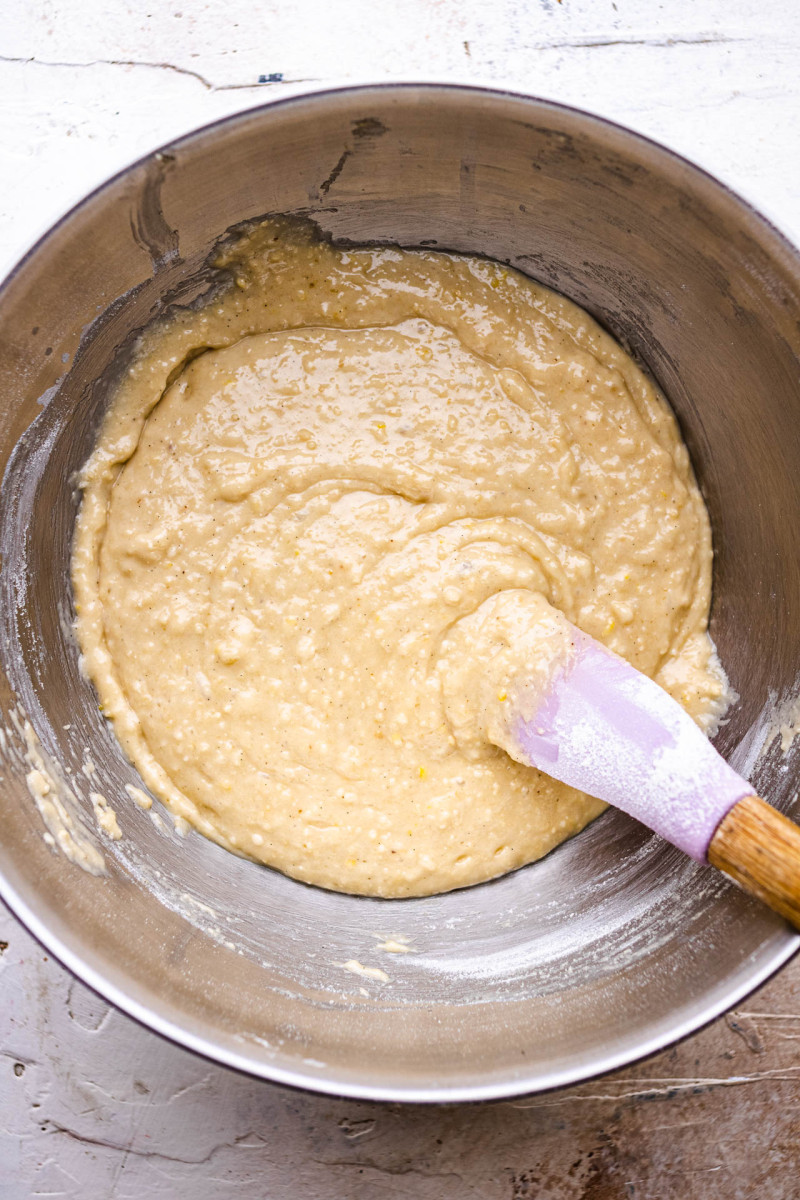
This vegan blackberry cake is a simple, single bowl cake that is perfectly achievable for a beginner. Start off by combining all the wet ingredients (that includes sugar and lemon zest) in a large mixing bowl. Once combined add finely ground hazelnuts (you can also use shop-bought ground almonds if you prefer) and then flour and baking agents in two to three batches. Finally, fold in blackberries gently and you are ready to bake.
Bake for 45-50 minutes until a skewer inserted in the middle of the cake comes out clean. Once you take the cake out of the oven, be sure to allow it to cool off completely before applying icing.
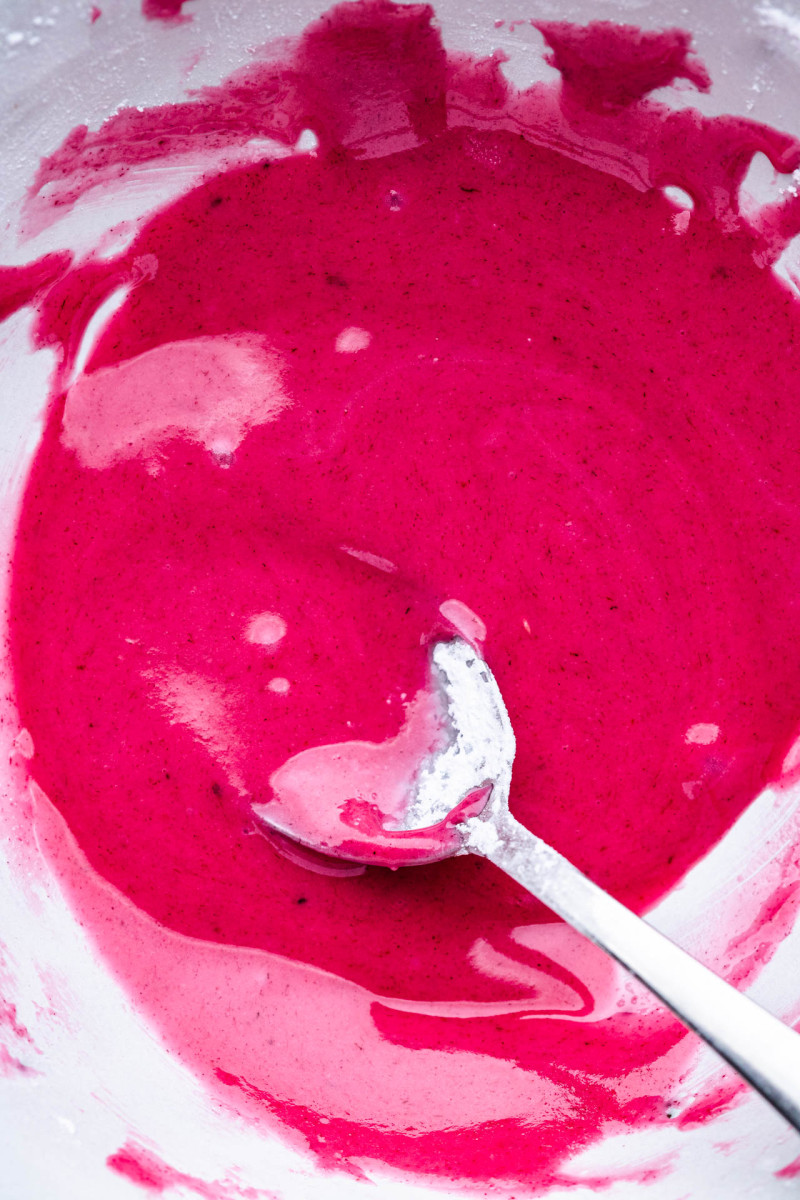
To make the icing, combine 50 g (a third of a cup) of icing sugar with approximately 3 tsp of liquid. You can use 100% blackberry juice (squeeze a few raspberries through a small sieve to separate juice from the flesh) but the icing will be purple, which I personally find less appetising so to make this colour I combined half lemon juice and half blackberry juice.
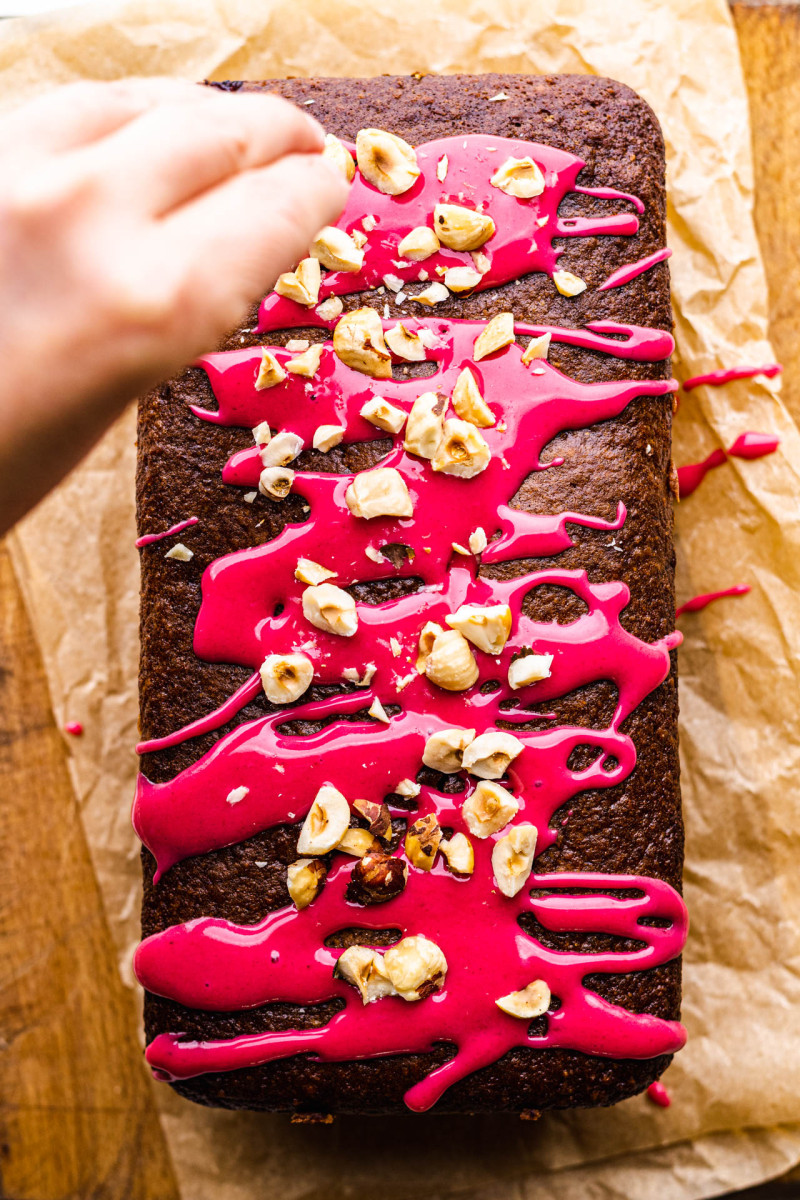
Drizzle the icing over a cold cake and sprinkle with roughly chopped hazelnuts (or almonds if you used almonds in the batter). I also topped it with a few extra blackberries for looks.
Heat up the oven to 175° C (or 155° C fan forced) / 350° F (310° F fan forced). Grease a 1 kg / 2 lb cake tin (see NOTES) and line it with a wide strip of baking paper to be able to remove your cake easily.
Grind hazelnuts very finely in a food processor, set aside.
Stir the yoghurt, oil and sugar together with a spatula until the mixture is uniform.
Add in the vanilla extract, plant milk, lemon zest and juice. Mix well.
Stir in ground hazelnuts into the wet ingredients.
Next sift in flour, salt and both baking agents over the wet ingredients, in two to three batches. Fold each batch into the wet ingredients gently with a spatula. The finished batter should be a fairly thick, but still pourable.
Finally, fold in blackberries very gently.
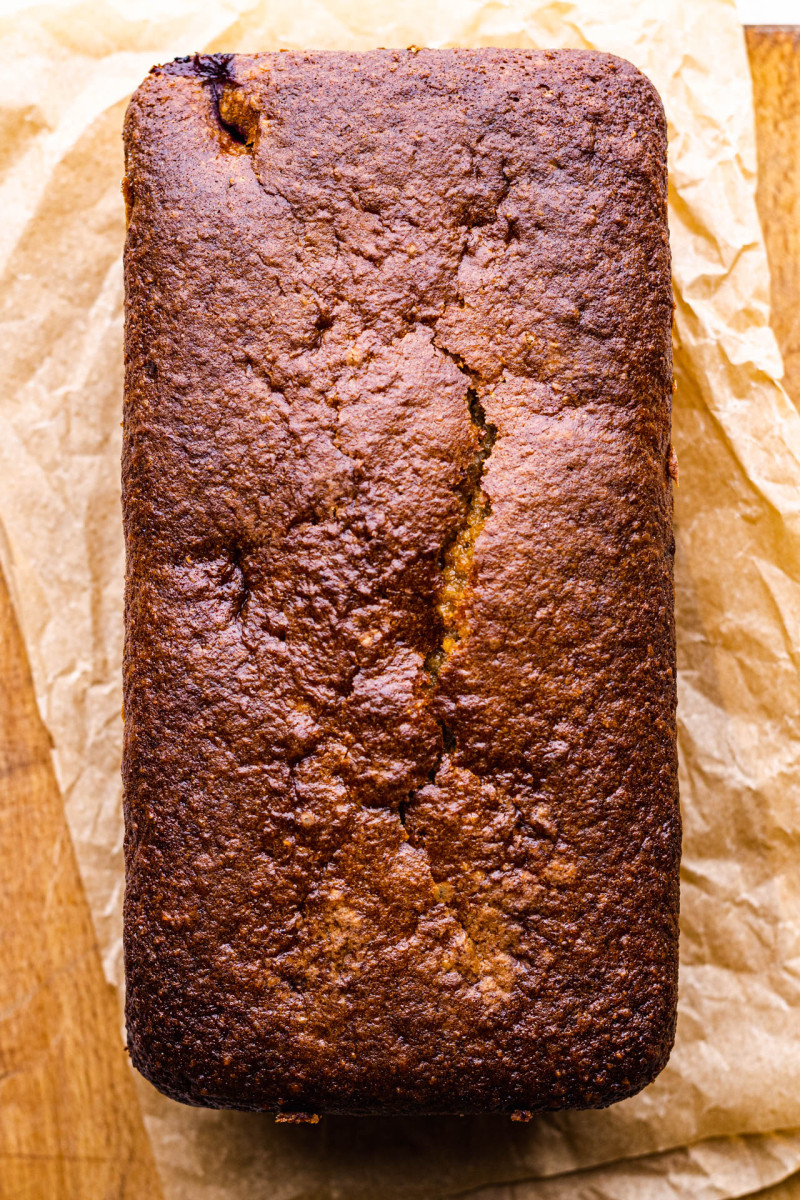
Transfer the batter into the prepared baking tin and bake for about 45-50 min, until a toothpick comes out clean and the top is nicely browned – if the top is browning too quickly, tent it with a piece of kitchen foil.
Once the cake is completely cool, make the icing by whisking in small amount of liquid (about 3 tsp) into the icing sugar. I used one and a half teaspoon of lemon juice and the same amount of blackberry juice obtained by squeezing a couple of fresh blackberries over a small sieve.
Drizzle icing over the cake, then immediately sprinkle with chopped hazelnuts on top. Decorate with a few more blackberries if you wish. Use a serrated knife and gentle pressure to produce neat looking slices.
NOTES
*OIL-FREE: make this loaf oil-free, substitute oil with 30 g / 2 tbsp more yoghurt.
*GLUTEN-FREE: to make this cake without gluten, sub regular flour with a well composed gluten-free flour mix (one that contains a dose of starches for binding). I also recommend about a tsp of xanthan gum to ensure the flour binds well.
900 g / 2 lb tins vary enormously between brands so I recommend measuring the volume of the tin you intend to use first. For this recipe, I used a tin that holds 1250 ml / 5 cups of liquid (to the brim), but the batter should fill no more than 2/3 – 3/4 of the 2lb cake tin or else the cake may not raise.
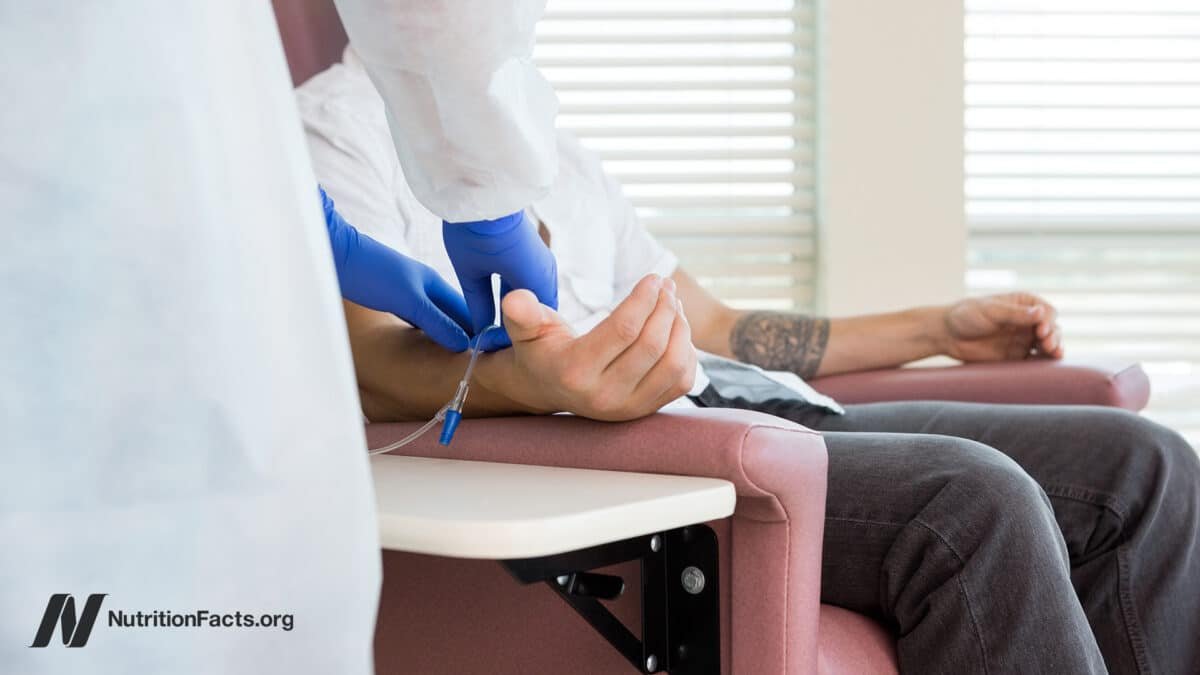
Most chemotherapy drugs are approved by the U.S. Food and Drug Administration (FDA) without evidence that they benefit survival or quality of life.
By 2030, the number of new cancer cases in the United States is expected to skyrocket by 45%, from 1.6 million to 2.3 million every year. Are we really winning the war on cancer? Sadly, in general, no, despite the hundreds of new anticancer drugs that have been introduced.
As I discuss in my video How Effective Is Chemotherapy?, the war on cancer has been likened to the war on terror. No matter how many drone strikes you do, it’s nearly impossible to kill all the bad guys, and no matter how precise the bombing, one must always consider the collateral damage. Toxicity from cancer therapy can be debilitating—and not just health-wise. There is also “financial toxicity.”
Some patented anticancer drugs can cost nearly a thousand dollars a day. Even with health insurance, the average cost to patients with stage IV breast cancer, for example, can run about $190,000. It’s bad enough to have to fight for your life; you shouldn’t have to face bankrupting your family at the same time. Sadly, it remains a common problem today.
Who can forget the apocryphal story of Walter White in “Breaking Bad,” who worked two jobs with health insurance and still couldn’t afford his cancer care? Now, not everyone is willing to start their own meth lab, but many are willing to go for broke. A large portion of cancer patients reported their willingness to declare bankruptcy or sell their homes to pay for treatment. Aren’t the high prices of cancer medicines justified if innovative, new treatments offer patients significant benefits? You may be shocked to find out that “many FDA-approved cancer drugs might lack clinical benefit.”
Well, then how did they become FDA-approved? “Most approvals of cancer drugs are based on flimsy or untested surrogate endpoints, and postmarketing studies rarely validate the efficacy and safety of these drugs on patient-centred endpoints.” Let me explain what that means. New chemotherapy drugs are increasingly approved based only on surrogate endpoints, which means instead of looking at what we really care about—survival or quality of life—drugs are being approved based on things like “response rate” or tumor shrinkage. But who cares if the tumor shrinks if it doesn’t actually extend your quantity or quality of life? It’s kind of counterintuitive, but just seeing a tumor shrink on a CT scan or an MRI is not necessarily correlated with improvements in symptoms or survival. In fact, most studies that have actually followed people over time found low correlations with survival. The most recent comprehensive analysis found 91% of studies of such validation trials found little correlation with overall survival.
Of 36 new chemo drugs approved by the FDA based on these kinds of surrogate endpoints, once they were actually put to the test in the real world, only one in seven was shown to extend life, half explicitly flopped, and the rest remain untested, revealing “that most cancer drug approvals have not been shown to, or do not, improve clinically relevant end points.” “Exorbitant drug prices are bad enough for treatments that work. Charging vulnerable patients for drugs without evidence that they actually improve patients’ survival and quality of life is unconscionable.”
Why doesn’t the FDA require proof that chemo drugs actually benefit patients before it approves them? Some drug companies say that requiring randomized, controlled trials with “meaningful measures” would take too long, but the study time reduction using surrogate endpoints rather than overall survival is estimated at just 11 months. So, instead of it taking 7.3 years to come to market, on average, it would take 8.2 years. Of course, we want to get these drugs out as soon as possible, but only if they’re actually going to help people.
Do cancer drugs improve survival or quality of life? “You don’t need to know, according to our broken regulatory system” in the United States—and things are not much better over in Europe. A systematic evaluation of chemo drug approvals showed that most entered the market without evidence they benefited survival or quality of life. Even years later, there was still no conclusive evidence that they offered any benefit, and, when they did, the gains were often marginal.
That’s why you see editorials in the Journal of the National Cancer Institute with titles like “Hans Christian Andersen and the Value of New Cancer Treatments,” alluding to Andersen’s tale The Emperor’s New Clothes. “These studies all converge on a singular conclusion: only a minority of new cancer drugs approved by US and European regulatory authorities in recent years deliver clinically meaningful benefits to patients…” In fact, some cancer-related deaths may be hastened, or even caused, by the toxic effects of chemotherapy rather than the cancer itself. Based on a review of tens of thousands of cancer patients, in as many as 27% of cases, the cancer treatment itself caused or hastened death. But it might be worth that risk if the potential benefit is large enough. That’s the subject of my next blog.
Doctor’s Note
What about preventing cancer in the first place? See Fighting the Ten Hallmarks of Cancer with Food and How Not to Die from Cancer.
Coming up? How Much Do New Chemotherapy Drugs Extend Life?.
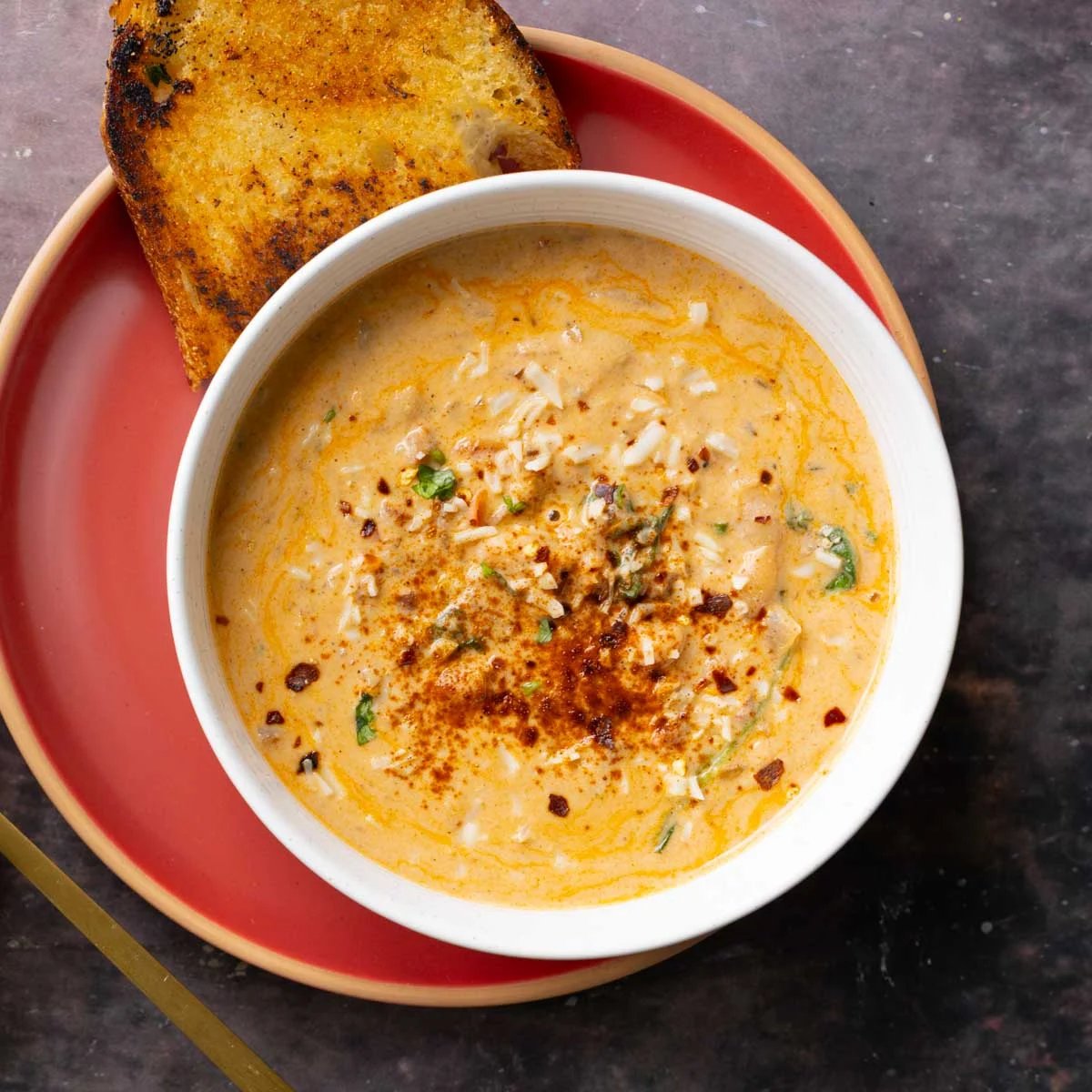
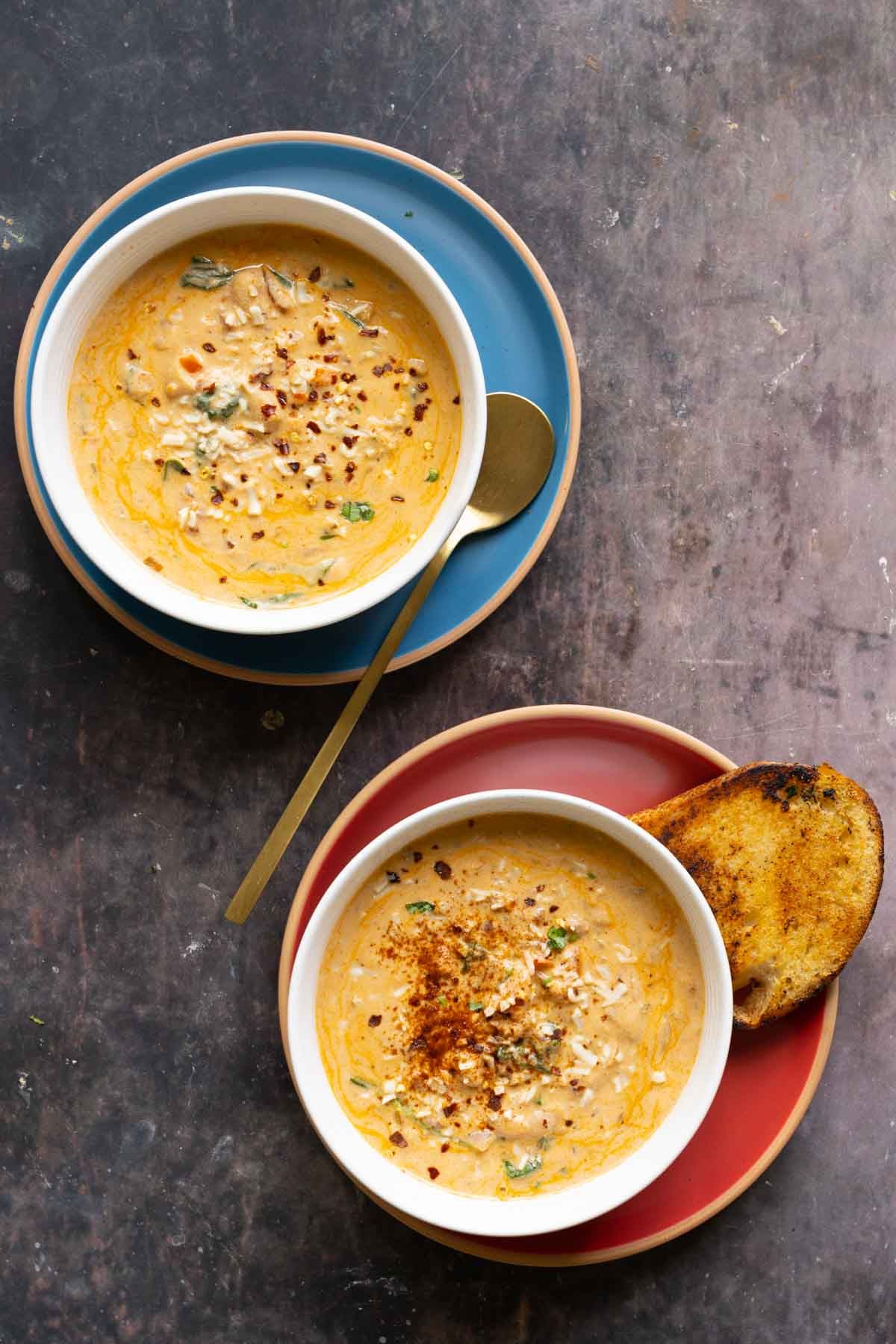
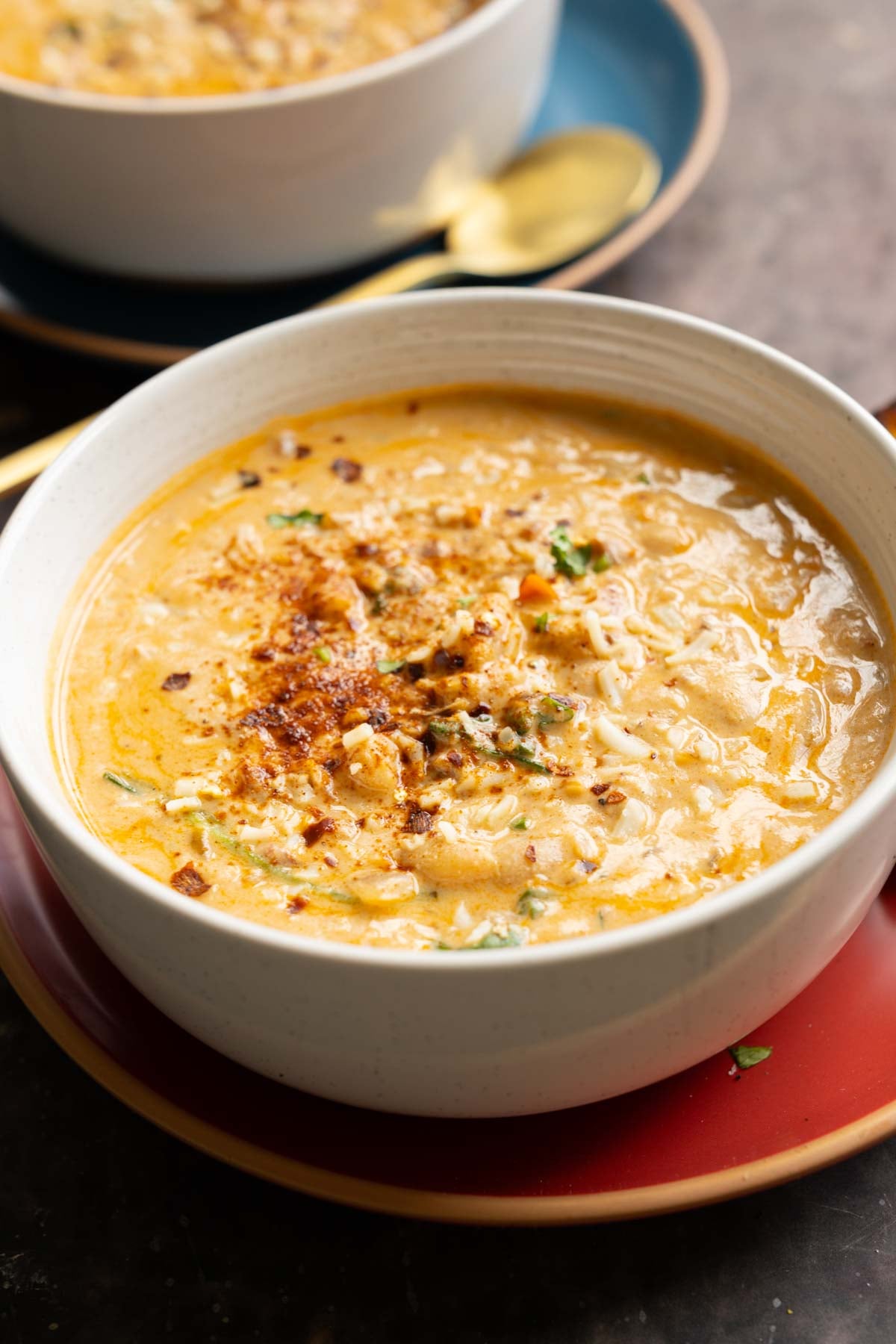
Marry Me White Bean Soup is a creamy, smoky soup with rich, Italian flavors. 23g Protein 13g fiber 1 Pot 30 minutes. That Tofu Cashew Hemp cream packs nutrition! (gluten-free with easy soy-free and nut-free options) Freezer friendly. budget friendly
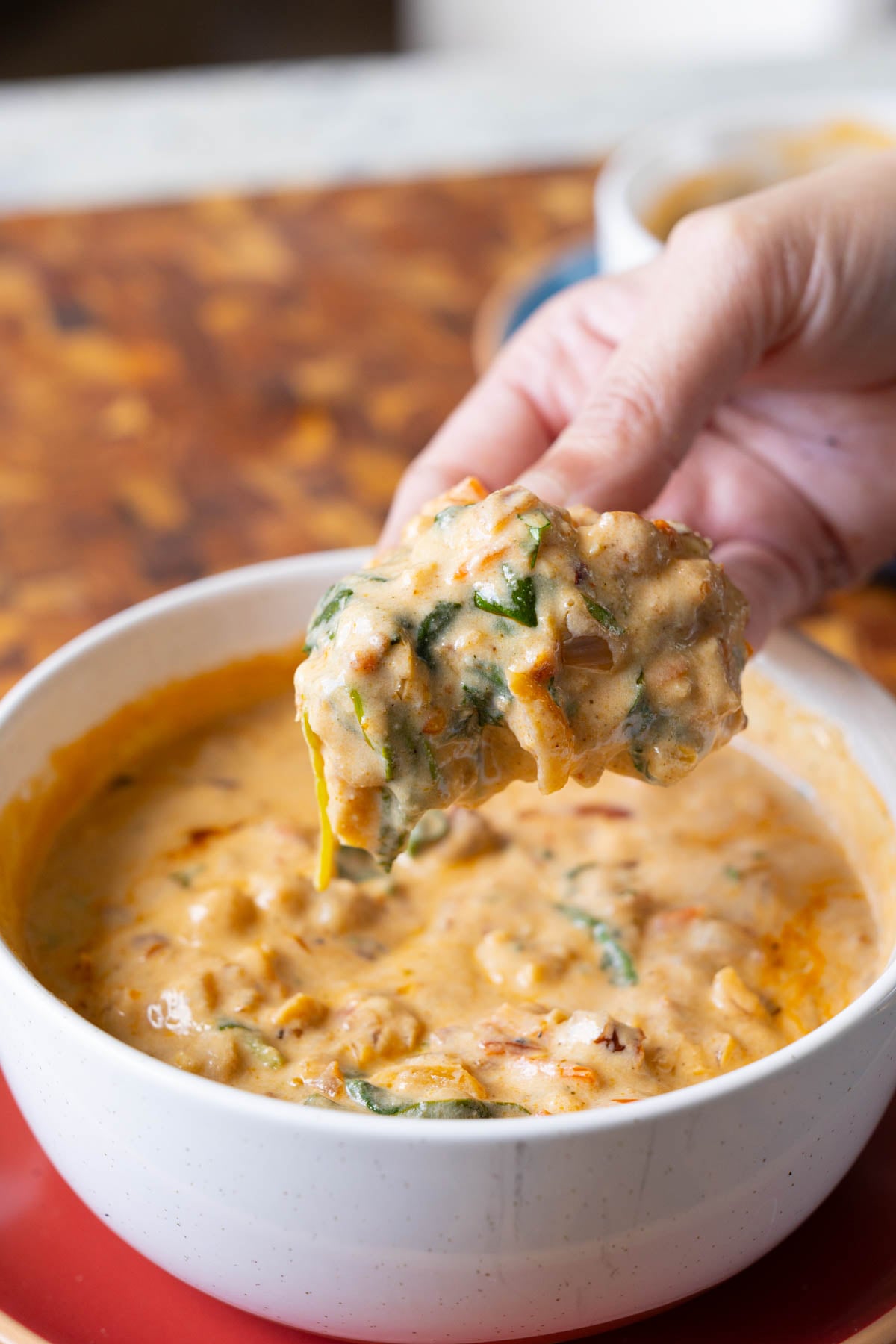
What if I told you that you could make an amazing, creamy, 1-pot soup that is also comforting and nutrient-dense? It is hearty, budget-friendly, easy, and packed with protein, fiber, and iron. It is also packed with amazing flavor and is ready within 30 minutes. It is also weeknight-friendly and uses mostly pantry staples. The whole pot only costs about $5 to $6 to make.
Marry me white bean soup is creamy, hearty, and nutrient-dense. There’s 23 grams protein, 13 grams fiber, 7 mg iron, and even more nutrients in a bowl of this marry me soup! There’s protein from the white beans, cashews, hemp seeds, tofu, and nutritional yeast, and fiber from the vegetables, greens, and white beans.
To make it more hearty, you can add red lentils to the soup while simmering in the stock. The lentils add even more protein and fiber! Or, you can double up on the white beans.
The sun-dried tomato, smoked paprika, creamy texture, and garlicky flavors work really well with some pasta as well. You can also serve it with cheese toast or toasted sourdough, garlic bread, pita.
Why You’ll Love Marry Me White Bean Soup
The flavor! We build the flavor by
1. Toasting garlic and pepper flakes to infuse the oil
2. Toasting the tomato paste and sun dried tomatoes to deepen the umami
3. Using a combination of tofu hemp seeds and cashews for cream so that the cream has volume and hearty creamy flavor!
30-minute 1-pot meal, easy weeknight dinner using mostly pantry ingredients
creamy, smoky, hearty soup with tons of Protein and Fiber in every bite
Meal prep, freezer friendly.
naturally gluten-free with easy soy-free and nut-free options
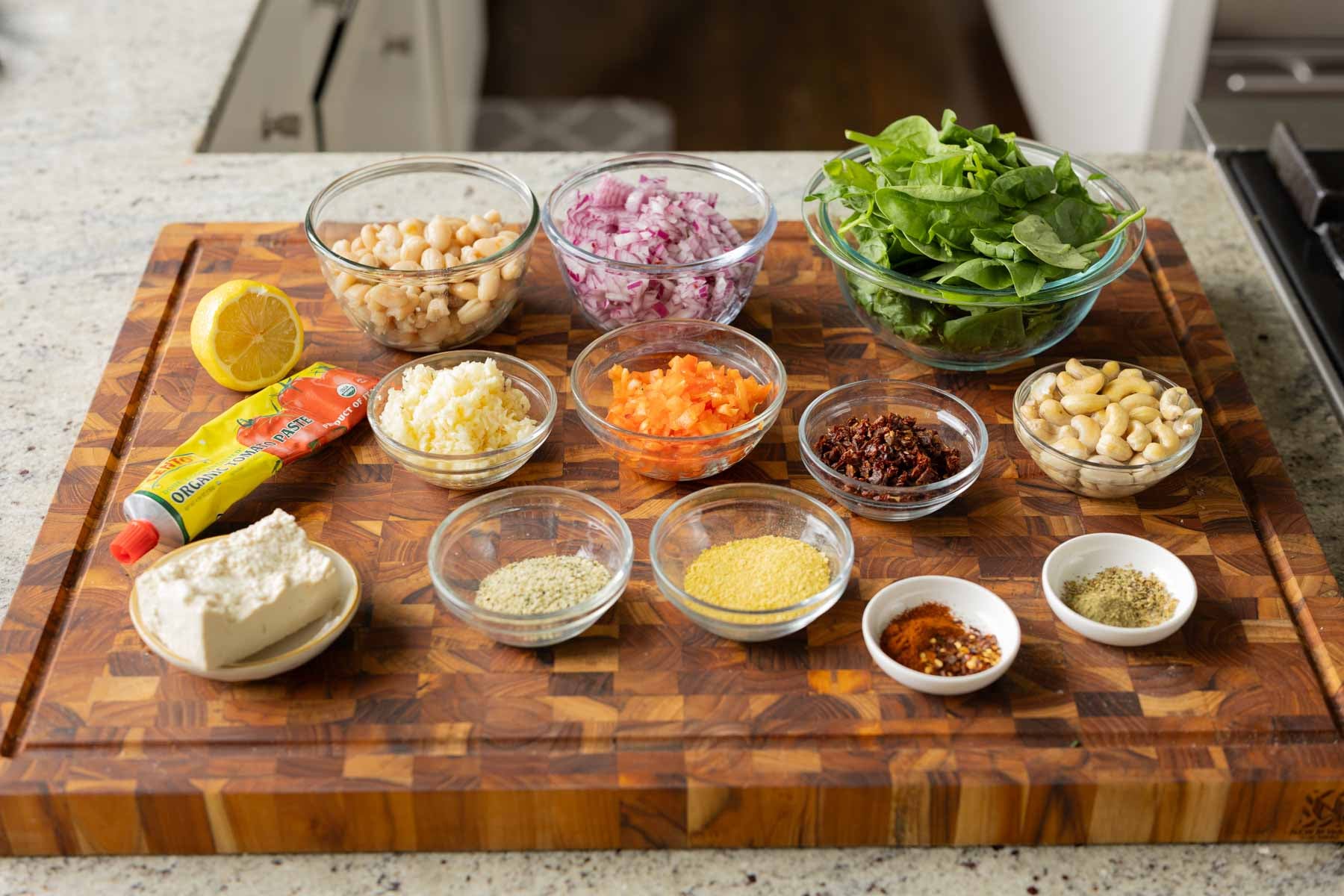
For the Marry Me Soup
2teaspoonsolive oil
4clovesgarlic, minced
1/2teaspoondried oregano
1/2 to 1teaspoonItalian herbs
1/2teaspoonred pepper flakes
1teaspoonsmoked paprika
1 1/2tablespoonstomato paste
1/4cupchopped sun-dried tomatoes
1cupchopped red or white onion, or 3 shallots, chopped
1/2cupchopped red bell pepper
1/2teaspoonsalt, divided
15ouncecan white beans, such as cannellini beans, drained, or 1 1/2 cups cooked white beans of choice or chickpeas
1cupwater, or stock
2 to 3cupschopped baby greens, such as kale, spinach, or a mix
1tablespoonlemon juice
Prevent your screen from going dark
Make the cream.
In a blender, add the cashews, hemp seeds, nutritional yeast, tofu, and the water or stock. Blend for about 1 minute. Let the mixture sit for about 5 minutes, then blend again for another minute until the cashews are broken down and the mixture is really creamy. In the meanwhile, prep the rest of the ingredients and chop the aromatics.
Make the marry me white bean soup.
Start a large saucepan or deep pan over medium heat, and add the olive oil. Once the oil is starting to get a little warm, add the garlic, red pepper flakes, smoked paprika, Italian herbs, and mix. Then, mix in the tomato paste and sun-dried tomatoes. Cook the mixture until the tomato paste starts to smell a bit fragrant.
Mix in the onion or shallots and 1/4 teaspoon of salt. Cook until the onion is starting to turn golden, about 7 to 8 minutes. Halfway through cooking the onions, add the red bell pepper and continue to cook. If the pan is drying out, add a splash of water or some oil and continue cooking and mixing. Stir every 30 seconds or so in the beginning, so that the tomato paste, sun-dried tomatoes, and everything mixes into the onion really well. Then let it sit for a minute and stir again.
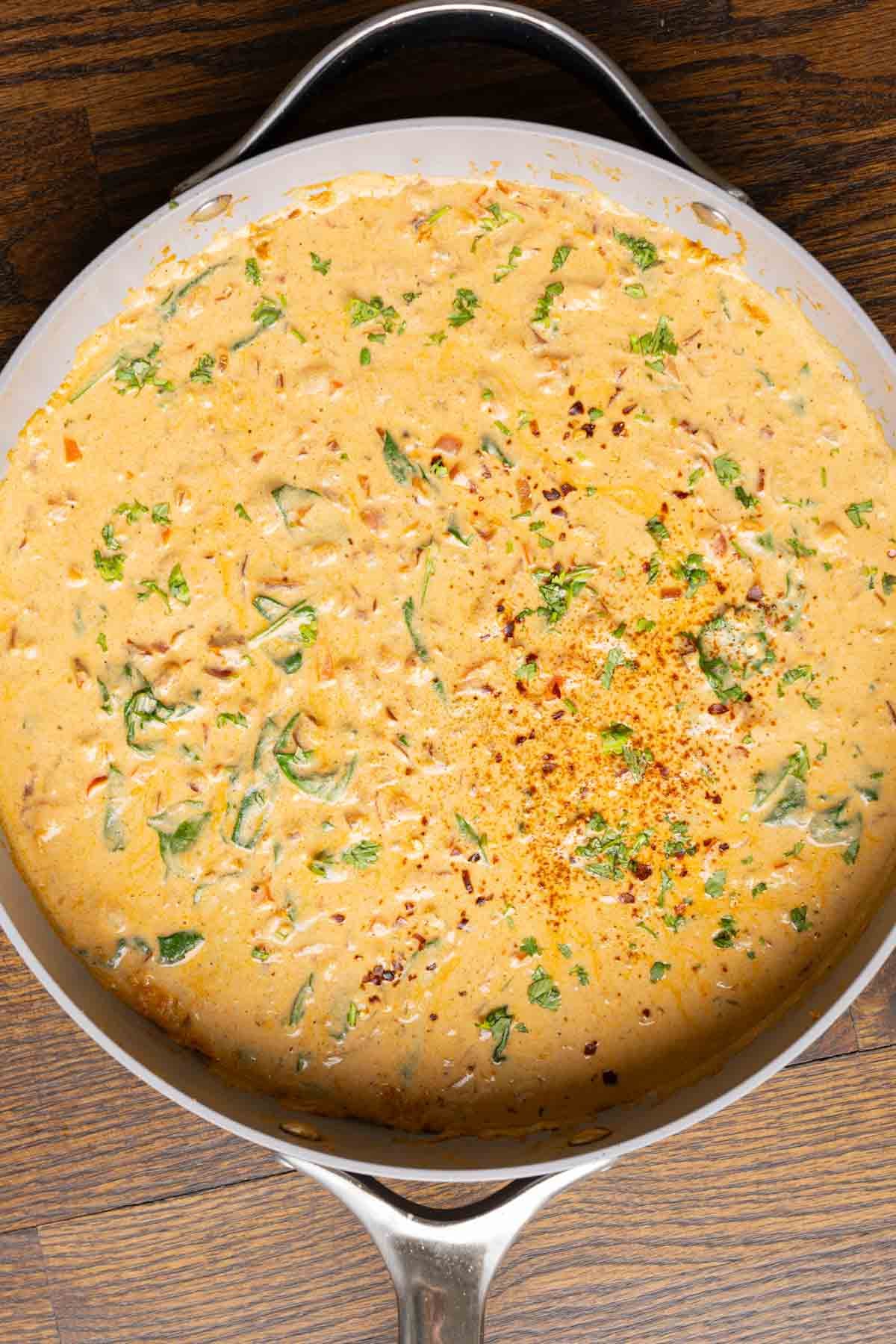
Once the onion is starting to turn golden, add the white beans and the blended-up cream. Rinse out the blender with 1 cup water or stock, and then add that to the pan. Mix in the remaining salt, and bring this mixture to a boil. The simmering will be about 6 to 8 minutes for the mixture to get nice and bubbly and creamy. Taste and adjust the flavor by adding more salt, more heat, or more herbs, if needed.
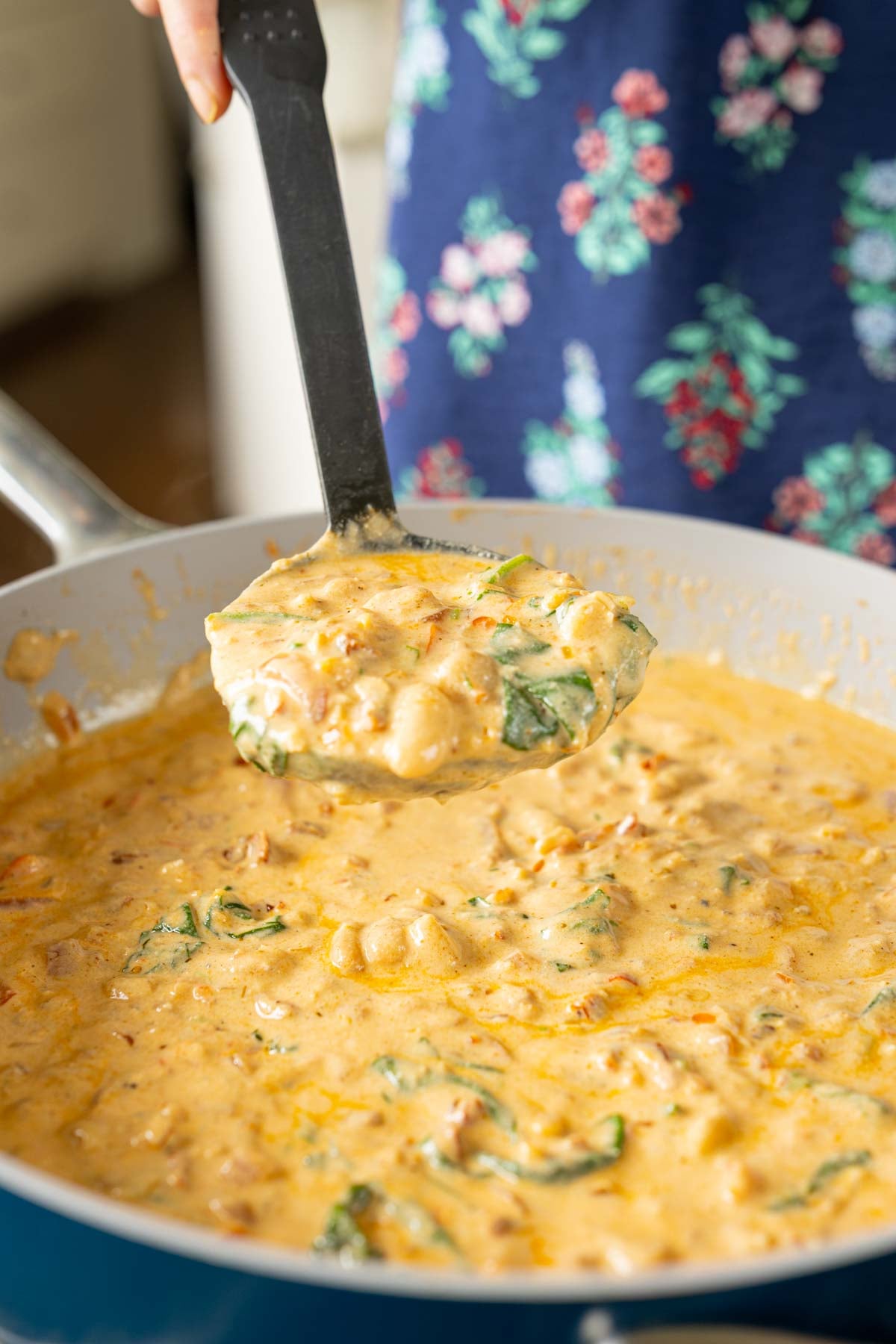
Now, fold in the greens and lemon juice. Simmer for about 1 minute, so that the greens start to wilt. Then switch off the heat. After adding the greens and lemon juice and tasting, adjust the consistency. Add more stock if needed for a thinner soup, or simmer for a bit longer for a thicker soup. This soup will continue to thicken as it cools, so don’t over-thicken it during cooking. Top with some vegan Parmesan and more red pepper flakes. Scoop or ladle it into bowls and enjoy.
Serve marry me soup with a side of some toasty bread, sourdough, garlic bread, a side salad, or over pasta. This soup is thick and delicious and will work with all of those.
You can also use other white beans such as Northern beans or navy beans, or use chickpeas. To amp up the protein, top it with some roasted chickpeas, tofu bacon bits, or chili lime tempeh. Marry me white bean soup is naturally gluten-free. To make this soy-free, use more cashews and hemp seeds. To make it nut-free, omit the cashews and use more tofu. You can also use 1 cup of cooked white beans to make the cream along with the hemp seeds and nutritional yeast instead of using the nuts and tofu. This makes the cream completely nut-free and soy-free. Storage: Leftovers will store really well in the fridge for up to 3 days. It is also freezer-friendly up to 6 months. Reheat in a skillet or microwave to serve.
Nutrition information is automatically calculated, so should only be used as an approximation.
Ingredients
blender cream sauce – This is a mixture of raw cashews, hemp seeds, tofu, nutritional yeast, and water or stock. You can replace the tofu with more cashews and hemp seeds for soy-free or replace the cashews with more tofu for nut-free. For soy-free and nut-free, use 1 cup cooked white beans instead of the cashews and tofu.
oil – To sauté. You can broth fry, if needed.
aromatics – Garlic, onion, and bell pepper add a ton of flavor to this marry me white bean soup!
dried spices – Oregano, Italian seasoning, crushed red pepper flakes, and smoked paprika give this soup an amazing, smoky, Italian-inspired flavor.
tomato paste – Adds so much umami and color to the soup!
sun-dried tomatoes – Ups the umami even more.
white beans – Use your favorite white beans, homemade or canned. Chickpeas will also work in this marry me soup.
baby greens – Baby kale, baby spinach, or a mix of the two add color and texture.
lemon juice – For tang.
garnishes – Top your marry me bean soup with vegan parmesan, more crushed pepper flakes, and fresh basil or parsley add freshness, heat, and more flavor!
Depending on your pan, the tomato paste can cook very quickly. If it’s getting too dry, add a splash of water. Same goes for when you are cooking the onions.
You can also use other white beans such as Northern beans or navy beans, or use chickpeas.
How to Make Marry Me Soup
In a blender, add the cashews, hemp seeds, nutritional yeast, tofu, and the water or stock. Blend for about 1 minute. Let the mixture sit for about 5 minutes, then blend again for another minute until the cashews are broken down and the mixture is really creamy.
Start a large saucepan or deep pan over medium heat, and add the olive oil. Once the oil is starting to get a little warm, add the garlic, red pepper flakes, smoked paprika, Italian herbs, and mix. Then, mix in the tomato paste and sun-dried tomatoes. Cook the mixture until the tomato paste starts to smell a bit fragrant.
Mix in the onion or shallots and 1/4 teaspoon of salt. Cook until the onion is starting to turn golden, about 7 to 8 minutes.
Halfway through cooking the onions, add the red bell pepper and continue to cook. If the pan is drying out, add a splash of water or some oil and continue cooking and mixing. Stir every 30 seconds or so in the beginning, so that the tomato paste, sun-dried tomatoes, and everything mixes into the onion really well. Then let it sit for a minute and stir again.
Once the onion is starting to turn golden, add the white beans and the blended-up cream. Rinse out the blender with 1 cup water or stock, and then add that to the pan. Mix in the remaining salt, and bring this mixture to a boil. The simmering will be about 6 to 8 minutes for the mixture to get nice and bubbly and creamy. Taste and adjust the flavor by adding more salt, more heat, or more herbs, if needed.
Now, fold in the greens and lemon juice. Simmer for about 1 minute, so that the greens start to wilt. Then switch off the heat. After adding the greens and lemon juice and tasting, adjust the consistency. Add more stock if needed for a thinner soup, or simmer for a bit longer for a thicker soup. This soup will continue to thicken as it cools, so don’t over-thicken it during cooking. Top with some vegan Parmesan and more red pepper flakes. Scoop or ladle it into bowls and enjoy.
What to Serve with Marry Me White Bean Soup
Serve marry me soup with a side of some toasty bread, sourdough, garlic bread, a side salad, or over pasta. This soup is thick and delicious and will work with all of those.
Frequently Asked Questions
Is this recipe allergy friendly?
Marry me white bean soup is naturally gluten-free. To make this soy-free, use more cashews and hemp seeds. To make it nut-free, omit the cashews and use more tofu. You can also use 1 cup of cooked white beans to make the cream along with the hemp seeds and nutritional yeast instead of using the nuts and tofu. This makes the cream completely nut-free and soy-free.
Is this make-ahead friendly?
Yes! This soup will store really well in the fridge for up to 3 days. It is also freezer-friendly up to 6 months. Reheat in a skillet or microwave to serve.
The following article was originally submitted in early June 2026, during the height of tick season, with the intention of introducing alpha-gal to Herbal Legacy readers through the author’s
personal experience. It was submitted prior to our recently published article on alpha-gal, but publication was delayed and its original seasonal context has since changed.
While the context has changed, the effects and challenges of living with alpha-gal extend well beyond tick season. The author’s personal experience offers
a distinct perspective that complements our recent discussion of the subject and may provide encouragement and insight to those navigating the restrictions that can accompany the condition.
If you haven’t heard of alpha-galactose allergy, I’m sure you will soon. With so many news stories and discussions centering around ticks and
tick-borne diseases, “alpha-gal syndrome” (short for the alpha-galactose allergy caused by tick bites) is becoming a common term in 2026.
I grew up in northern Wisconsin. Being bitten by ticks was just a normal part of the summer season. No one worried about tick-borne diseases. Just get the tick off and go about your business.
As a child, I do not recall anyone getting sick from tick bites. However by the time I was in high school and college, there was talk about Lyme disease and even crippling arthritis associated with some tick-borne infections.
Fast forward to 2019, I was bit by a tick and developed a large bulls-eye rash. I began experiencing
symptoms that I had never had before.
Quickly, I found that I could no longer tolerate products containing mammal derivatives. The change was not limited to food. I discovered that even gelatin capsules enveloping wholesome herbs were a problem. Eventually, an integrative ENT familiar with tick-related issues tested me for
alpha-galactose allergy. The test came back positive.
While reactions vary from person to person, alpha-gal syndrome can be serious and may even lead to anaphylaxis when mammal-derived ingredients are unknowingly consumed or otherwise introduced into the body. Because these ingredients can appear in more than food—including
supplements, pharmaceuticals and other medical products, some of which are injected—awareness becomes an important part of living safely.
Eating in restaurants became nearly impossible. Foods that one might have thought were vegan often contained hidden ingredients. Label scrutiny became a necessity. Yet packaged foods did
not always make mammal derivatives easy to identify and restaurants rarely shared full ingredient lists. Homemade food became the safest and healthiest choice.
For many people, an alpha-gal diagnosis can feel overwhelming when focusing on what they can no longer have. It is easy to concentrate on what has been lost.
However, rather than counting restrictions, try counting possibilities. There remains an abundance of nourishing foods that can support excellent health. Thankfully, I had a strong foundation from Dr. Christopher’s Mucusless Diet and had been eating nearly-vegan for many years. An alpha-gal diagnosis can become an opportunity to focus more intentionally on foods that build overall health beyond the allergy.
Focusing on the positive, fresh fruits, vegetables, nuts, seeds, legumes and whole (non-gluten) grains provide tremendous nourishment. Fresh vegan eating can be tasty & healthy. There are ways to prep the ingredients so it does not take hours to make each meal. By letting food be the primary medicine, it is amazing to notice how healthy someone can become
just by improving the diet.
This experience brought me back to the wisdom of Dr. Christopher. He taught the importance of cleansing and nourishing the body through wholesome foods. When food is eaten in its wholesome state, nature provides superior nutrition.
Herbalists may encounter more people living with alpha-gal syndrome in the years ahead. Along with helping them navigate ingredients, offering encouragement is equally important. Many individuals will be discouraged and focused on what they can no longer eat. We can help them see their opportunity to build health – by letting food be their medicine.
Alpha-gal syndrome presents challenges, but it also provides possibilities. With knowledge, planning and an appreciation for wholesome foods, people can more than exist, they can become ‘A Healthier You.’
Kellie (Kalili) Haszard holds a Bachelor of Arts degree and earned her Master’s of Herbology through the School of Natural Healing. She is currently completing advanced studies in iridology through Dr. Pesek’s International Institute of Iridology. Her passion is helping individuals and families improve their health through wholesome foods, herbal & natural healing education and personal responsibility.
Through her writing, teaching, organizing Plant & Seed Exchanges and supporting organic gardening and local food security efforts, she encourages others to discover how simple, time-tested principles can lead to lasting wellness.
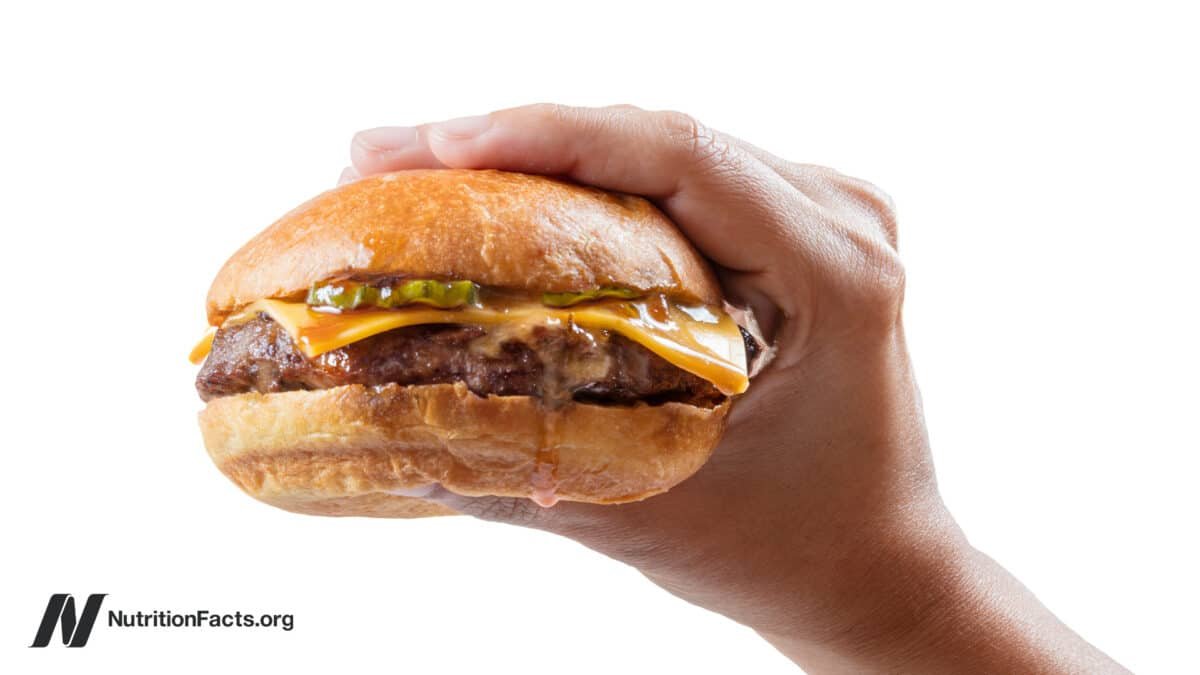
If you care about your health so much that it would be unthinkable to light up a cigarette before and after lunch, maybe you should order a bean burrito instead of a meaty one.
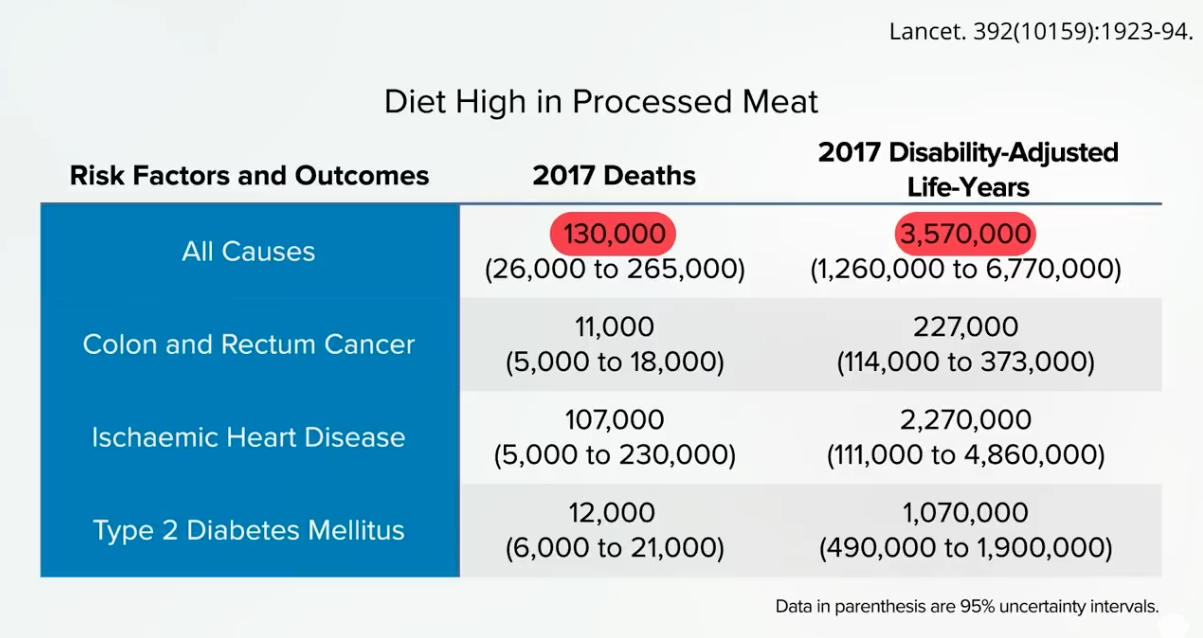
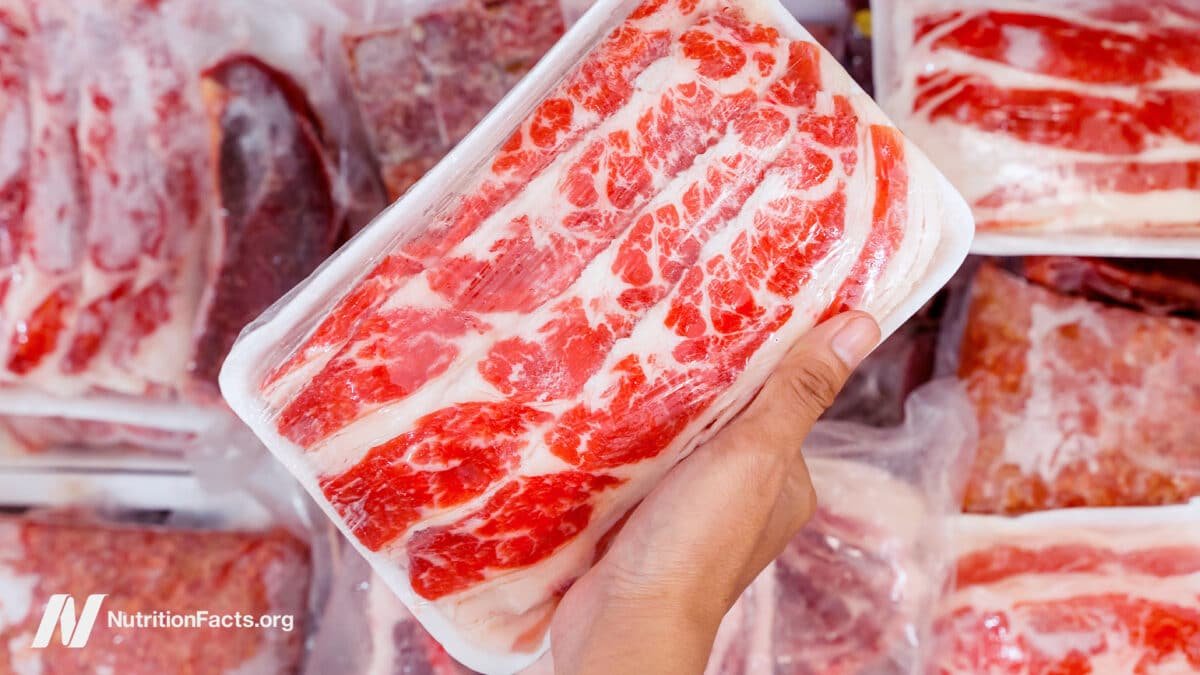
According to the Global Burden of Disease Study, diets high in processed meat, like bacon, ham, hot dogs, lunch meat, and sausage, may kill more than 100,000 people every year, due largely to heart disease, but also cancer and diabetes. This results in millions of healthy years of life lost every year around the world, as you can see below and at 0:29 in my video How Much Does Meat Affect Longevity?.
It doesn’t take much either. The Union of Concerned Scientists estimated that if Americans could cut down to just an ounce of processed meat a week, thousands of cancer deaths could be averted every year. But that’s on a population scale. How can we better understand our individual risk?
In the last few blogs, I’ve talked a lot about the NutriRECS meat papers published in the Annals of Internal Medicine. Though the panel discarded its own findings, analyses determined that a reduction in red and processed meat consumption is in fact associated with a 13% lower risk of premature death—and that’s using its own numbers. What does a 13% difference in mortality risk actually mean? To get a better handle on it, let me introduce the concept of microlives.
Acute risks, like skydiving or riding a motorbike, could result in an accident. A good way to compare such risks is with a unit known as a micromort, defined as a one-in-a-million chance of sudden death. (I made a really fascinating video about it.) “However many risks we take don’t kill you straight away: think of all the lifestyle frailties we get warned about, such as smoking, drinking, eating badly, not exercising, and so on. The microlife aims to make all these chronic risks comparable by showing how much life we lose on average when we’re exposed to them: a microlifeis30 minutes of your life expectancy.”
Why is that? Well, someone in their 20s—say a 22-year-old man or a 26-year-old woman—may have, on average, about 57 years of life left. That’s about 20,000 days, or 500,000 hours, or a million half hours. So, that’s how they define a microlife—a reduction of one of the million half hours we may have left. What would, on average, cost a 30-year-old man one microlife?
smoking two cigarettes
drinking two pints of strong beer
living every day 11 pounds (5 kg) overweight
See how helpful this can be in terms of comparing risks? So, drinking a pint of strong beer shortens your life expectancy as much as smoking one cigarette would. If it’s unthinkable to have so little respect for your own health that you’d light up twice a day, maybe one cigarette in the morning and one at night, then it should be just as unthinkable to be 11 pounds overweight.
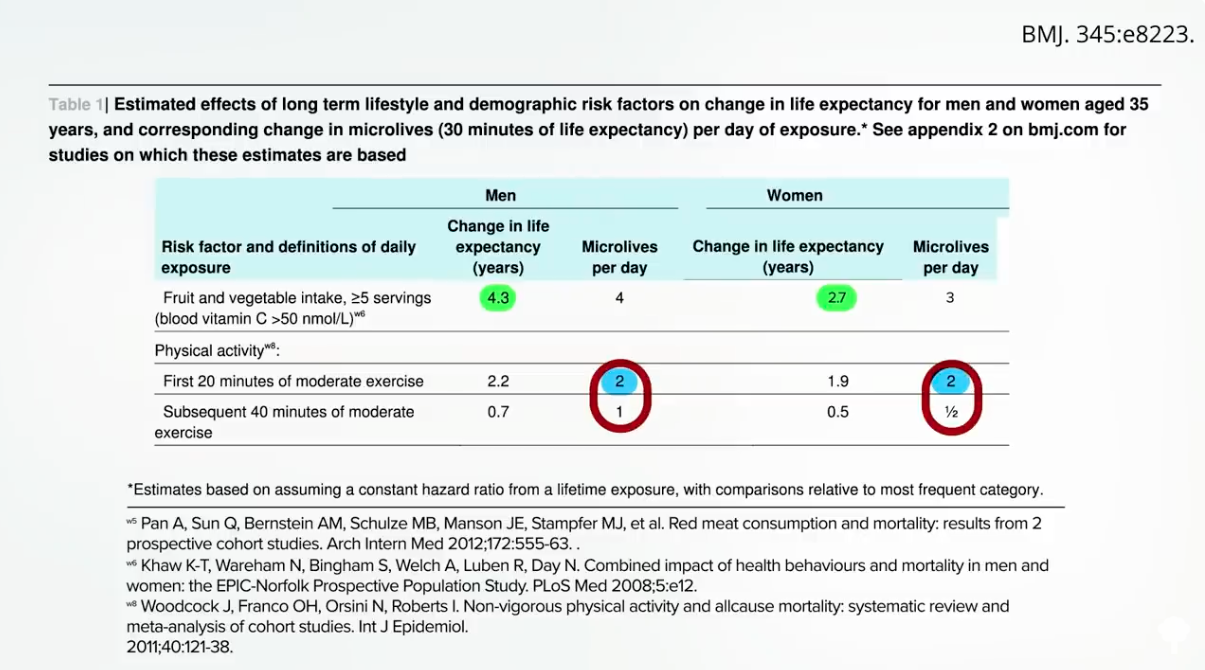
Alternatively, you can compare life-extending behaviors. For example, eating at least five servings of fruits and vegetables a day may add an average of four years onto your lifespan for men and three years for women. That’s up to twice as beneficial as exercising every day. But guess what—exercise for 20 minutes, and the payoff is an extra hour of life (two microlives). So, for everyone who says they don’t have time to exercise, it’s like a 3-to-1 return on investment! Give 20 minutes of your life to get 60 minutes of life. Beyond that, there’s a bit of diminishing returns, but exercise an hour a day and get back more time than you put in, as you can see below and at 3:45 in my video.
So, what about meat? Each burger is associated with the loss of one microlife; it’s as if each burger were taking 30 minutes off your life. So, in terms of your lifespan, one burger appears to equal two cigarettes. If lighting up at lunch seems unimaginable, maybe a bean burrito is a better choice.
Processed meat is even worse. Here are a few ways to put it into perspective:
Imagine two people who are completely identical except in one way: One person eats about 50 grams of processed meat a day (roughly one large sausage or a few strips of bacon), and the other eats none. Eating that single serving of processed meat every day is expected to take about two years off the length of that first person’s life. That’s two fewer years with loved ones, grandkids, or a spouse, and two more years of being mourned.
Or think about it on a day-to-day basis. Eating a bologna or ham sandwich every day—just two slices of deli meat—is expected to take about an hour off life each day. If there never seem to be enough hours in the day, you may effectively have one less depending on what you pack for lunch.
Another way to think about it is in terms of “effective age.” Eating 50 grams of processed meat a day is expected to add about two years to a person’s “effective age,” meaning the annual risk of death is similar to that of someone two years older.
In summary, wrote the chair of nutrition at Harvard and his colleagues, the NutriRECS meat recommendations “suffer from important methodological limitations and involve misinterpretations of nutritional evidence. To improve human and planetary health [as a side bonus], dietary guidelines should continue to emphasize dietary patterns low in red and processed meats and high in minimally processed plant foods such as fruits and vegetables, whole grains, nuts, and legumes,” that is, beans, split peas, chickpeas, and lentils.
Let me end with a quote from Dr. Dean Ornish about the Annals of Internal Medicine meat papers that suggested people should continue to eat meat with abandon. His Lifestyle Heart Trial was one of the many studies the meat panel ignored. It showed that a plant-based diet and lifestyle program could reverse the progression of even severe coronary heart disease, a top killer of men and women. The control group actually made modest reductions in meat similar to those in the Annals review and showed continued worsening of their atherosclerosis. “I take solace,” Ornish said, “in knowing that the light drives out the darkness. But, these days, the light has to be very bright indeed. Caveat emptor. Don’t be fooled. Your life may depend on it.”
Doctor’s Note
If this concept of comparing different risks is interesting to you, I think you’ll love my micromorts video: Micromorts: How Risky Is It to Go Under Anesthesia?.
This is the final blog in an eight-part series on how industries impact dietary and health guidelines. If you missed any of the others, see the related posts below.
I have a number of videos on longevity, including this popular one: How to Increase Your Life Expectancy 12 to 14 Years.
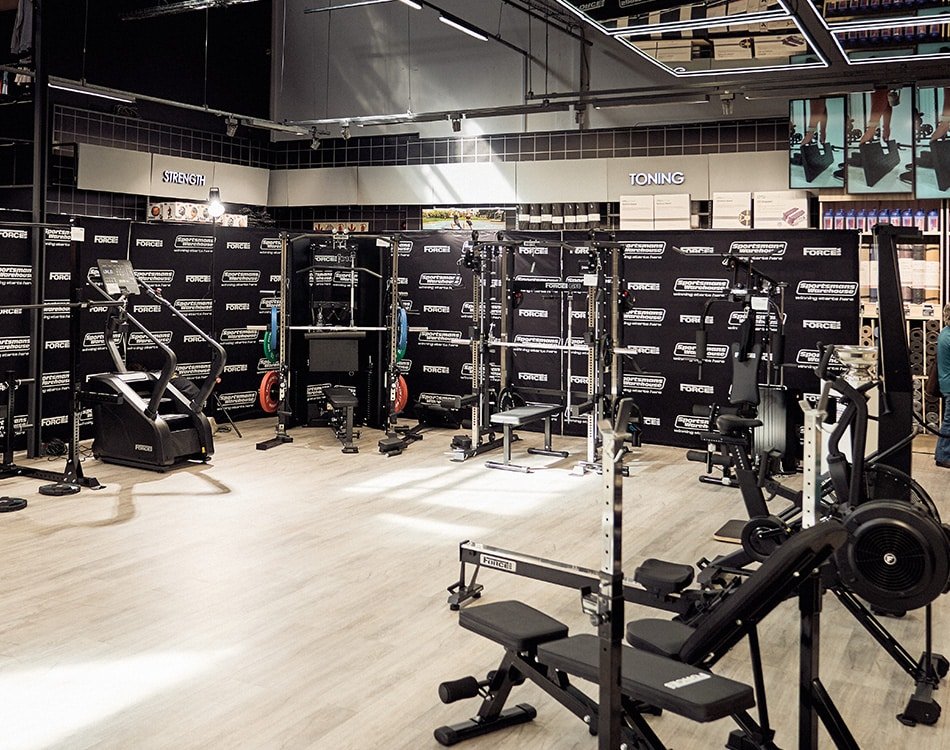
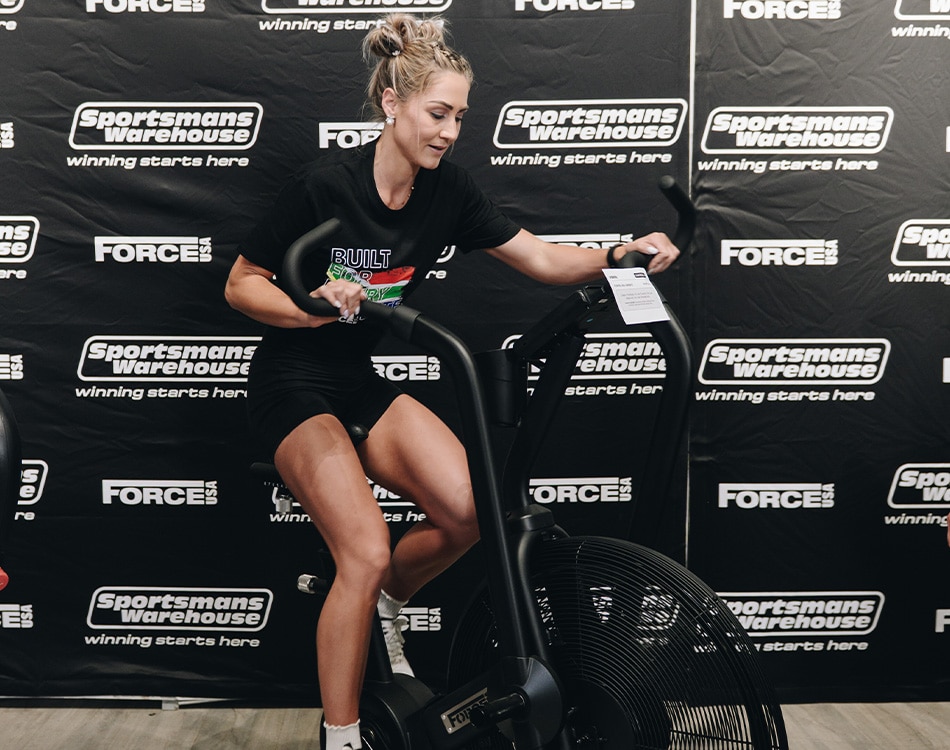
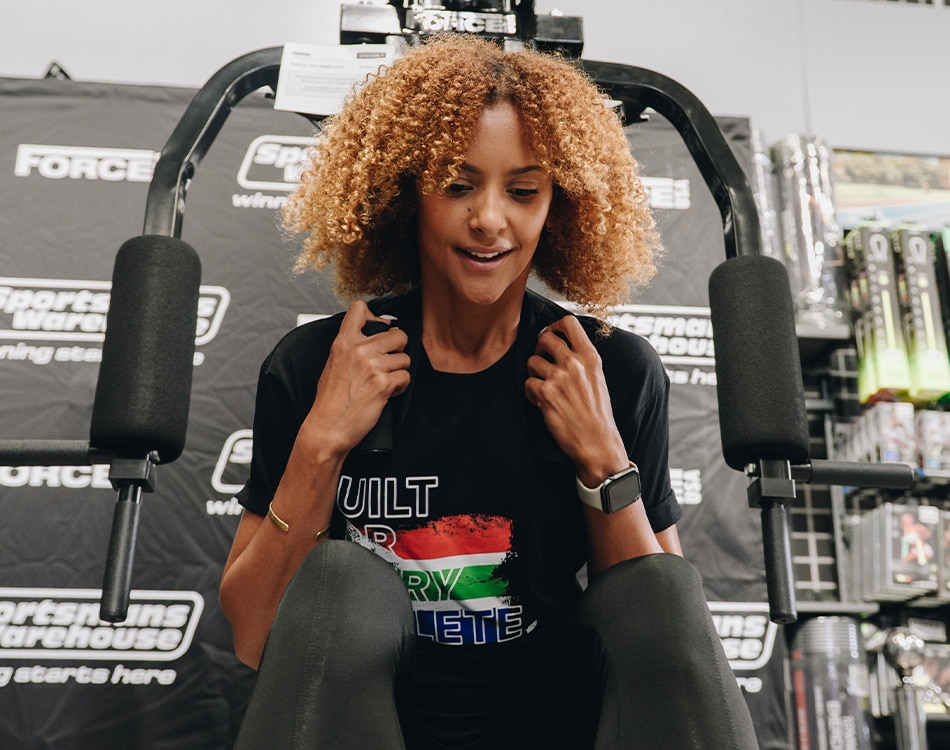
Force USA, a fitness brand built around making serious training more accessible without the need for a commercial gym budget or footprint, has officially launched in Sportsmans Warehouse nationwide.
The global fitness brand brings its All-In-One trainers and wider strength, cardio and conditioning range to South Africa, giving consumers more options for training at home.
Making Training Equipment Accessible
Founded on the belief that effective training equipment should deliver more without taking up unnecessary space, Force USA created the All-In-One training category, bringing multiple training functions together in a single system.
The approach allows users to build more complete training setups without the need for multiple machines or a large dedicated training space.
The launch marks a new retail partnership between Force USA and Sportsmans Warehouse, bringing the global fitness brand into the retailer’s offering for the first time. The partnership gives South African consumers a new way to access Force USA’s range and experience its approach to flexible, performance-led training.
“For years, people in South Africa who wanted commercial-grade training results to have had to choose between a full gym membership or settling for entry-level home equipment,” says Simon Heinrich, International Sales Manager at Force USA.
“Force USA closes that gap. Our All-In-One trainers give people the depth of a fully equipped gym in a fraction of the space, and launching with Sportsman’s Warehouse means South Africans can finally access that experience at home.”
Built Around the All-In-One Trainer
Two products anchor the South African launch and demonstrate what sets Force USA apart: the C10 All-In-One Trainer & Sliding Bench and G3 All-In-One Trainer.
The C10 features a patent-pending central cable system, six pulley stations and dual 200-degree adjustable upright pulleys, together with the C10 Sliding Bench. Designed to offer a well-rounded training experience in one setup, it brings a broad range of training options to a compact footprint.
The G3 All-In-One Trainer combines a Smith Machine, Functional Trainer, Power Rack, Core Trainer and Multi-Grip Chin-Up Station, with optional upgrade kits available.
Together, the C10 and G3 demonstrate Force USA’s approach to bringing multiple training capabilities into a single system.
The Wider Range: Strength, Cardio and Conditioning
Beyond its All-In-One trainers, Force USA’s wider range covers strength, cardio and conditioning, offering equipment for different training goals.
Strength: The Force USA range includes versatile equipment designed to support a variety of strength-training needs, including the C10 Functional Trainer, G3 All-In-One Trainer and Compact Leg Press & Hack Squat.
Cardio and conditioning: The range also includes equipment such as the Stepper, designed for high-intensity cardiovascular conditioning, alongside other cardio and conditioning solutions for a complete training setup.
“The arrival of Force USA marks an exciting new addition to the Sportsmans Warehouse offering.” says Nicole Schumann, Marketing Manager at Sportsmans Warehouse.
“We’re proud to bring the brand into our fitness range, giving our customers access to quality home gym equipment for those who want more from their training. With a focus on quality, versatility and performance, Force USA offers equipment designed to help take home training to the next level.”
From building strength and improving conditioning to creating a more complete training setup, the range offers solutions for taking training further, without requiring a commercial gym environment.
The Force USA collection is now available to explore at Sportsmans Warehouse nationwide, in stores and online, giving consumers the opportunity to find equipment suited to their individual training goals.
Author: Pedro van Gaalen
When he’s not writing about sport or health and fitness, Pedro is probably out training for his next marathon or ultra-marathon. He’s worked as a fitness professional and as a marketing and comms expert. He now combines his passions in his role as managing editor at Fitness magazine.
Big Meat downplays the magnitude of meat mortality.
A series of studies published in the Annals of Internal Medicine found a statistically significant association between lower consumption of red and processed meats and lower total mortality (meaning living a longer life), lower cardiovascular disease mortality, as well as lower risk of dying from cancer—across the board. Yet, remarkably, the authors of these studies concluded that people should ignore all the other dietary guidelines and keep eating meat to their heart’s content (or rather discontent).
They offered three reasons why their panel reached a conclusion at odds with other contemporary dietary guidelines that advise people to cut down on meat. One reason is taste. In short, people who enjoy eating meat, enjoy eating meat. I talked about this in my last blog, but in short, taste preference probably should not be a major factor in developing dietary guidelines. Many people don’t want to exercise more or stop smoking or drinking, but that doesn’t change the science; it shouldn’t change the public health recommendations.
A second reason they explain why their recommendations differ from everyone else’s is that other guidelines didn’t use the so-called GRADE (Grading of Recommendations, Assessment, Development, and Evaluation) approach, and no wonder, since GRADE was largely created to evaluate evidence from drug trials. There are grading systems for dietary and lifestyle approaches, but the meat panel chose to inappropriately apply GRADE, which similarly “could be misused to undermine recommendations about secondhand smoke, air pollution, trans fats, or physical inactivity”—you name it. I have three blogs delving deep into all that, but this blog is about the third reason they give for ignoring meat reduction advice: Other guidelines didn’t highlight the “very small magnitude” of the effects of meat consumption. In other words, even if meat does cause heart disease, cancer, diabetes, and death, it doesn’t cause that many heart attacks, doesn’t kill that many people, doesn’t cause that much cancer to offset all those taste benefits.
Of course, it matters what people replace the meat with. Replacing even 3% of calories from animal protein with plant protein is linked to living longer. Eggs appear to be the worst. Yes, replacing red meat protein with plant protein sources may lower overall mortality by more than 10%, but eliminating egg protein could mean more than 20% lower risk of premature death. So, if someone reduces meat consumption by replacing a burger with an egg salad sandwich, that particular reduction in meat could mean more mortality.
But maybe the meat panel researchers concluded there was such a small effect only because “major bodies of evidence were omitted, [and] relevant studies excluded because the authors didn’t like the results.” It’s not that there aren’t tons of randomized controlled trials about meat; it’s just that they appeared to cherry-pick a few to fit their agenda, discarded studies that even met their own criteria, and wrongly rejected randomized controlled trials clearly showing that meat increased risk factors like cholesterol or blood pressure. Why wasn’t the PREDIMED trial included? What about the hundreds of randomized trials on the DASH diet?
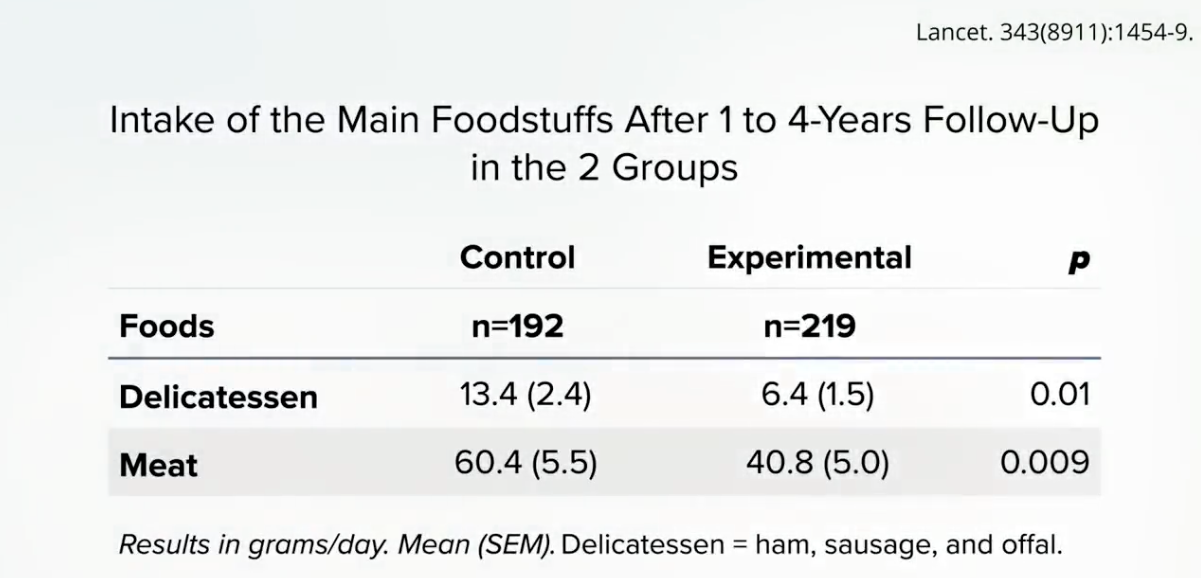
What about the Lyon Diet Heart Study? It involved randomizing people to a more Mediterranean diet that included a significant drop in meat consumption, as you can see below and at 3:32 in my video How Big Meat Manipulated the Science.
Compared to the control group, those on the lower-meat diet experienced a 70% reduction in mortality from all causes put together. Why did the meat panel exclude that study? They excluded it because, in their words, it reported “an implausibly large treatment effect.” In other words, it worked too well.
That’s no surprise, given that this so-called NutriRECS meat panel was partnered with—and had multiple people on the payroll of—Texas A&M AgriLife, which receives millions of dollars of meat industry money every year. So, it’s probably not shocking to find out that they also excluded research that compared health outcomes of vegetarians to meat eaters. As they described it, they were interested in “realistic decreases in meat consumption,” like cutting out three servings a week. In fact, the study that they mostly relied on, the Women’s Health Initiative, achieved only a difference of 1.4 servings of meat per week. That amounts to a difference in meat consumption of just half an ounce each day—about a fifth of a hamburger.
“Participants in the Women’s Health Initiative reduced meat intake only modestly, resulting in a modest reduction in mortality related to breast cancer. This finding in no way supports the notion that there is ‘No need to reduce red or processed meat consumption for good health.’ Rather, it shows that modest dietary changes yield modest benefits. As an analogy, if studies showed that modest reductions in tobacco use yielded only modest health benefits, it would be inaccurate and dangerous to suggest that there is ‘No need to reduce tobacco use for good health.’”
“To say that small increases in meat consumption only cause small increases in the risk of disease doesn’t mean that eating meat is good for you,” said Dr. Dean Ornish. “That’s like saying that smoking 24 cigarettes a day increases your risk of lung cancer only a little more than smoking 20 cigarettes a day”—and being careful not to include any studies that compared smoking 24 cigs to smoking none—“and then erroneously concluding that smoking isn’t that bad for your health.”
Despite ignoring and excluding evidence, the meat panel “nonetheless found entirely consistent, clinically meaningful, statistically significant adverse effects of eating more meat and processed meat on all-cause mortality, on cardiovascular disease, on cancer, and on diabetes. That they did so despite the obstacles they put on the path to this finding is nearly incredible, and directly bespeaks the magnitude of adverse effects of meat and processed meat intake on health.”
Based on their meta-analyses of large cohorts, dietary patterns with just a moderate reduction in the consumption of red and processed meats were associated with lower total mortality by 13%, lower cardiovascular disease mortality by 14%, lower cancer mortality by 11%, and a 24% reduced risk of type 2 diabetes. We spend tens of billions of dollars a year trying to tweak risk factors by about this magnitude. And this one intervention—a reduction in meat consumption—appears to do all those things at the same time. There are statin drugs that can reduce heart disease risk, but they actually increase risk for type 2 diabetes and have little effect on cancer. If there was a drug that did as much for your health, it would be a multi-billion-dollar blockbuster.
The chair of nutrition at Harvard estimates that moderately reducing red meat consumption could prevent 200,000 deaths each year. Now, the meat panel can call that a very small effect if they want to, but I imagine it’s no small effect to those 200,000 families.
The numbers are on par with the amount of cancer and heart disease attributable to secondhand smoke and based on the same kind of studies—population studies. (They didn’t randomize people to sit in smoky rooms all day for a couple years.) But no rational person who looks at the public health data around the effectiveness of smoke-free zones would argue that people should continue exposing themselves to secondhand smoke; so, why do the same for red meat and processed meats?
The smoking analogy is actually a good one. “[I]magine researchers select studies with extremely small between-group differences in the number of cigarettes smoked per week. They avoid any studies that actually compare smoking to non-smoking [i.e., meat-eating to vegetarian]. They find that despite the small differences in exposure, there is still a clear and consistent benefit of smoking less. They then apply methods of grading the evidence that strongly favor randomized trials over all other methods. Since there are few if any randomized trials of smoking, they conclude that they have very low confidence in the reliability of their own findings. On that basis, they publish guidelines recommending—that the public simply continue to smoke. After all, they reason, people who smoke like smoking.” That really does sum up the Annals of Internal Medicine papers in a nutshell.
That reminds me of a quote from a famous paper published in 1959, compiling all the most poignant evidence linking smoking and lung cancer, after coming up against those same charges of inadequate proof. This quote could just as well have been written about the state of science on meat today. If the mountain of evidence they found “had been made on a new agent, to which hundreds of millions of adults were not already addicted, and on one which did not support a large industry, skilled in the arts of mass persuasion, the evidence for the hazardous nature of the agent would be generally regarded as beyond dispute.”
Doctor’s Note
See this video for more on How Smoking in 1959 Is Like Eating in 2019.
This is the seventh in an eight-part series on how industries impact dietary and health guidelines. The first six parts are in the related posts below.
The final blog, coming up, is How Many Minutes of Life Does a Burger Cost?.
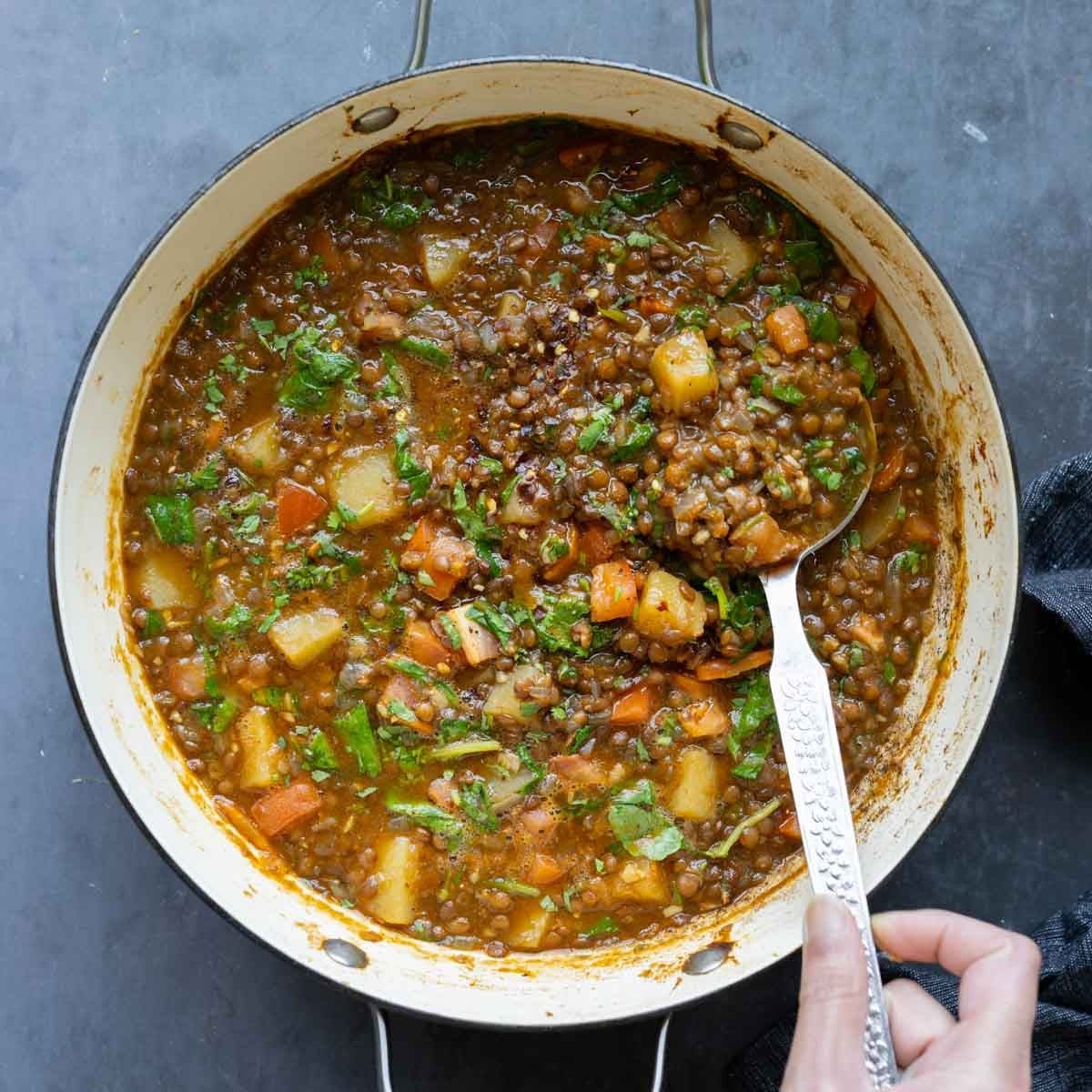
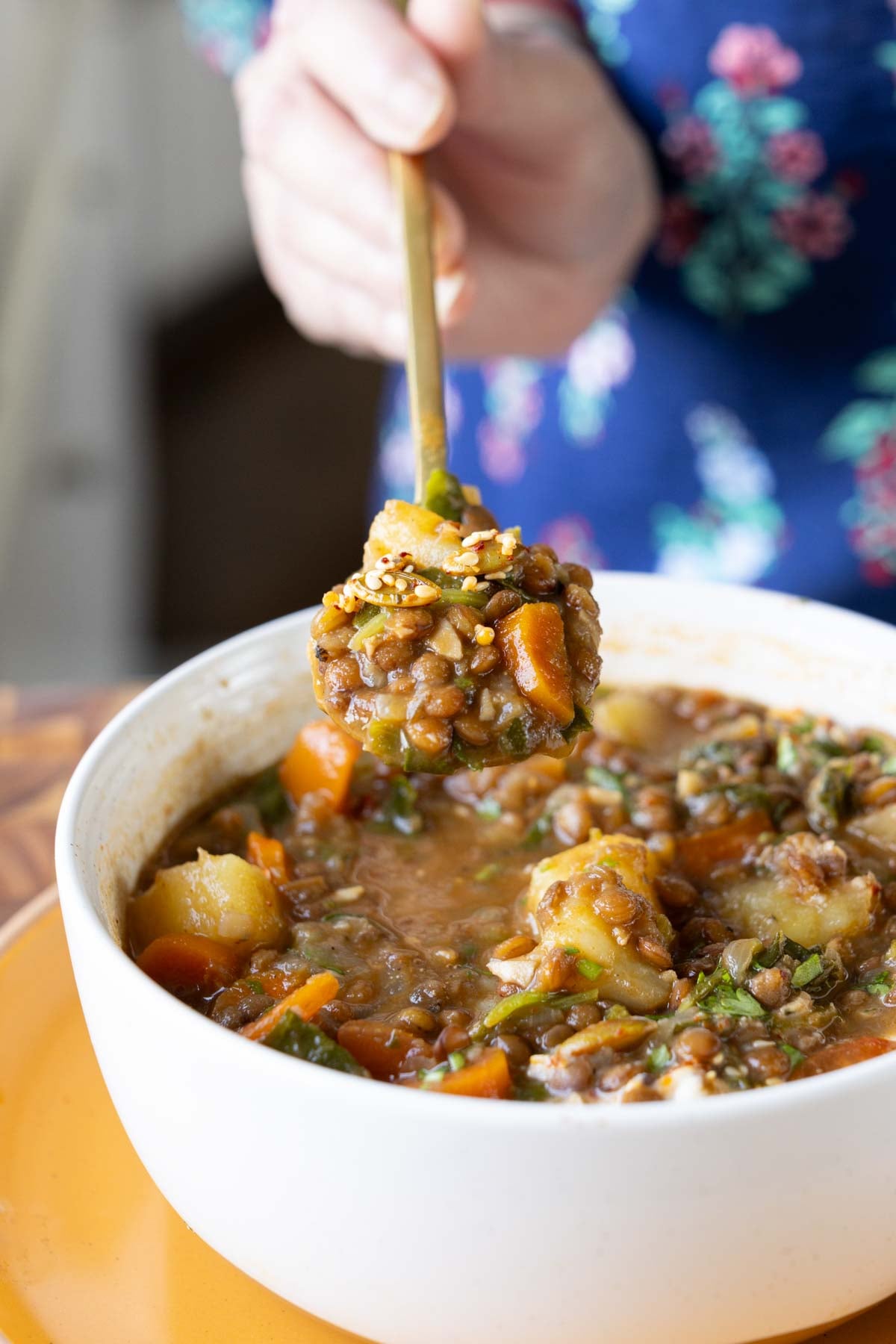
I’ve made plenty of lentil soups, but this lentil potato soup is the one I keep coming back to. It always wins on flavor and nutrition, and I’ll tell you the simple techniques that make it unbelievably flavorful every time. Each serve packs 20g Protein 14g Fiber (gluten-free, soy-free, nut-free)
This pot of lentil potato soup, including the toasted seed topping, has 75+ grams of protein, 56 grams of fiber, 24 milligrams of iron, about 700 milligrams of magnesium, 12 milligrams of zinc, plenty of omega fats, and lots of vitamins A and C, along with calcium.
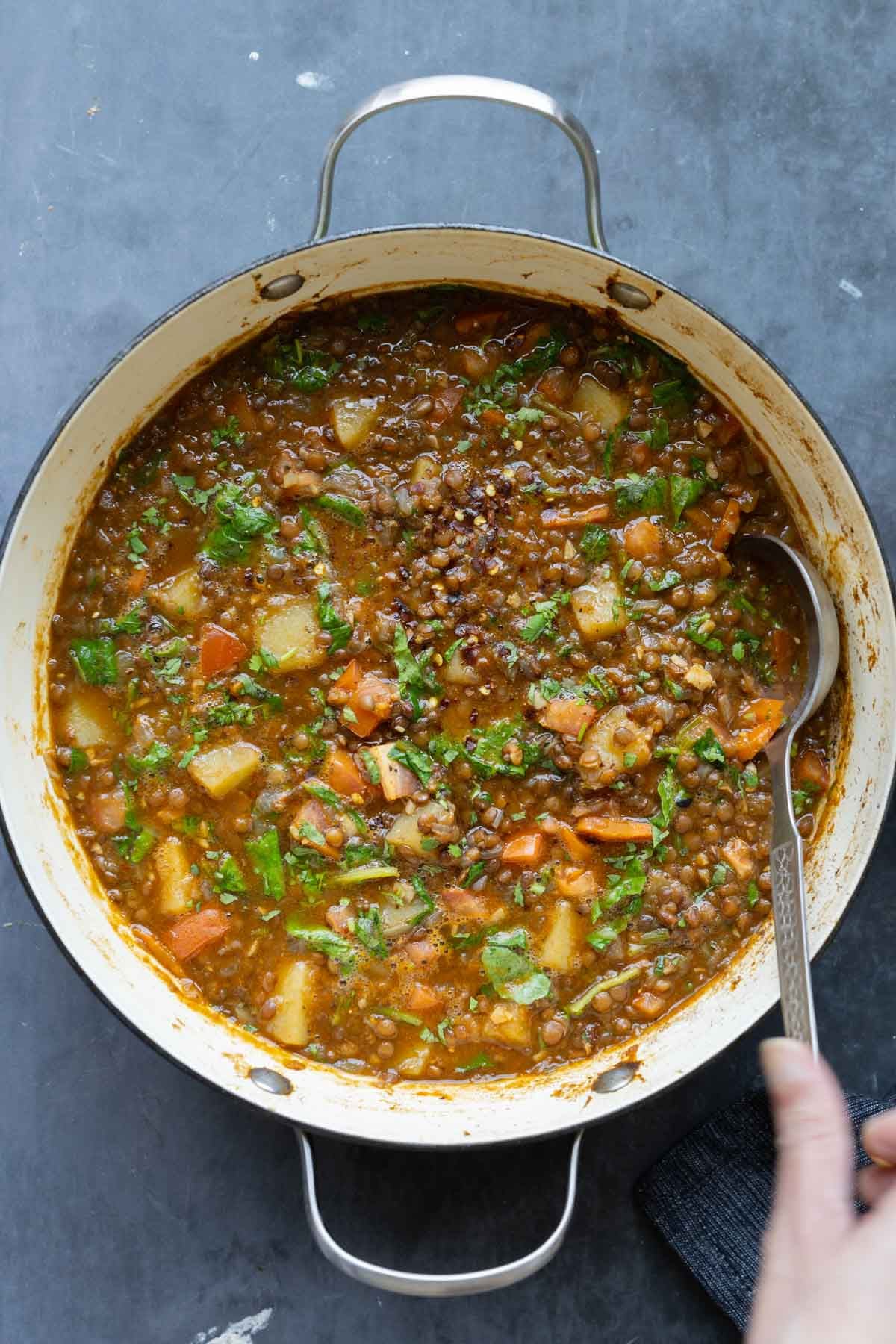
This lentil soup has so much flavor from the way we build up the flavor profile and spices. It is hearty with plenty of veggies and kale, and then we level it up with a toasty seed topping that not only adds amazing texture but also boosts the nutrient profile of the soup.
The lentils bring protein, fiber, iron, and folate. Kale adds vitamins K, C, and A, along with calcium. Pumpkin seeds, hemp seeds, and sesame seeds bring magnesium, zinc, calcium, omegas, and even more protein. The potatoes add vitamin B6 and potassium, while the carrots contribute beta-carotene. This lentil soup is truly a powerhouse of nutrients.
To level up this lentil potato soup, we first toast the garlic in the oil. Toasting the garlic releases its flavor into the oil, and then we add the onion. The onion stops the garlic from continuing to cook, so you get perfectly golden garlic without burning it. Next, we toast the tomato paste with the onion. This caramelizes the tomato paste and builds even more umami into the soup.
After that, we build layers of flavor with herbs and spices. I use oregano, but basil or thyme work just as well.
Then, I make a quick harissa-style spice blend with ground coriander, cumin, onion powder, and smoked paprika. You can also use a prepared harissa blend, sumac, shawarma spice blend, baharat, curry powder, or Cajun seasoning. All of these work wonderfully here. I also add black pepper to deepen the flavor and add a gentle heat.
These layers of herbs and spices create an incredibly flavorful broth for the lentils and potatoes to cook in.
The potatoes are added midway through cooking, so they become perfectly tender while still holding their shape. They soak up all of the delicious broth without falling apart. If you prefer a thicker soup, you can add the potatoes at the beginning, so they break down into the broth.
Toward the end of cooking, we stir in plenty of kale to make the soup even more nutrient-dense.
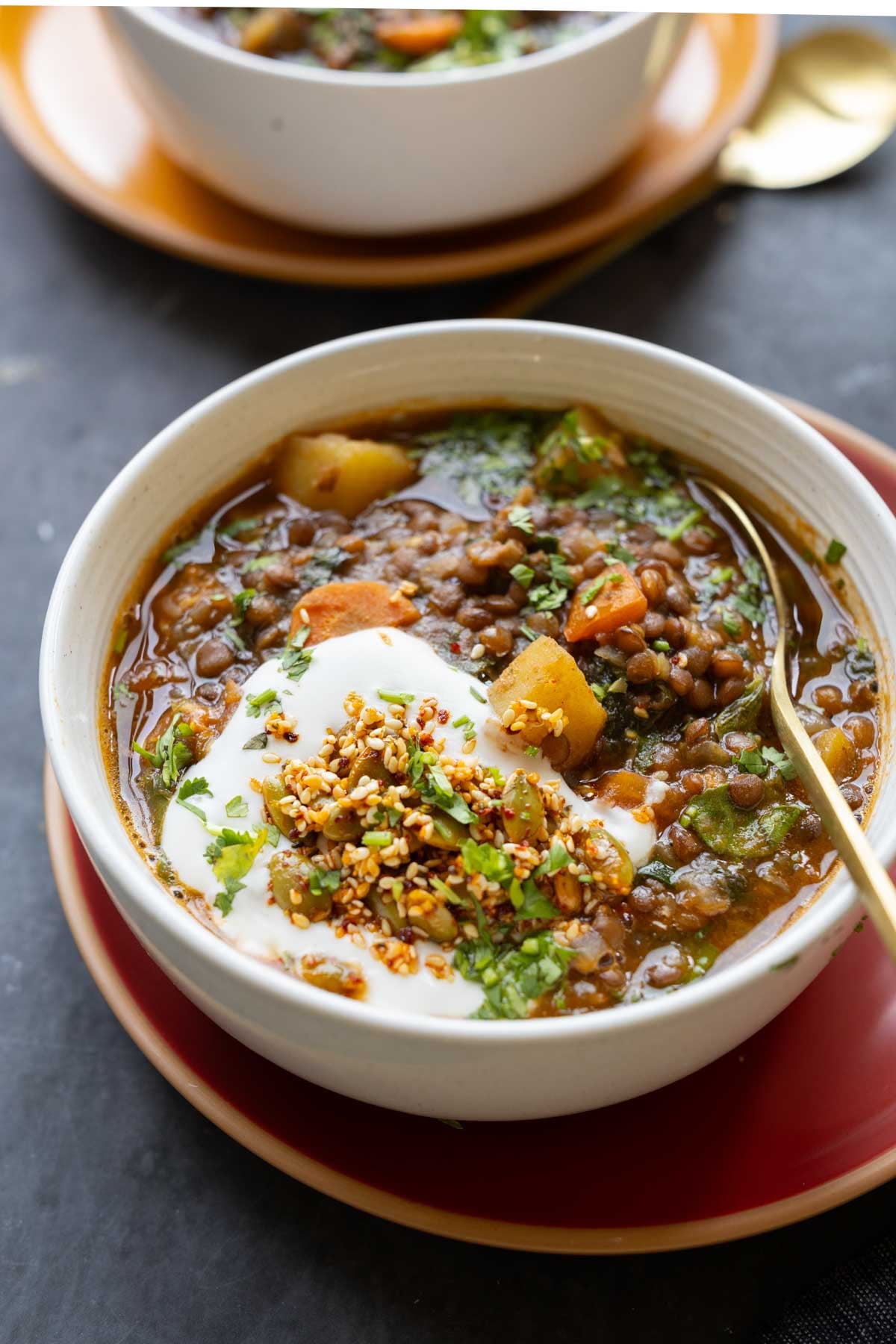
Finally, we make a quick toasted seed topping with pumpkin seeds, hemp seeds, and sesame seeds. The seeds are toasted with lemon zest, which adds a bright, zesty flavor that pairs beautifully with their nutty richness. We finish the topping with Aleppo pepper flakes for a smoky, gentle heat. If you don’t have all three kinds of seeds, use one or two instead, but definitely make the topping. It adds incredible texture and flavor to every bowl of this lentil potato soup!
Why You’ll Love Lentil Potato Soup
nutrient-packed pot of soup with tons of amazing flavor
easy to make with simple ingredients
versatile! Use different spice blends and additions to change the flavor profile to preference.
crunchy seed topping adds even more flavor, an incredible texture and nutrient boost
naturally gluten-free, soy-free, and nut-free
For the Lentil Potato Soup
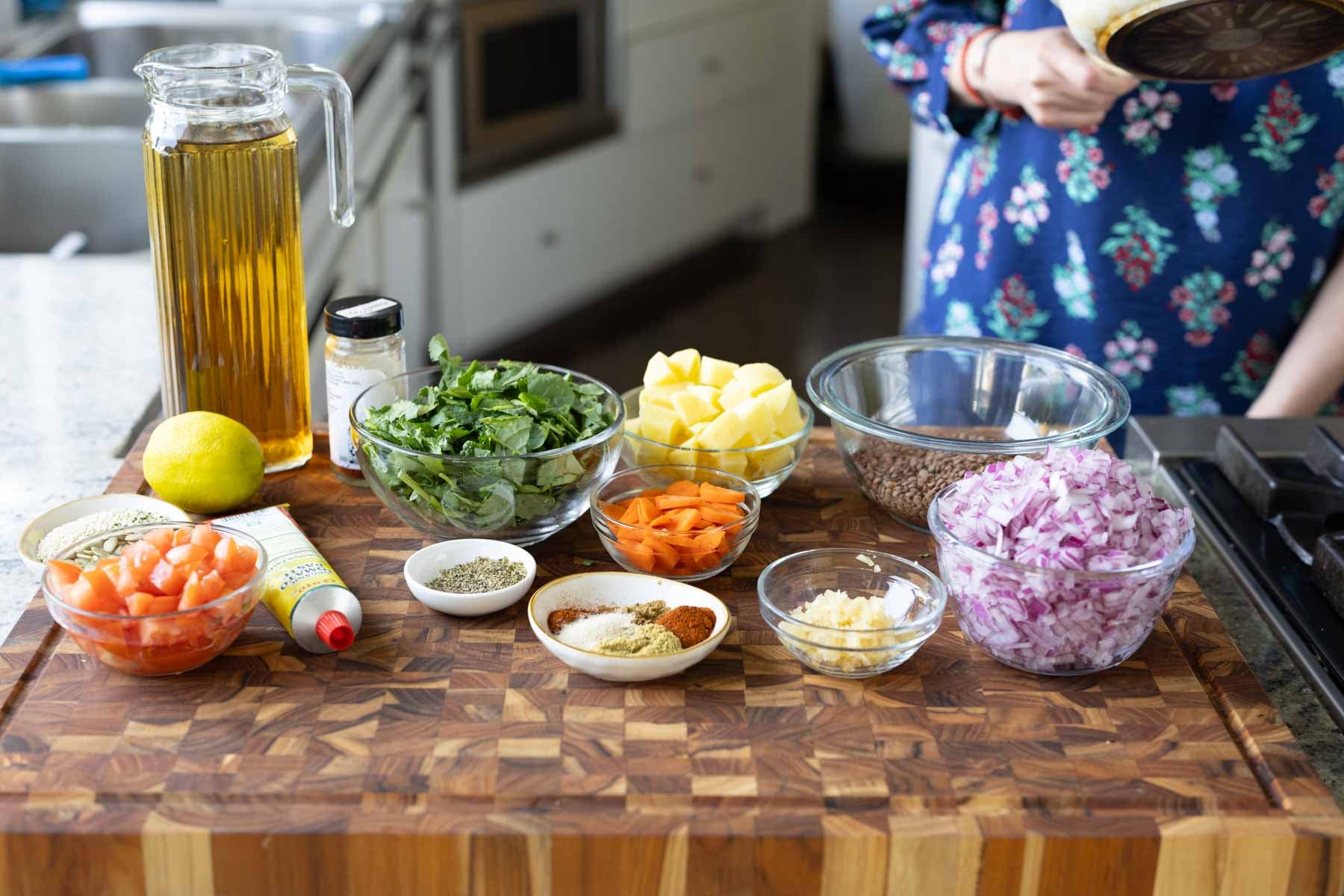
2teaspoonsoil
5clovesgarlic, minced or finely chopped
1 1/2cupschopped onion, red or yellow
3/4teaspoonsalt, divided
1cupchopped carrots, chopped into thin half moons
1tablespoontomato paste
1teaspoondried oregano
2teaspoonsspice blend,, such as harissa, shawarma, sumac, or a combination (see notes for my quick harissa blend)
1/2teaspoonblack pepper, or cayenne, or both
6cupsvegetable stock
1cupdried lentils, picked through for debris, washed well, and drained. I use brown, green will work too
1cuppeeled and cubed potatoes, or more, to taste
1cupchopped tomatoes
2 to 3cupschopped baby kale, spinach, or a mix
1tablespoonlemon juice, or more, to taste
For the Toasted Seed Topping
Prevent your screen from going dark
Make the soup.
Wash the lentils if you haven’t already, then drain them and set them aside.
Heat a large pot over medium heat, and add the oil. Once the oil is hot, reduce the heat to low and add the garlic. Cook until the garlic is just starting to turn golden.
Increase the heat to medium, and mix in the onion, carrots, and 1/4 teaspoon salt. Cook until the onion starts to turn golden on some of the edges. 5-7 minutes. Add the tomato paste and cook until it becomes more fragrant. Add the oregano, spice blend, and black pepper, and stir to coat everything evenly. Pour in the vegetable stock, and mix well. Add the drained lentils along with another 1/4 teaspoon salt, and mix well. Bring the soup to a boil, then partially cover, reduce the heat to just below medium, and cook for 15 to 20 minutes.
Add the potatoes, partially cover and continue cooking until both the lentils and potatoes are cooked to preference. 15-20 minutes
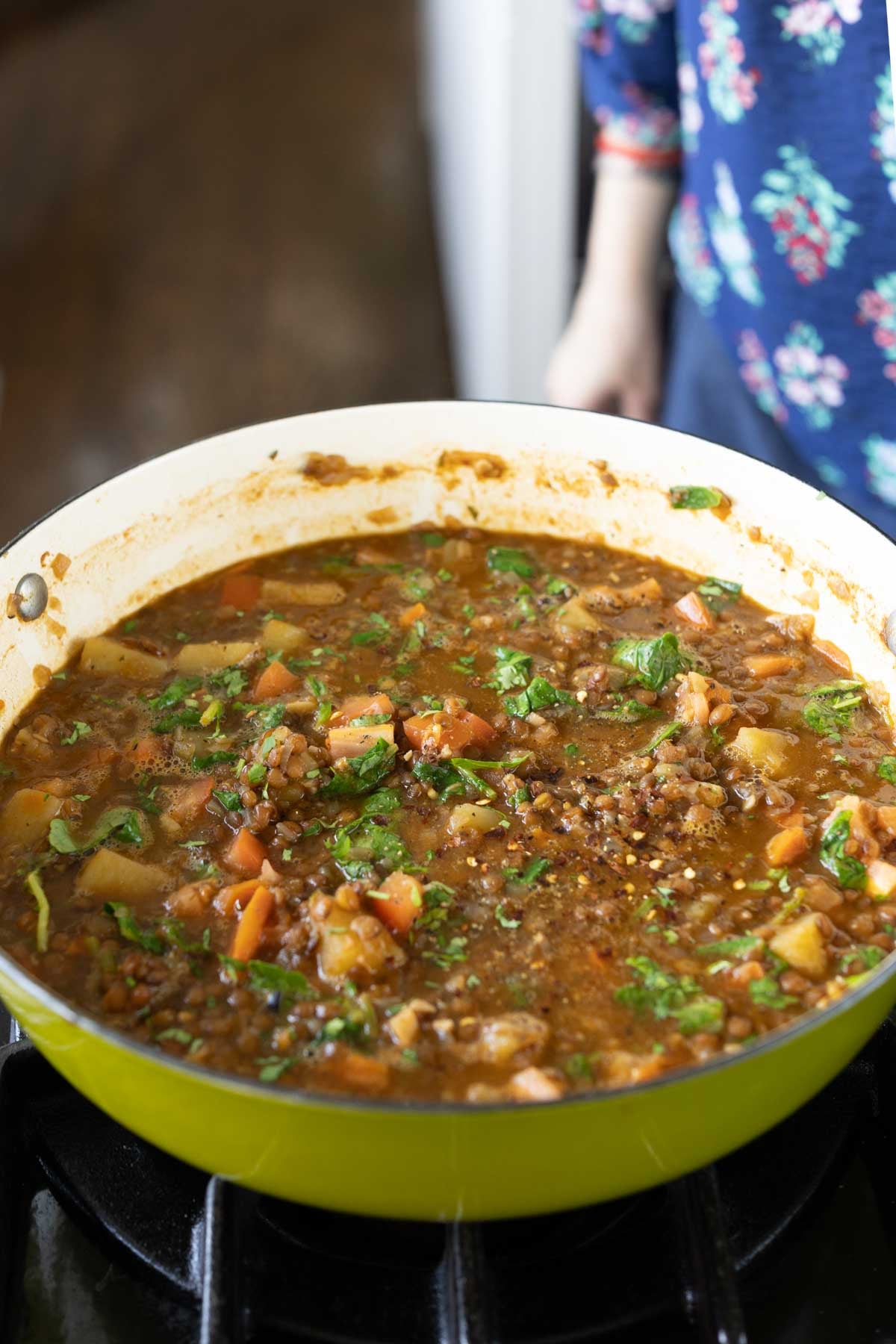
Once the lentils are cooked to preference, add the tomatoes, kale, and lemon juice. Mix well and cook until the kale or spinach start to change color a little bit. 2-4 minutes. Taste and adjust the flavor. Add more salt, more spices, more heat, or additional lemon juice, if needed. You can also add in 1 tablespoon balsamic vinegar and/or 1 tablespoon nutritional yeast for more flavor, if you like. Mix well, then switch off the heat.
Meanwhile, make the toasted seed topping.
Heat a small skillet over medium heat. Add the oil. Once hot, add the pumpkin seeds, hemp seeds, and sesame seeds. Reduce the heat to medium-low and toast until the seeds are fragrant, lightly golden, and the pumpkin seeds might begin to pop a little bit. Switch off the heat, then stir in the Aleppo pepper flakes and lemon zest.
Serve generous bowls of the lentil potato soup topped with non-dairy yogurt, fresh herbs, and plenty of the toasted seed topping.
You don’t want to add all of the salt and the tomatoes when you first add the lentils, as both can increase the lentils’ cooking time. Quick harissa spice blend: 2 teaspoons ground coriander, 1 teaspoon ground cumin, 1 teaspoon onion powder (or a mix of onion and garlic powder), 1 teaspoon smoked paprika. 1/4 to 1/2 teaspoon cayenne (optional, for heat). Mix together, and use as directed in the recipe. Use curry powder, Cajun, baharat, Garam masala or other blends for variation Lentil potato soup is naturally gluten-free, soy-free, and nut-free as long as your non-dairy yogurt is soy-free and nut-free.
Nutrition information is automatically calculated, so should only be used as an approximation.
Ingredients
aromatics – Sautéed garlic and onions are the first layer of flavor in this soup.
veggies – Carrots, potatoes, tomatoes, and baby kale or spinach add tons of nutrients, texture, and flavor.
tomato paste – This deepens the flavor, especially after we toast it in the pan.
ground spices – Oregano and black pepper are a must for this soup! You are also adding a spice blend of choice, such as harissa, shawarma, sumac, or a combination of these. We are adding Aleppo pepper flakes to the toasted seed topping for even more flavor.
vegetable stock – For flavor and moisture.
lemon juice – Adds some tang.
seeds – For the topping, we are using a mix of pumpkin seeds, hemp seeds, and sesame seeds. If you don’t have all three of these, choose two to use instead, and increase the amounts of those two to make up for it.
lemon zest – Adds a bright flavor to the seed topping.
toppings – In addition to the seed mixture, some non-dairy yogurt and fresh herbs boost the flavor even more.
💡Tips
Roasting the tomato paste adds such an incredible flavor and doesn’t take long. Don’t skip this step!
The lentil cooking time will depend on your pan, your stove, the age of the lentils, and your texture preference.
You don’t want to add all of the salt and the tomatoes when you first add the lentils, as both can increase the lentils’ cooking time.
Adding the potatoes later in the cooking process makes them firmer in the finished soup. If you like them softer, you can add them sooner.
How to Make Lentil Potato Soup
Wash the lentils if you haven’t already, then drain them and set them aside.
Heat a large pot over medium heat, and add the oil. Once the oil is hot, reduce the heat to low and add the garlic. Cook until the garlic is just starting to turn golden.
Increase the heat to medium, and mix in the onion, carrots, and 1/4 teaspoon salt. Cook until the onion starts to turn golden on some of the edges. Add the tomato paste and cook until it becomes more fragrant.
Add the oregano, spice blend, and black pepper, and stir to coat everything evenly. Pour in the vegetable stock, and mix well.
Add the drained lentils along with another 1/4 teaspoon salt, and mix well. Bring the soup to a boil, then partially cover, reduce the heat to just below medium, and cook for 15 to 20 minutes.
Add the potatoes, and continue cooking until both the lentils and potatoes are cooked to preference.
Once the lentils are cooked to preference, add the tomatoes, kale, and lemon juice. Mix well and cook until the kale or spinach start to change color a little bit. Taste and adjust the flavor. Add more salt, more spices, more heat, or additional lemon juice, if needed. You can also add in 1 tablespoon balsamic vinegar and/or 1 tablespoon nutritional yeast for more flavor, if you like. Mix well, then switch off the heat.
Meanwhile, heat a small skillet over medium heat. Add the oil. Once hot, add the pumpkin seeds, hemp seeds, and sesame seeds. Reduce the heat to medium-low and toast until the seeds are fragrant, lightly golden, and the pumpkin seeds might begin to pop a little bit.
Switch off the heat, then stir in the Aleppo pepper flakes and lemon zest.
Serve generous bowls of the lentil potato soup topped with non-dairy yogurt, fresh herbs, and plenty of the toasted seed topping.
What to Serve with Lentil Potato Soup
This hearty lentil potato soup is a great meal on its own, served with crusty bread or flatbread to dip!
Frequently Asked Questions
Is this recipe allergy friendly?
Lentil potato soup is naturally gluten-free, soy-free, and nut-free as long as your non-dairy yogurt is soy-free and nut-free.
How do I make the harissa spice blend?
In a small bowl, combine 2 teaspoons ground coriander, 1 teaspoon ground cumin, 1 teaspoon onion powder (or a mix of onion and garlic powder), 1 teaspoon smoked paprika. 1/4 to 1/2 teaspoon cayenne (optional, for heat).
September 16, 2026 Lovage: Levisticum officinaleby Jo Francks, MH Lovage is a hardy perennial plant that can grow up to 5 or 6 feet tall. It is in the…
Credit: Source link